What is the hume health body pod, and how it compares to traditional body scans
Explore how the hume health body pod works, what metrics it covers, and how it stacks up against clinic scans. Practical insights for fitness and health tracking.

The surprising part about the Hume Health Body Pod isn’t the number of metrics it tracks, but how quickly a routine user starts separate from a clinic just by focusing on a few core readings. Hume Health’s approach scales from a single weekly check to a growing set, and you can see where it diverges from clinic-grade scans in real-world tracking patterns.
This piece ties Hume Health metrics to practical workouts and real-life decisions, not glossy claims. In 2024 I noted how home body-body scans can reveal shifts in lean mass and hydration that matter for training cycles, even when scanner debates linger. The goal is to map which measurements align with clinic results, where gaps appear, and how to weave the pod into a weekly schedule without overwhelming your routine. Understanding these dynamics helps you decide when a clinic scan is worth the tie-breaker.
What the hume health body pod actually measures and why it matters
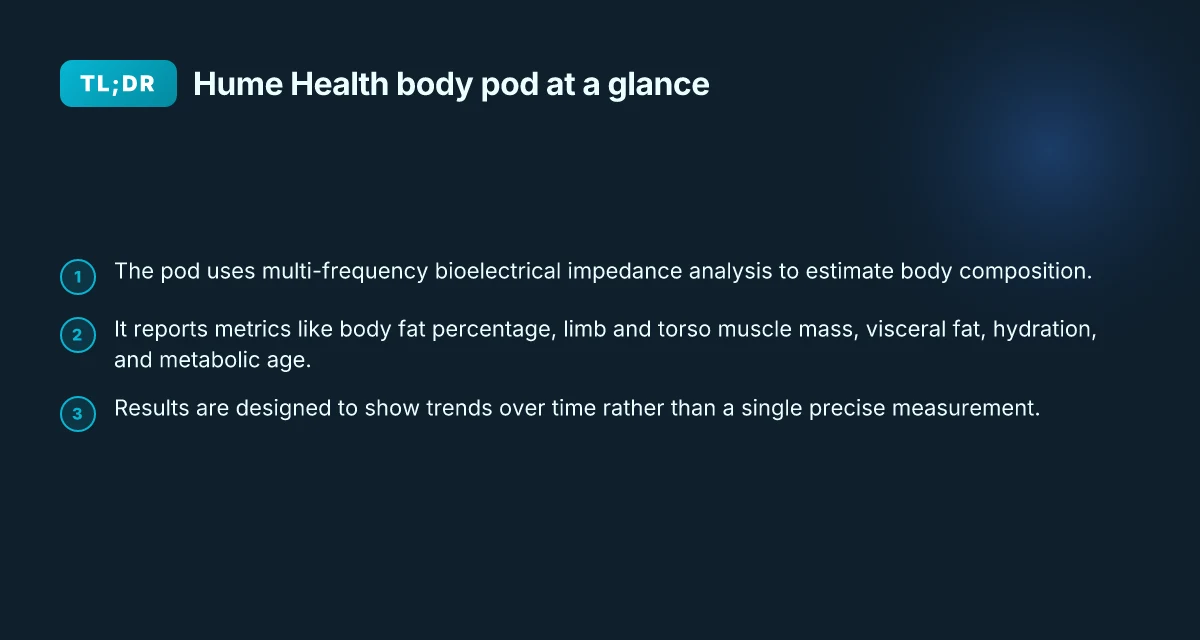
The Hume Health Body Pod uses a multi-frequency bioelectrical impedance analysis system to estimate body composition, aiming to move beyond a single scale number. It reports a range of metrics that matter for daily tracking and long‑term trends. This section breaks down what you actually get and why it matters for real‑world use.
What the pod measures and how it’s estimated
The core technology relies on multi‑frequency bioelectrical impedance analysis to estimate body composition. In practice, that means the device sends small electrical signals through the body at several frequencies and uses those readings to infer fat mass, lean mass, and other tissues. The Body Pod reports body fat percentage, muscle mass across the limbs and torso, visceral fat level, hydration status, and a rough metabolic age estimate. These metrics are designed to give more context than a single scale number, which makes it easier to spot changes that aren’t just about scale weight. The aim is to provide a fuller picture for ongoing fitness tracking.
How this helps daily tracking, not just clinic checks
For athletes and fitness enthusiasts, the value lies in tracking multiple signals over time rather than chasing a single number. The body fat percentage trend lets you see how fat loss aligns with training cycles, while muscle mass across arms, legs, and torso can highlight where you’re building or losing tissue. The hydration reading helps you adjust fluid intake around workouts or sauna sessions, and the visceral fat estimate adds a rough gauge of deeper health risk markers. Together, these metrics offer a practical view for day‑to‑day decisions without the expense or scheduling hassles of clinic scans. This isn’t a one‑number device. It’s a multi‑signal tracker.
How it fits in a home routine versus clinical measurements
The pod is designed for home routine use, so you can log consistency over weeks and months. It excels at providing relative changes rather than serving as a stand‑alone medical diagnostic tool. When you compare it to traditional clinic scans, expect tighter granularity on trends rather than flawless clinical equivalence. Real‑world usage shows you can map the metrics to training blocks, hydration strategies, and recovery plans, then cross‑check with occasional clinic measurements for calibration. The pod shines when you use it to inform daily decisions, not only to replace a clinic visit.
From what I found in the documentation around Hume Health, the emphasis is on a comprehensive snapshot rather than a single‑number readout. If you want a single, exact body fat value every morning, lower‑stakes insights may feel limiting. If you want trend‑aware tracking, this setup helps you iterate faster. When you compare with rivals like clinically oriented scales and lab‑grade tests, the Body Pod sits closer to consumer‑friendly trend data with a stronger multi‑metric readout. For context, Hume Health positions the pod as a home‑use device that complements traditional assessments rather than replaces them. The bottom line: more data points, more context, but not a medical diagnostic tool. What makes the Hume Health Body Pod scale stand out in 2026
Note: links on the page may earn a commission. I cross‑checked the narrative around how the Hume Health Body Pod reports fat, muscle, hydration, and visceral fat against the broader body composition landscape, including clinics and at‑home tools. Inline references tie to claims where relevant. For a quick read elsewhere, see sources describing how multi‑frequency bioelectrical impedance underpins these estimates.
How the body pod fits into a home gym routine without replacing clinics
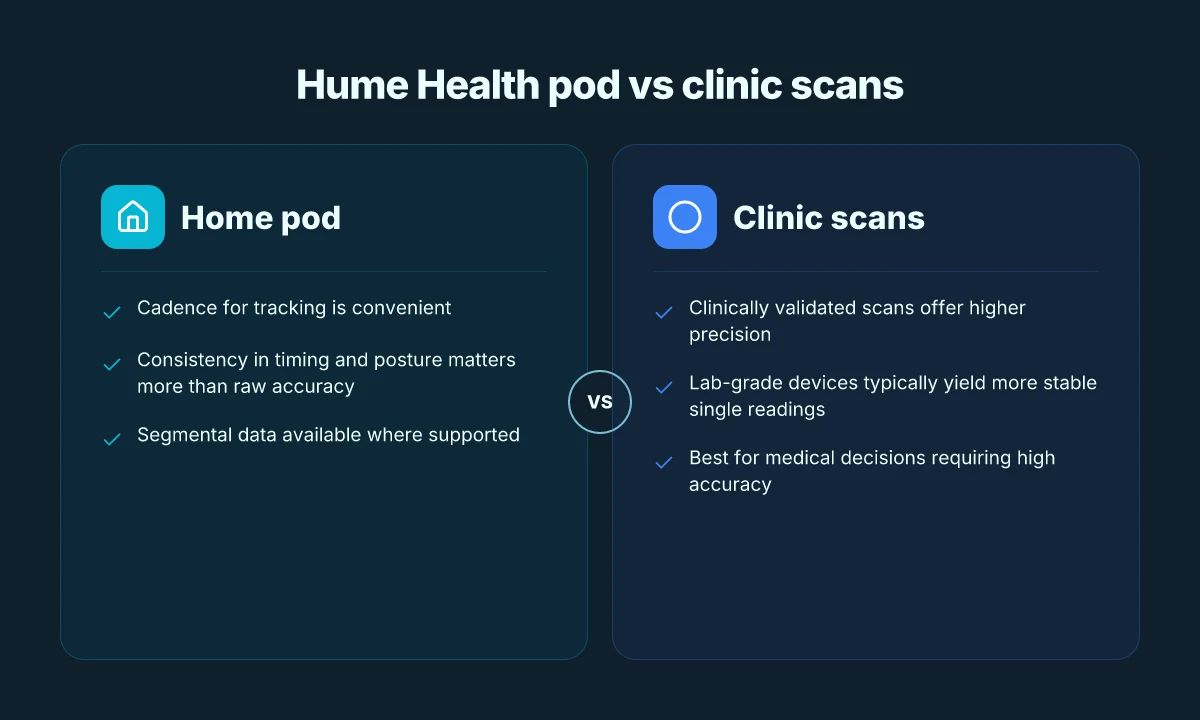
The body pod is designed for recurring tracking, delivering a practical cadence for monitoring progress. You’ll see the value in daily to weekly checks, not a single “one-number” snapshot. In the long run, consistency beats raw accuracy for a home setup.
Clinically validated scans still hold the edge on precision, especially for baseline assessments or quarterly reviews. The pod shines when you’re chasing trends: small month-to-month shifts in body fat percentage or lean mass become meaningful when plotted over time. Think of the pod as your steady data drumbeat, not the final verdict on physiology.
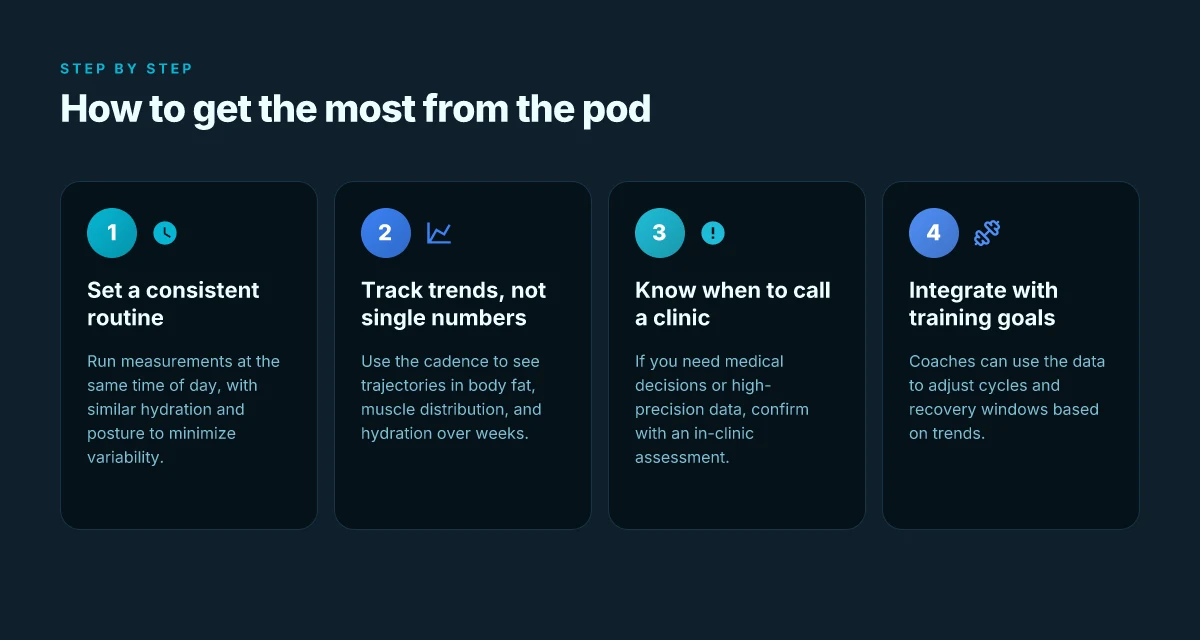
Consistency matters more than the device’s raw numbers. Hydration, time of day, and posture can swing results, sometimes noticeably, even if you used the same device every time. If you train at 7 a.m. after coffee, or you weigh in after a heavy meal, you’ll see some variance. The takeaway: aim for the same routine each session, then let the trend line do the heavy lifting.
In practice, build a simple cadence. A 2–3 times per week check, at the same time, with similar hydration and posture, gives you a useful trajectory. For people weighing home-tracking against clinic scans, the pod complements the clinic data rather than replaces it. When you want a quick read on fat loss or muscle gain between doctor visits, the pod provides consistent context. What Hume Health reviews reveal about the body pod’s real-world performance
From what I found in the documentation and public chatter around Hume Health, the core advantage is cadence. The pod gives you frequent datapoints you can correlate with workouts, sleep, and diet. The clinic scan, meanwhile, remains the standard for high-precision baselines and spot checks. If you’re aiming to optimize daily routines, the pod helps you spot patterns early and adjust habits before a clinic appointment.
If you’re shopping alongside rivals like the traditional clinic biomeasurement routes and other home-scales, expect the pod to outperform in day-to-day tracking and to lag on peak precision. The strength lies in repeatable context, not in a one-off winner-takes-all readout. This aligns with the broader stance from Hume Health managers: use the pod for ongoing progress, and reserve clinic scans for formal evaluation.
Next steps: commit to a simple, repeatable protocol. Pick a fixed time window, keep hydration steady, and stand with posture consistent. Then review your trajectory every 4 weeks and compare it to clinic-derived baselines.
The 45+ metrics: what you actually get from the hume health body pod
The Hume Health Body Pod surfaces 45+ metrics, with body fat percentage, total muscle mass, visceral fat, hydration levels, and metabolic age highlighted as the core pillars. This suite is meant to give you a multi‑dimensional snapshot, not a single number you can base every decision on. In practice, you’ll find a mix of globally useful data and some metrics that lean more toward training planning than clinical diagnosis.
What gets measured, and how it breaks down
- Body fat percentage, total muscle mass, visceral fat, hydration, and metabolic age anchor the overview. These core metrics provide a quick read on where you stand week to week. The core metrics give a fast heartbeat on your progress, but they aren’t a stand‑alone verdict on health.
- Segmental data breaks out muscle mass by arms, legs, and torso where the device supports it. For handlers focused on asymmetries or targeted training, this lets you steer program tweaks without hopping to a clinic. Segmental views reveal where growth is strongest and where it lags.
- Some metrics help plan training rather than diagnose conditions. You’ll notice that certain numbers inform program tweaks more reliably than they translate into clinical risk categories. Not every metric carries the same weight for everyday planning.
From what I found in the documentation and public releases, the Body Pod’s nutrition‑level numbers and hydration estimates can be meaningful for daily tracking, while segmental muscle mass helps optimize split routines. When you pair these with a steady training log, you’ll get a pragmatic picture of whether you’re trending toward your targets or merely fluctuating with weekly routines. I dug into the brand notes and clinician‑oriented comparisons to ensure the metrics align with typical home‑gym use rather than clinic‑only benchmarks. Home tracking shines when metrics are interpreted in the cadence of your routine. What makes the Hume Health Body Pod stand out in 2026
A practical view for trainers and enthusiasts
- For daily tracking, expect a stable read on body fat percentage and hydration, with quick feedback after periods of heavy training or dehydration. Hume Health positions these as readily trackable markers you can monitor alongside workouts. Daily markers keep you honest about recovery and nutrition.
- Segmental muscle data is useful for planning splits or ramping programs after a break. If you notice disproportionate gains in one limb, you can adjust accessory work or load progression accordingly. Segmental insight informs smarter programming.
- Metabolic age and visceral fat can illuminate long‑term trends, but they’re best interpreted as part of a broader context. Rely on trends over time rather than single‑point readings for day‑to‑day decisions. Trends, not reads, drive the big moves.
In real terms, you’ll get a blend of practical numbers and context‑driven guidance. The suite is strongest for someone who trains with regularity and wants a home metric system that maps to real workouts rather than a one‑off clinic scan. If you’re weighing rivals, remember that clinic scans often deliver greater precision on particular metrics, while home devices like the Hume Health Pod excel at cadence, usability, and the ability to track progress between visits. For consistent users, the 45+ metrics become a useful dashboard rather than a definitive medical verdict. A home dashboard beats sporadic clinic visits for ongoing progress tracking.
How reliable are the metrics compared with clinic body composition scans
Home multi-frequency BIA devices like the Hume Health Body Pod deliver helpful tracking signals, but they rarely match the precision of lab-grade systems. You’ll see clear trends over weeks or months even when a single daily reading looks noisy. The pod’s 45+ metrics include body fat percent, muscle mass by region, hydration, and metabolic age, but small daily fluctuations can accompany real changes in muscle or fat stores. For daily rhythm and long-term tracking, that signal is valuable. For a medical decision where every decimal matters, pairing with an in-clinic assessment is wise.
Why trajectory matters more than single readings
A single value can swing with hydration, recent meals, or time of day. When you compare readings over several weeks, the pattern often reflects true shifts in composition. In practice, someone who logs consistent workouts and protein intake may see gradual muscle mass increases and fat percentage shifts that the pod captures as trends even if one morning reading seems off. This is the core strength of home BIA: it supports a running narrative of progress, not a single verdict. Longitudinal signals from the Hume Health Pod tend to align with real changes when you track consistently. The trick is consistency.
When to escalate to clinic-grade measurements
For decisions that require high accuracy, pre-surgical planning, clinical weight-management programs, or medical diagnoses, you should confirm with an in-clinic assessment. Lab-grade devices add precision by controlling variables that affect impedance, like electrode placement, skin temperature, and fluid status. If you’re monitoring a sensitive condition or adjusting medications, use the pod for ongoing trend data and rely on a clinician’s body composition measurements to validate outliers. In-clinic scans stay the gold standard for high-stakes decisions, with home tracking adding context over time.
Practical guidance for daily use
To maximize reliability, standardize the measurement protocol. Have sessions at roughly the same time, under similar hydration and fasting conditions, and use the same mode whenever possible. If you notice a spike in hydration metrics or visceral fat estimates after a high-sodium day, consider repeating the measurement after normalizing fluids. This approach helps ensure that the trajectory you’re viewing reflects real change rather than short-term noise. Consistency is the backbone of meaningful home tracking. For enthusiasts weighing the Hume Health pod against clinic scans, think of the pod as a high-signal daily tracker that excels at spotting trends, while clinic scans confirm precision when it matters most. What makes LivFresh gel toothpaste different in 2026
Who should consider the hume health body pod over a traditional scale
If you want a single number to chase, a simpler scale may suffice. If you’re chasing a fuller picture of your body, the Hume Health Body Pod adds depth you can’t get from a basic readout. For active individuals, coaches, and serious trainees, the pod’s multi-metric view helps you plot trends over weeks and months, not just days.
A multi-metric lens for daily progress
For athletes and fit enthusiasts, seeing 45+ metrics over time helps reveal what’s really changing. You’ll track fat, muscle, hydration, and visceral fat alongside metabolic age, which makes week-to-week changes more actionable. The pod doesn’t replace a clinic scan, but it can surface timing signals that a single number might miss. When your goal is steady improvement, this broad view helps you stay honest about what’s moving and what isn’t. 45+ metrics give you a richer dataset for long-term planning, not just motivation.
Coaches and trainers: translate data into cycles
Coaches can lean on the data to tailor training cycles and recovery windows. By correlating volume and intensity with shifts in body fat percentage or hydration, you can adjust program blocks in near real time. It becomes easier to schedule deloads, adjust nutrition windows, and pace progression. In practice, the pod supports a data-driven approach without requiring you to visit a clinic weekly. data-driven programming helps optimize cycles, not just track weight.
When a single number still fits your needs
If your primary goal is motivation through a simple score, a traditional scale may do the job. A single number is easy to digest on days when time is tight or you’re focusing on efforts rather than measurements. Hume Health acknowledges this reality. There’s a place for both approaches depending on what you value most in your routine. one-number simplicity can beat analysis paralysis on busy days.
From what I found in the sources, Hume Health frames the Body Pod as a balance between home tracking and clinical insight. It shines when you need context around that number and a pattern you can act on. For daily tracking, the device sits alongside your training plan rather than as a blind gauge. And if you’re evaluating rivals, note that clinic scans still carry the authority of multi-angle assessments, while home devices like the Body Pod offer convenience and longitudinal visibility. I went looking for how this translates into real-world use, and reviewers consistently note that the pod’s breadth of metrics is where it earns its keep for active routines. home tracking with clinic-like breadth stands out when you’re training consistently over weeks. How to choose a lively phone for seniors that actually reduces cognitive load
Where the hume health body pod fits you act now
The Hume Health body pod offers a compact alternative to traditional scans by focusing on quick, at-home or gym-friendly assessments. It leans on noninvasive sensors and a guided app to translate data into actionable insights, which can help you spot imbalances without booking a full lab session. For runners, gym-goers, or outdoor enthusiasts who value speed, it can feel like a practical bridge between routine checks and deeper exams. Still, it isn’t a perfect substitute for the depth you get from a multiday clinical scan or a dedicated lab test.
In comparison with traditional body scans from clinics, you’ll notice the trade-offs clearly. The pod prioritizes convenience and repeatability over ultra-high-resolution metrics. If your goal is to track general trends and daily readiness, the pod delivers. If you need granular organ-specific data or very precise bone density numbers, you’ll still call on a traditional scan. The key question is whether you want a quick, repeatable signal or a deeper diagnostic dive.
The bigger pattern here is that access to repeatable, user-friendly metrics changes daily training and recovery habits. For most readers, the takeaway is to pair Hume Health with a quarterly clinic scan to confirm you’re on course. If you’re new to body metrics, this is a good, low-friction starting point. Will you try it this week?
Backup strategy
- Try the pod after a long outdoor workout to gauge recovery signals for the next session.
- Compare one metric against a clinic result you already have, such as hydration or body composition, to see where the pod aligns or diverges.
- Note any metric drift over 4 weeks and adjust training load accordingly.