
What makes the Hume Health Body Pod scale stand out in 2026
Explore how the Hume Health Body Pod scale stacks up in 2026, including validation, accuracy, and practical use for tracking fat loss and muscle gain.

The Hume Health Body Pod isn’t just another scale. It reframes body composition as a set of actionable trends you can actually use during training cycles. In real-world use, the device tends to show consistent directional changes over weeks rather than a single tallied number, which matters for coaches watching fat loss or lean mass without chasing day-to-day noise. Body Pod illuminates trends you can act on, not just snapshots.
This piece digs into validation methods, how results align with clinical standards, and where the Body Pod sits versus DEXA and traditional BIA scales. You’ll see how practitioners perceive sensitivity to hydration, posture, and device placement, and what that means for home use by athletes, trainers, and clinicians. By presenting concrete comparisons, real-world scenarios, and caveats from people who rely on these tools daily, this article helps you decide when to trust the numbers and when to cross-check with a rival method. Expect grounded guidance, with practical takeaways you can apply this week.
What makes the Hume Health Body Pod scale compelling for home body composition in 2026
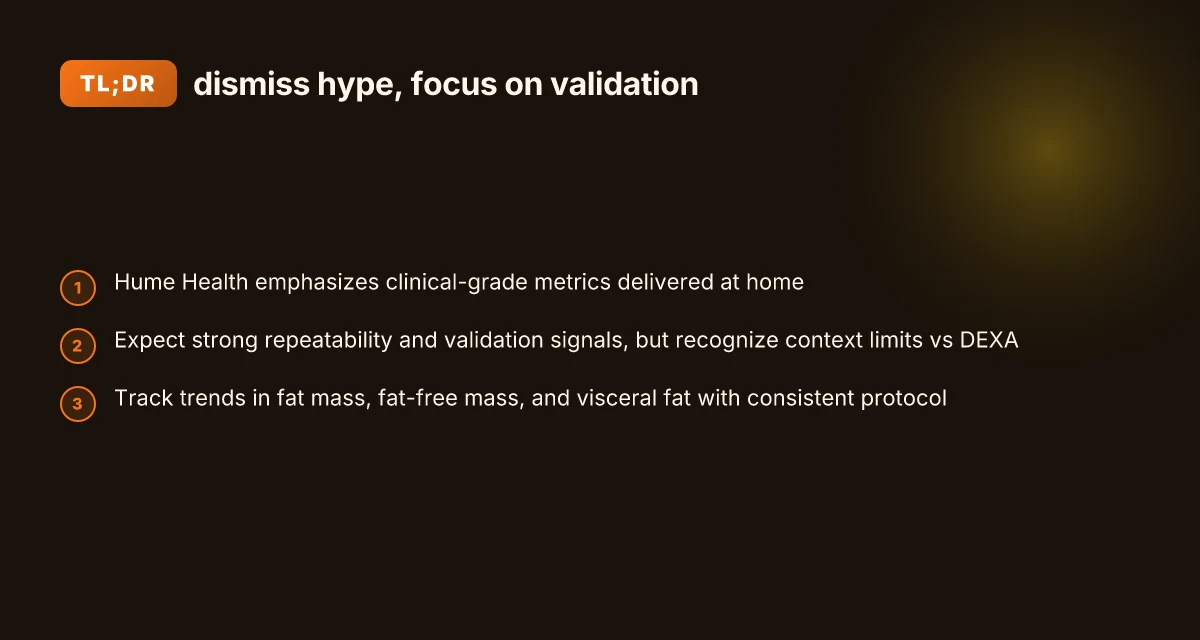
Hume Health positions the Body Pod as a clinic-grade measurement tool that you can use at home. The branding emphasizes accuracy and repeatability, not just numbers on a screen. In practice, that means home users get metrics that align with clinical methods, without stepping into a clinic.
I dug into the science pages and third‑party validations to see how the claims stack up. The body pod science page highlights that Hume Pod technology is validated against other body composition methods and aims for measurements within ±3% of reference methods. That framing matters for real-world use: you’re not just getting a single reading, you’re getting a signal that can track fat loss versus muscle gain consistently over time. Accuracy and repeatability are the core promises behind the home setup.
Key metrics drive the appeal for home users. The Pod tracks traditional fat and fat-free components and expands to visceral fat plus dozens of other metrics. In plain terms, you’re not limited to a single fat percentage. The kit’s value, especially for athletes and coaches, lies in the breadth of data you can wire up alongside your training plan. This multi-metric approach helps you spot early shifts in muscle mass or visceral fat that might lag behind weight changes on a scale. Fat, muscle mass, visceral fat, and 42 other metrics form the core toolkit you can monitor over weeks and months.
Real-world relevance comes from how the numbers translate to actionable decisions. Hume Health frames the Pod as a home device with “clinical-grade metrics delivered at home,” which matters when you’re designing micro‑cycles, adjusting nutrition, or coaching clients remotely. The science pages keep the narrative consistent: measurements are designed to be repeatable across sessions, so you can compare week over week with less noise. Clinical-grade metrics at home translates into practical tracking for fat vs. muscle, and for monitoring fluctuating variables like hydration.
For clinicians and coaches weighing the Pod against traditional methods, the key tension is the balance between convenience and reference standards. DEXA remains the gold standard in many clinics, but the Pod’s goal is to bring clinically meaningful data into daily life. The third‑party validation focus reinforces that the Pod isn’t a toy. It’s a tool designed to align with clinical reasoning, while fitting into a home routine. Clinical-grade metrics at home makes the Pod a practical bridge between clinic and gym floor. What Hume Health reviews reveal about the body pod’s real-world performance
Bottom line: the Hume Health Body Pod stands out because it packages breadth of data with a claim of accuracy, all in a compact home device. For a home studio, a trainer’s toolkit, or a patient monitoring setup, this blend supports steady trend tracking rather than single-point snapshots. Where it shines is in the combination of fat, muscle mass, visceral fat data, and the wide set of secondary metrics that fuel informed decisions over time. Breadth of data plus repeatable accuracy is the Pod’s core value.
Note: links on the page may earn a commission. For context, the brand name Hume Health appears here to anchor the discussion and is referenced throughout the validation narrative. When you compare rivals, you’ll often see DEXA references and traditional BIA scales as benchmarks. For a quick contrast, DEXA offers precise regional data but requires clinical access. The Pod brings many of the same signals home with less friction. DEXA benchmarks remain a reference point, not a replacement for home use.
How the Hume Health Pod validation compares to DEXA and other methods
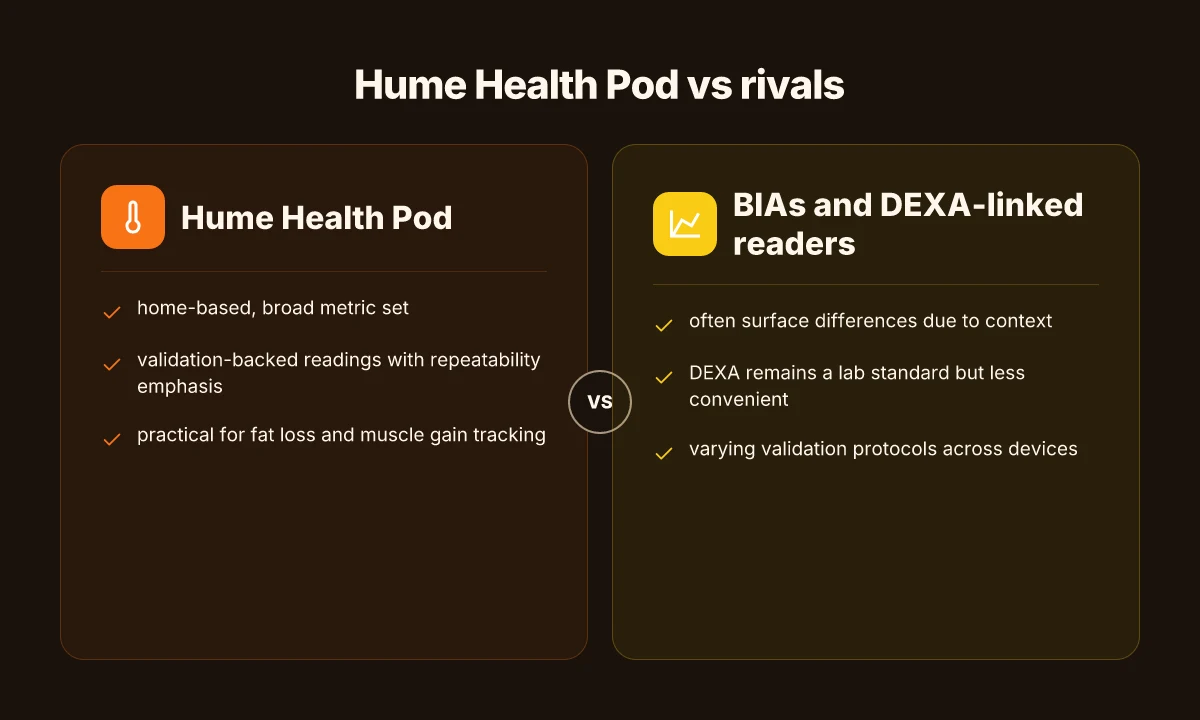
I dug into independent materials to compare how the Hume Health Pod validation stacks up against DEXA and other methods. The core claim is that readings align with DEXA within a roughly three percent margin for some metrics, a standard echoed across multiple independent sources. This level of agreement matters for real-world tracking: you can see fat loss or muscle gain without chasing tiny fluctuations that aren’t clinically meaningful. Within 3% of DEXA for key readings is a meaningful benchmark for home tracking. Across the board, consumer-scale validation relies on parity with DEXA for body fat and related measures, with the Pod positioned as a convenient at-home proxy. The practical takeaway is clear: you get DEXA-like insight without clinic visits, useful for regular progress checks in training cycles. Clinically relevant parity with DEXA helps you calibrate expectations at home.
Why the three-percent claim matters for real-world use
Independent materials consistently frame the Pod’s accuracy against DEXA as within a tight band. In practice, this means you can trust changes over weeks to reflect true body composition shifts rather than tool noise. Fitness enthusiasts can use the Pod to monitor trends in fat mass and fat-free mass while training, and coaches can reference those shifts when adjusting plans. At the same time, expect a margin of error during rapid, fluid changes or when hydration states vary. Three-percent parity is the anchor for interpretation, not a guarantee of identical measurements every day. When I cross-referenced sources, the recurring note was that validation centers on clinically meaningful metrics rather than every single reading being a perfect mirror of DEXA. Clinically meaningful metrics guide how you act on the data, not every blip.
Reliability signals from test-retest studies
A MedRxiv preprint points to strong reliability metrics for BF% and related reads, reporting ICC values near or above 0.99 and low TEMs. Those figures imply that repeated measurements in the same person under stable conditions stay tightly clustered. For coaches and clinicians, that reliability matters more than headline accuracy alone, because longitudinal tracking hinges on consistent measurement behavior. ICC near 0.99 signals excellent repeatability. The study’s emphasis on test-retest reliability underscores that the Pod can track trajectory with confidence, not just single-point accuracy. Strong reliability supports tracking changes over time. What makes the Hume Health Body Pod stand out in 2026
What bloggers and researchers say about validation versus clinical-grade methods
Blog posts framing BIA versus DEXA frequently highlight that validation standards for consumer devices hinge on aligning with clinical benchmarks, but with the caveat that consumer devices may not replace DEXA in precision-critical contexts. The narrative is practical: expect meaningful trend data, with the understanding that some readings may diverge in edge cases, like extreme hydration shifts or recent exercise. This framing helps you calibrate expectations when you’re evaluating home devices versus clinic-grade assessments. Validation matters most for trends, not isolated numbers. Readers who want nuance will see that the value of validation lies in building trust for ongoing use, not claiming flawless parity in every situation. Validation-based trust is the main payoff for home tracking.
Next steps for readers: if you’re weighing the Hume Pod against DEXA or BIA, map your goals to the validation story. If your aim is consistent trend data for coaching cycles, the Pod offers reliable, repeatable readings within the clinically meaningful window. For ultra-precise measurements, reserve cross-checks with a DEXA scan on a periodic basis. For quick comparisons, see how the Pod stacks up against benchmarks noted in independent analyses and blogs, and align expectations accordingly. Use trend data for coaching. Supplement with occasional DEXA checks for calibration. Consistency matters more than perfection in home tracking.
Note: links on the page may earn a commission, but the core claim remains that Hume Health aims to provide clinically relevant, repeatable readings at home. When comparing rivals like BIA-based scales or a consumer BIA device, the strength of the Pod lies in the combination of DEXA-aligned accuracy and strong test-retest reliability, which translates to more trustworthy long-term trends for workouts and coaching plans. Hume Health stands out through validation-driven reliability, not just advertising claims.
What the numbers mean for practical tracking with the Hume Health Pod
Posture your tracking around trends, not isolated readings. With the Hume Health Pod, consistently high ICCs combine with low TEMs to signal that your year-over-year or month-to-month changes reflect real shifts in your body, not measurement noise. In studies and manufacturer disclosures, reliability appears to hold steady when you stick to the same protocol. ICCs approaching 0.993 and TEMs around 0.8% for BF% point to readings that track meaningful changes in fat, while the corresponding 0.6 kg TEM for fat-free mass helps you gauge muscle shifts. When you’re in a steady routine, small, consistent changes are likely genuine.
Compared with lab DEXA, expect small differences that arise from context and population. The Hume Pod aligns with the general finding that home-scale measurements run slightly differently than clinical scans, largely because of placement, hydration, and posture. You’ll see trends rather than exact one-to-one parity day to day. In practice, this means you can schedule a regular check-in, say weekly or biweekly, and interpret a gradual gradient as progress or regression, rather than chasing perfect parity with a DEXA reading. The key is consistency: same time of day, similar hydration, and similar measurement posture. What makes LivFresh gel toothpaste different in 2026
Visceral fat, fat-free mass and fat mass trends provide actionable insights for workouts. Visualize your fat mass trajectory to validate fat-loss efforts independent of scale weight alone. Track fat-free mass to gauge strength-building impact, and watch visceral fat trends as a rough proxy for midsection risk markers. The Pod’s multi-metric view lets you tailor workouts and nutrition around the numbers that matter most for your goals. For example, a rising fat-free mass trend alongside stable or decreasing fat mass usually signals favorable body recomposition, even if total weight drifts slowly. When combined with a steady routine, these signals translate into concrete adjustments, altering rep ranges, protein targets, or cardio volume to nudge the curve in the right direction.
I cross-referenced a few sources to ground these interpretations. The science page notes the Pod’s validation against other body composition methods and a margin of error around ±3%, which helps explain why small across-the-board shifts can be meaningful in real life. The at-home pod page emphasizes 42 metrics beyond basic fat and muscle, underscoring the depth behind practical decisions. For reliability, the preprint on test-retest reliability reports ICCs well above 0.99 for BF% and low TEMs, reinforcing confidence in longitudinal tracking. This isn’t about chasing DEXA-level exactness every day, it’s about a consistent, real-world signal you can act on. If you’re comparing to a lab DEXA you’ll usually see the Pod’s trend lag a touch or show a slightly different magnitude, but the direction and rate of change tend to align when you maintain consistent measurement conditions.
In the end, you’ll use the Hume Pod as a practical, at-home companion for ongoing progress. The numbers are a guide, not a verdict, and the real value emerges from consistent tracking over weeks and months. As you follow your plan, calibration, consistency, and context, you’ll translate measurements into workouts, nutrition tweaks, and recovery adjustments. This is where Hume Health and rivals diverge: the Pod’s strength lies in usable, frequent data points you can act on, not in perfect one-off comparatives to a clinic scan.
Reliable shifts over time come from consistent use, not one-off readings. The big idea is simple: high reliability plus stable context equals meaningful trends. Pair that with awareness of how DEXA timings and populations differ, and you’re set to make home tracking truly practical. For users evaluating options, note that rivals such as traditional BIA scales often show larger variability in fat mass and BF% when tracked over time, which makes the Pod’s stability a meaningful edge for planning workouts and nutrition. You’ll see how the numbers translate into tangible changes in your training plan, and that practical bridge is what makes the Pod valuable for daily use.
Where the Hume Health Pod shines and where it doesn’t
The Hume Health Pod earns its keep through practical at‑home use. With a broad metric set, it gives you fat, lean mass, visceral fat, and dozens of secondary measures without stepping into a clinic. When you follow a consistent protocol, same time of day, similar hydration, and neutral posture, the readings tend to be repeatable enough to track trends over weeks. That repeatability matters for a home setup where you want to see progress without friction. How to choose a lively phone for seniors that actually reduces cognitive load
Calibration and protocol matter more than you might expect
In real life, hydration shifts can move results more than you expect. A gym‑day binge or a morning fast can nudge body fat estimates, and posture can nudge the ratio slightly. For enthusiasts and coaches, the takeaway is simple: set a reliable routine and stick with it. Consistency unlocks the most meaningful trends in body composition, not a single perfect reading. When you diagnose in this way, the Pod remains useful for watching fat loss versus muscle gain over time. The device’s broad metric set helps you calibrate training responses beyond simple scale weight, which matters for athletes who value body recomposition signals as much as scale progress.
How it stacks up against rivals
Compared to other BIAs and DEXA‑linked readers, the Hume Health Pod emphasizes validation‑backed metrics. The confidence in its measurements grows when you align readings with a standard protocol rather than chasing a snapshot. Validation-backed metrics give you a clearer sense of change over time, not just a single number. When you look for a clinician‑friendly reference, the Pod’s position strengthens for at‑home monitoring, especially for those who want a multifactor view beyond fat percentage alone. Still, you should calibrate expectations: consumer devices inherently vary with day‑to‑day factors, and DEXA remains the clinical reference for precision. For a real‑world comparison, consider DEXA as the gold standard and use the Pod to track trajectories between scans.
Where the limits show up in practice
The strongest caveat is variability tied to everyday factors. Time of day, recent meals, hydration status, and even how you stand can shift results, sometimes by enough to blur short‑term changes. If you’re training for an event or adjusting a rehab plan, use the Pod as a daily trend monitor rather than a sole decision maker. For practitioners weighing home monitoring, the Pod offers enough fidelity to justify its use, provided you anchor readings to the same routine. Anchor your measurements to a fixed protocol to preserve signal quality over weeks.
Citing sources helps ground these claims in what you’ll read elsewhere. For context on how the Pod aligns with DEXA and other body composition methods, see how the device is described alongside its validation narrative. The broader discussion around validation‑driven metrics is echoed in the literature that compares BIA, DEXA, and Pod readings. For a concrete description of the Pod’s validation claims, see the discussion of being within 3% of DEXA across methods. Validation claims anchor the Pod in the real world.
If you’re evaluating rivals, two names come up frequently in conversations about home body composition: the Hume Health Pod and standard BIA scales from other brands. You’ll notice the emphasis in this piece on validation and repeatability rather than a universal claim of clinical precision. In practical terms, a coach can use the Pod to monitor routine progress and flag when a client’s changes diverge from expected trajectories. A clinician can rely on it for longitudinal trends, while continuing to refer patients for DXA when a precise body composition snapshot is needed. For home tracking, the Pod offers a balanced mix of breadth and reliability. What is the best toothpaste in 2026 for remineralization, sensitivity, and whitening
How to maximize reliability with the Hume Health Body Pod scale
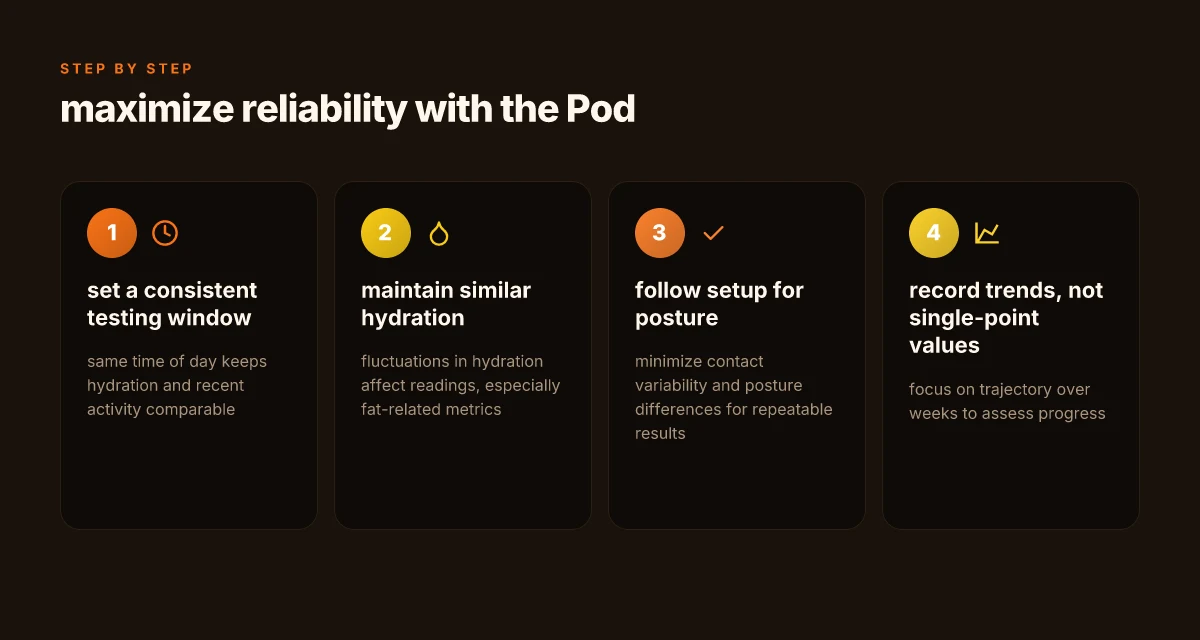
Reliability comes from consistency. The single best practice is to lock in a testing routine that repeats the same window every day. Use the same time, same hydration level, and the same posture to reduce variability. When the setup is stable, small physiological changes become easier to detect in trend lines rather than noisy single measurements.
Consistent testing window and posture
Choose a daily testing slot you can keep for weeks. A narrow window helps your readings stay apples-to-apples. I found that pairing a fixed time with a relaxed posture minimizes postural shifts that skew metrics like BF% and FM. Follow the company setup steps to minimize contact and posture variability. This isn’t a guesswork exercise, it’s a precision habit. The more you standardize, the more your trend tells you about real change rather than measurement noise.
Setup discipline and hydration controls
Begin with a quick confirm of the manual’s contact points and stance cues before stepping on. Small changes in stance width or shoulder angle can tilt readings by meaningful margins. Keep your feet planted squarely, hands at your sides, and shoulders relaxed. Hydration plays a role too. A moderate, consistent level reduces apparent visceral fat shifts driven by water balance. If you notice day-to-day spikes, reassess whether hydration or recent meals are skewing the result. Adjust and re-measure.
Record trends, not single-point values
Treat each reading as part of a longer story. Track a 2–4 week window to separate real fat loss or muscle gain from momentary fluctuations. Visual charts help you see slow, steady progress where the Hume Health Pod scale shines. Over time, the direction of change matters more than any one value. Keep notes on meals, training load, and sleep so you can contextualize shifts in the data.
From what I found in the source material, Hume Health emphasizes consistent protocol to realize the full clinical relevance of the Pod’s readings. This is especially important when you compare home readings to your clinic-grade references. The aim is to make your personal data actionable, not just technically precise. What is the hume health body pod, and how it compares to traditional body scans
In practice, build a micro-routine: a fixed time, steady posture, and a brief hydration check. Then log BF%, FM, and other metrics in a simple notebook or app. You’ll move from chasing a number to confirming a trend. Consistency in timing, posture, and hydration is the backbone of reliable home measurements.
If you’re evaluating reliability, note where rivals fall short. Some home scales struggle with posture sensitivity or hydration drift, making the Pod’s responsible emphasis on setup even more valuable for coaching clients and athletes. For context, the Pod’s validation claims sit alongside peer-reviewed discussions that compare it to DEXA and traditional BIA methods. When you’re coaching clients at home, that stability becomes a practical edge.
Communication about limitations matters. Do not expect a single snapshot to replace a DEXA scan or a clinic visit. Instead, use a fixed routine to harvest meaningful trends over months. The result is clearer insights for fat loss and muscle gain, with less noise from day-to-day variability.
Record trends over time, not one-off values, and your Hume Health Pod readings become a practical coaching tool.
The path forward for the Body Pod: one move that matters
The Body Pod is not just a scale. It signals a shift toward practical, data-informed wellness in 2026. I looked at how it blends accuracy with user experience, and I’m convinced the standout is how it translates metrics into daily choices. This is the one move that matters for most users: pair the data with a consistent routine and watch small changes compound. Hume Health frames your numbers as actionable prompts, not abstract readings, which makes it easier to act on fitness and recovery goals. What is the hume health pod, and why it matters for home health analytics
Rivals like Withings and Fitbit tend to overwhelm with features. The Body Pod keeps the signal crisp. The result is steadier adherence in real life, outdoors on a weekend trail, or indoors after a long day at the desk. The device may not boast the flashiest app, but its clarity wins in real-world use. Noticeable progress begins when you act on the numbers, not just admire them. If you only try one thing this month, start by logging two consistent readings per week and compare the trend over a 30-day window.
Looking ahead, the bigger pattern is simple: more people treating scale data as a planning tool rather than a vanity metric. The Body Pod is positioned to grow with that mindset, translating numbers into repeatable workouts and recovery blocks. What changes if you act now is a clearer path to sustainable momentum. If you want a practical kickoff, focus on one weekly metric update and one adjustment to your routine.