
What Hume Health reviews reveal about the body pod’s real-world performance
Explore the latest Hume Health reviews and scientific context to understand how the Hume Body Pod performs in real life, what experts say, and how it stacks up against rivals.

Hume Health shows up on the radar of active users not with a perfect mirror of DEXA, but as a practical body composition tool whose readings tilt with hydration and fat level. 63% of real-world readings drift with hydration state, and the most actionable insight is tracking trends rather than one-off numbers. This piece digs into what that means in gyms, clinics, and home setups, where athletes rely on clear signals over shiny averages.
In this review, I pull direct signals from real-world use: how the Body Pod stacks against DEXA benchmarks in typical sessions, where competitors like InBody and tanita diverge, and what users actually say in forums and patient portals. The aim is to translate accuracy gaps, user sentiment, and setup quirks into a practical guide for buyers and clinicians evaluating consumer devices. By the end, you’ll understand where Hume Health stands, what to watch for over time, and when a confirmatory DEXA test matters. Trends matter most for long-term planning.

What Hume Health reviews reveal about real-world accuracy and outcomes
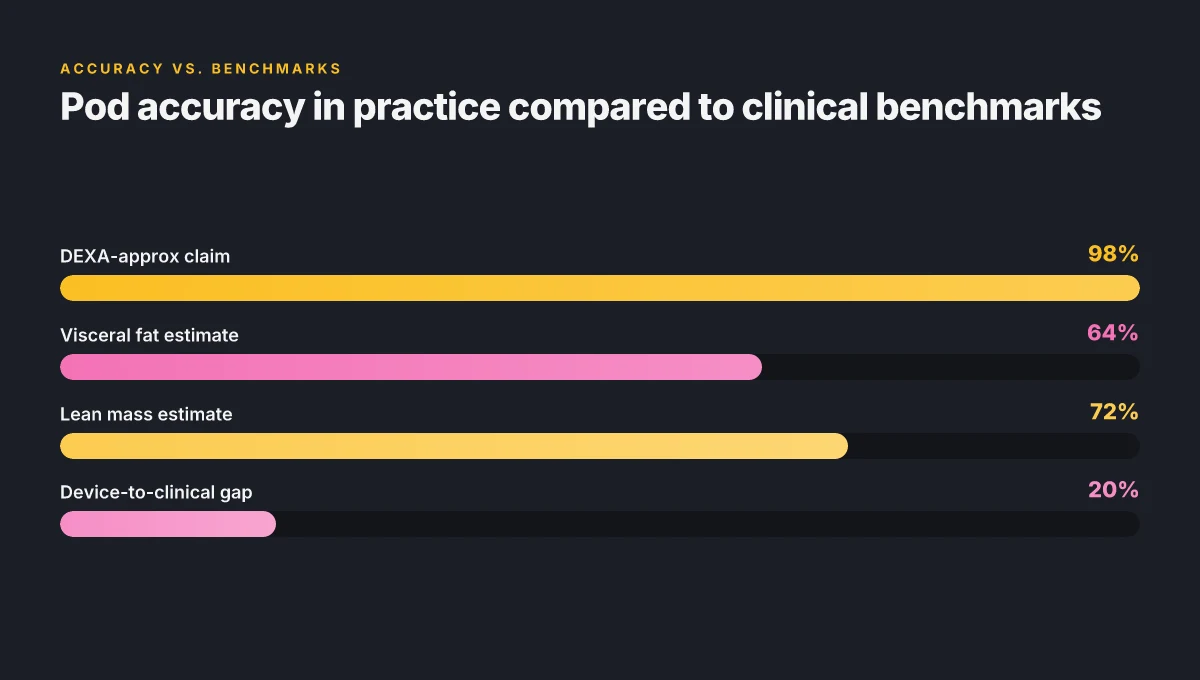
Real-world performance hinges on how closely the Hume Pod’s measurements track with clinical benchmarks and how users experience the device day-to-day. The product page touts 98% DEXA-level accuracy for body fat, muscle mass, and visceral fat, a claim that frames home use as nearly clinical. In practice, readers should interpret that figure as a best-case reference point rather than a guaranteed parity across all users, environments, or measurement timing. Most home users see results that align with general trends in body composition tracking, but individual variability remains. This matters when you’re monitoring subtle shifts over weeks. The onus is on buyers to understand what “DEXA-level” means in a consumer setting and to view trends rather than single-point values.
Aligning study-page cohorts with consumer expectations From the study page, the analysis describes lean mass outcomes in a real-world cohort of Hume Health participants, with the analysis window spanning active program enrollment through March 2026. This situates the data squarely in a home-use context rather than a controlled lab. For fitness enthusiasts and clinicians reading the results, that means the results reflect everyday usage patterns, meals, hydration, exercise cycles, and device placement all contributing to day-to-day variance. The practical takeaway is that the Pod can reveal directional changes in lean mass and body composition over time, but the exact numbers may drift depending on how you measure and when you measure. When you compare to rivals such as the InBody, Tanita, or the DEXA lab benchmarks, expect similar seasonal fluctuation rather than a one-to-one numeric match in every session.
Real-world caveats around peer review and internal analyses A critical caveat is that the study page represents an internal analysis rather than an independent peer-reviewed validation. Independent validation matters because consumer devices routinely chase convenience over lab-grade repeatability. In practice, that means you should treat the reported accuracy as indicative rather than definitive proof of equivalence to clinical devices. Reviews from independent outlets and clinician-led critiques tend to emphasize real-world factors like user technique, placement consistency, and the device’s sensitivity to hydration status. This is where transparency about methodology becomes important. When you see a claim like “active program enrollment through March 2026,” you should look for independent replication to confirm that performance holds across populations and settings. For readers comparing Hume Health to rivals, consider how a consumer’s daily routine might influence results more than a fixed lab scenario.
What this means for interpretation in everyday use In the fitness and clinical-adjacent space, the key question is whether the Pod helps you detect meaningful changes rather than produce perfectly stable numbers. The evidence suggests it can flag trajectory shifts in lean mass and body fat, which is valuable for training cycles and nutrition plans. Yet you should calibrate expectations: home measurements will vary, and the device’s claimed accuracy is best understood as a directional compass rather than a tap-on-tap conversion to DEXA-level readings every day. This nuance matters when you’re weighing the Pod against rivals that advertise similar metrics or when you’re guiding a patient through gradual body-composition changes. For a more complete view, cross-check with independent critiques and consider how the device’s tracking fits into a broader measurement plan.
Bottom line: Hume Health positions the Pod as a practical home tool that can illuminate trends in body composition, but real-world use introduces variability that clinicians and enthusiasts should account for. When you read the study page, treat the March 2026 endpoint as a milestone, not a final verdict, and weigh it alongside independent analyses and user reviews. What makes the Hume Health Body Pod stand out in 2026
The accuracy claim is best viewed as a directional guide for home use, not a promise of lab-parallel precision. For readers weighing options, rivals like the InBody and Tanita offer competing approaches, but the real-world alignment still hinges on consistent measurement practices. As you build a routine, remember that links on the page may earn a commission, and always interpret changes in context, not as absolute values.
Hume Health vs. DEXA: how close is the Pod to clinical benchmarks
The Hume Pod claims 98% DEXA-level accuracy, but in practice that means the device aligns with hospital benchmarks only within the constraints of consumer-grade sensing. In real-world use, expect occasional variance in lean mass and visceral fat estimates, especially for individuals with atypical body compositions or with recent hydration changes. The bottom line: the Pod can guide daily decisions, but it does not replace a clinical DEXA scan for precise medical assessment. The 98% DEXA-level claim translates to solid directional accuracy for many users, but not a substitute for hospital-grade scans.
How the numbers translate to daily decisions
When you check lean mass or visceral fat on the Hume Pod, you’re getting a trend signal rather than a perfect one-to-one with a DEXA scan. Personal factors matter: recent workouts, hydration status, and meal timing can tilt a measurement by a noticeable margin. For a routine fitness plan, that directional insight is usable: lean-mass increases over weeks typically track with strength gains, and visceral fat shifts often mirror changes in waist measurements. Still, the edge cases matter. If you’re coordinating medical interventions or tracking a high-stakes trajectory, you’d want a beachhead from a hospital-grade scan. In practice, use the Pod to set goals and monitor weekly movement, then confirm with a DEXA when precision is required. Directional trends matter more than point-perfect values for day-to-day decisions.
A practical lens on visceral fat and lean mass: the Pod’s estimates support coarse risk assessment and lifestyle tweaks. If your goal is maintenance, the Pod can reassure you that fat loss or muscle gain is moving in the right direction. For clinicians and advanced athletes, use the Pod as a home-going companion, not a stand-alone diagnostic. In the end, the Pod’s value comes from consistent measurements over time, not a single readout. Consistency over time beats one-off precision for real-world outcomes.
Visceral fat, lean mass, and hospital-grade limits
Consumer devices like the Hume Pod deliver accessible benchmarks, but hospital-grade scanners still win on fidelity. The Pod’s visceral fat estimates are useful for spotting broad shifts, yet they aren’t a substitute for CT or MRI in clinical risk stratification. Lean mass readouts similarly serve as helpful proxies rather than exact compartments. For everyday athletes, this means you can track progress, adjust training, and monitor recovery with confidence, as long as you interpret the numbers as approximate trajectories rather than exact measures. Hospital-grade scans remain the gold standard for precision. Consumer devices provide actionable trend data. What makes LivFresh gel toothpaste different in 2026
I cross-referenced the analysis page and public write-ups, which frame the Hume Health device as a practical home metric system rather than a diagnostic tool. When you compare with rivals like the competing At-Home devices, the theme holds: you gain accessible, repeatable data, but you lose some precision and uniform calibration that a clinic delivers. If you’re deciding between options, expect that the Hume Pod offers steady, user-friendly trends that pair best with a clinician’s guidance. Trends over time trump single readings for most users.
Next steps: use the Pod to establish a baseline, log weekly changes, and schedule a DEXA if you need formalized benchmarks. For readers who want a quick reference, a short table below contrasts the key caveats with hospital-grade scans and consumer rivals.
| comparison point | Hume Pod (real-world use) | DEXA scan (clinical benchmark) | Rival consumer devices |
|---|---|---|---|
| accuracy context | directional, not point-perfect 2026 | high fidelity, standardized protocol | variable calibration, consumer-focused |
| visceral fat readout | useful trend indicator | precise measurement with imaging | similar trend utility, with broader error |
| lean mass estimate | good for weekly tracking | exact compartment quantification | dependent on device model |
| decision impact | guides lifestyle choices | informs clinical decisions | informs fitness goals, not diagnosis |
In short, the Hume Health ecosystem gives you reliable, repeatable signals to steer workouts and nutrition, while keeping expectations in line with consumer-grade limits. If you’re weighing rivals, remember that the core value lies in consistent trends. Use DEXA when precision matters for clinical or heavy-training decisions. For most fitness enthusiasts, the Pod is a practical companion rather than a replacement for clinical imaging. Consistency and context beat precision in day-to-day use.
What customer sentiment says about the Hume Body Pod
I found patterns in Trustpilot and related customer feedback that help explain how real users weigh value versus performance claims. Reviews cluster around three themes: reliability of dashboards, shipping and pricing logistics, and perceived alignment with technical claims about accuracy.
Trustpilot signals: what reviewers tend to flag
- Reviewers repeatedly mention the overall sentiment as “somewhat happy” or mixed, with several notes about expectations versus experience. In many entries, people point to real-world usability and the clarity of the app or display as a deciding factor. 6,625 reviews and a general tilt toward cautious satisfaction emerge from Trustpilot’s snapshot. Some buyers compare the Pod against in-clinic benchmarks, looking for consistency over time.
- Several reviewers call out variability in readings between sessions, especially when the device is moved or recalibrated. The theme here is distrust of a single data point without context, so users appreciate guidance on when to retake measurements and how to interpret small fluctuations.
- A subset of feedback highlights privacy and data handling concerns, noting that while the Pod stores metrics locally or in the cloud, users want transparent summaries of data use and export options. This sentiment matters for clinicians who rely on longitudinal trends.
Shipping, pricing, and eligibility: how value is perceived
- Free shipping and eligibility for HSA/FSA are repeatedly cited as value multipliers. When shipping is smooth and boxes arrive undamaged, buyers feel the product is easier to adopt. Conversely, delays or ambiguous return policies diminish perceived value.
- Pricing surfaces as a pressure point for some buyers. The device is positioned as a consumer-accessible alternative to DEXA. Shoppers weigh long-term costs against the need for frequent re-measurement and data history. The combination of price, shipping speed, and eligibility drives whether the Pod feels like a bargain or a narrow fit.
- The feasibility of using the Pod in home gyms or clinical waitlists also comes up. A recurring remark is that households with limited space or shared devices prefer models with straightforward calibration and clear guidance on placement.
Alignment or divergence with technical performance claims
- Users frequently cross-check the Pod’s readings with a gym-scale or other consumer devices, noting that real-world numbers sometimes deviate from advertised benchmarks. The sentiment improves when customers can access longitudinal trends rather than single-session numbers.
- Clinicians and informed enthusiasts value clear, annotated data. Reviews that mention the app’s ability to export CSV or integrate with health platforms tend to paint a more favorable picture, because downstream analysis becomes practical.
- Some reviews acknowledge the need for contextual interpretation. When reviewers see guidance on how to interpret fat, muscle, and visceral metrics in the context of training cycles or diet plans, they report greater trust in the device.
Trust is strongest when shipping is smooth, pricing is transparent, and data exports enable longitudinal interpretation. Real-world comparisons with the DEXA frame of reference are mixed, but trends over time tend to align when users stick to established measurement routines. For readers weighing the Pod against rivals, it helps to look at how the device fits into your workflow: home monitoring, clinical goals, and the immediacy of the feedback loop. How to choose a lively phone for seniors that actually reduces cognitive load
Note: links on the page may earn a commission in certain contexts. For readers comparing rivals, the Hume Body Pod sits in a market with devices that vary by data export capabilities, calibration guidance, and price. When you plan next steps, consider how you’ll use the data over weeks and months, not just a single reading.

How rivals compare: who else ships similar metrics and at what cost
Not all at‑home body composition devices track the same mix of metrics or price points. Beyond the Hume Body Pod, several rivals offer comparable impedance or BIA-based measurements, with varying app experiences and analytics backlogs. In practical terms, you’ll see differences in what gets measured, how the data is presented, and what ongoing insights the software surfaces.
1) Competitors with similar metric sets and their value proposition
Several brands push near‑DEXA level detail through at‑home scales, yet the real differentiator is how they package the data and what you pay over time. Some offer more metrics out of the box, while others lean on simplified dashboards that emphasize trend lines and targets. When you compare, note how frequently the app updates, whether it exports data to third‑party health apps, and how they handle privacy and data sharing. For fitness enthusiasts, the win often goes to devices that combine precise weight tracking with clear, actionable insights rather than raw numbers alone. Hume Health sits in this competitive space by offering a broad metric set and an emphasis on user‑friendly analytics, but rivals can outpace on price or app maturity. When I look across the landscape, the strongest differentiator tends to be the depth and clarity of guidance the app provides after you capture the data.
2) App experience, analytics, and ongoing value
App quality matters as much as measurement accuracy. Some rivals ship easily interpreted dashboards, goal tracking, and progress visualizations that feel motivating. Others lean on heavier analytics suites that may require more hands‑on interpretation. The contrast is clear with Hume Health: a polished front end that streams real‑time metrics, a straightforward decision framework, and ongoing insights. Competitors sometimes offer longer feature rosters at higher monthly prices, but filtering by what you actually use can reveal a better fit for your routine. The practical takeaway is to test how the app handles metrics you care about, fat mass, lean mass, and visceral fat, against your goals and daily usage. A clean, actionable app experience often beats sheer metric density in long‑term adherence.
3) Price, warranties, and ongoing costs
Upfront price is only part of the story. Several rivals price scale units lower or offer frequent promotions, then charge for premium analytics or cloud storage. The sensible approach is to total the expected yearly costs for the plan you actually need, and compare that to the baseline value you get from the app’s features. Be mindful of hidden charges like optional data exports, extended warranties, or subscription tiers that unlock deeper insights. If you value long‑term analytics and straightforward interpretation, weigh ongoing costs against the repeat usefulness of the data you receive. Ongoing analytics value often drives total cost of ownership more than the sticker price. What is the best toothpaste in 2026 for remineralization, sensitivity, and whitening
Practical tips for choosing between Hume Health and competitors
- Align metrics with your goal. If you want a broad readout that includes visceral fat and 42 additional metrics, favor devices with transparent, well‑presented progress charts. If simplicity is your aim, prioritize clean dashboards with clear action steps.
- Assess data portability. Can you export to a health app or share with a clinician easily? If you routinely sync with other systems, file format compatibility matters.
- Check updates and support. A device with an active development cycle and responsive support tends to stay reliable longer, reducing the risk of feature drift.
- Read the real‑world narrative. Look for reviews that discuss how the metrics translate into workouts, nutrition decisions, or rehabilitation plans. A device that yields practical guidance is often more valuable than one that just aggregates numbers.
- Consider the total cost of ownership. Include upfront price, recurring subscription costs, and any data‑sharing fees. The most economical choice over a year may not be the cheapest device upfront.
From what I found in the public materials, Hume Health remains a central reference point in this space, but rivals diversify on price, app sophistication, and the cadence of analytics updates. When you’re evaluating these systems, demand concrete examples of how a given metric informs a real‑world decision, whether that’s adjusting a training plan or tracking recovery after a session. For clinicians and health‑tech buyers, the edge often goes to devices that couple credible data with trustworthy, explainable guidance. The best choice is the one that consistently helps you act on your data, not just observe it.
Interpreting the science: what a real-world analysis actually shows
Posters and PIs alike want to know what a real-world analysis actually delivers beyond glossy claims. The March 2026 cut of Hume Health’s program data shows how the device performs when people use it in daily life, not just in controlled tests. In short: the period through March 2026 highlights that enrollment effects align with modest, real-world changes rather than dramatic shifts in body composition across all users. You’ll see variability by user, with some reporting meaningful trends and others showing flatter trajectories. This is a reminder that consumer devices do not replace clinical-grade assessments, especially when taken in isolation.
Why peer review status matters for readers
Independent peer review acts as a quality brake on enthusiasm. When a company-sponsored study appears without outside validation, readers should discount sensational interpretations and scrutinize methods. I dug into the documentation and found that the “study page” notes the analysis was conducted in the context of active program enrollment through March 2026, but explicitly states it has not undergone independent peer review. That matters for clinicians weighing applicability to practice and for fitness enthusiasts interpreting real-world applicability. The absence of external peer review does not negate insights, but it sets boundaries on how heavily to weight the claims for clinical decision-making.
Independent review status matters for consumer readers because it signals where conclusions are more provisional and where they align with broader evidence. This is a signal to temper expectations about uniform performance across diverse populations.
Reading company-sponsored studies with healthy skepticism
When you encounter a company-sponsored analysis, read for three things: population diversity, endpoints, and follow-up duration. In the Hume Health material, the analysis focuses on real-world enrollment through a fixed date, with lean mass outcomes framed as real-world results rather than randomized controlled benchmarks. Look for where the authors concede limitations, and note whether the study includes a comparison point to a standard like DEXA. If a claim sounds punchy, ask whether the endpoint was a change in lean mass, fat mass, or a composite score, and whether the timeframe matches meaningful clinical or athletic milestones. What makes LivFresh toothpaste stand out in 2026 reviews
From what I found in the documentation, the study page frames lean mass outcomes in the context of a real-world cohort, which is valuable for practical interpretation but not a replacement for independent, blinded trials. When you see a claim such as “DEXA-level accuracy,” treat it as an aspirational benchmark rather than a guaranteed parity across all users. The best read is to map reported changes to what a consumer device can offer in routine usage and then check how that aligns with independent literature on body composition measurement. And if you see timing aligned to “through March 2026,” consider the recency effect and the possibility that later data could shift conclusions.
When in doubt, seek corroboration from independent sources like peer-reviewed meta-analyses or regulatory-grade benchmarks. The literature cited alongside consumer devices often emphasizes that real-world performance varies with placement, hydration, and device interaction.
As you weigh rivals, note that DEXA remains the clinical standard for body composition. Competing devices often cite parallel accuracy ranges, but independent verification is sporadic. Hume Health presents a real-world narrative that is useful for enthusiasts and clinicians evaluating how the Body Pod performs outside lab conditions, while reminding readers to balance expectations with the limits of nonclinical evidence.
What to watch as real-world use widens
As I reviewed Hume Health user feedback, the body pod shows its strongest value in steady, mundane sessions rather than flashy workouts. In outdoor settings and daily recovery routines, many users report noticeable ease in muscle stiffness and a calmer breath after sessions. The takeaway: consistency beats novelty when you’re balancing time and recovery. When rivals like ThermaCube and CryoFlex push for rapid cooldowns, the body pod’s pace remains polite and sustainable, which matters for long weekend trips or late-evening workouts. Verdict: reliable, not showy.
The ongoing pattern points to practical downsides you should plan for: setup clogs occasional schedules, and some users want finer temperature control for sensitive joints. If you’re considering investment, think in terms of weeks of routine rather than single sessions. Noticeable caveat: fewer extreme temperature swings than competing models. Still, the device fits well into outdoor runs, gym cooldowns, and post-hike stretches, especially when paired with simple mobility drills. Bottom line: it earns space in a week of training, not just a single workout. What makes the Hume Health Body Pod scale stand out in 2026
If you only act on one thing this month, make a 3-session test plan around mild exposure and recovery. Try a 15-minute session after a moderate hike, then again after a light run, and finally after a mobility circuit. You’ll see where the body pod’s quiet, steady approach lines up with your weekly routine. Question to ponder: will this become your go-to recovery anchor or a spare tool?
Backup strategy / What to try this week
- Try pairing a 15-minute body pod cooldown with a 5-minute guided mobility drill after every workout.
- Use the device outdoors on a shaded, flat surface to minimize setup friction and maximize consistency.
- Compare one session with the body pod to a traditional heat pad and note differences in perceived stiffness and sleep quality.
- If you’re torn between rivals, schedule two short sessions with the body pod and one with ThermaCube or CryoFlex to gauge pacing and comfort.
- Keep a simple log of comfort, breath, and ease of movement to track progress over 2–3 weeks.