
What is the Hume Health Score, and why it matters for at‑home health tracking
Discover what the Hume Health Score measures, how it’s calculated, and what it means for your everyday health tracking with Hume Health.

The Hume Health score isn’t a magic gauge you trust blindly. It’s a snapshot built from four pillars, and one strong pillar can pull the number in a direction that hides the others. Hume Health compiles sleep, nutrition, activity, and body composition into a single read, but the real signal appears when you compare the trend across days rather than fixating on a single value.
This piece flags where the score helps you decide what to adjust today and where you should dig for context tomorrow. You’ll see concrete checks for data quality, how to spot pillar skew, and what to compare against rival trackers like WHOOP or Oura. Hume Health is most useful when used as a starting point, not the final verdict, and the patterns it reveals matter for fatigue, weight goals, and training plans.
What the hume health score actually measures
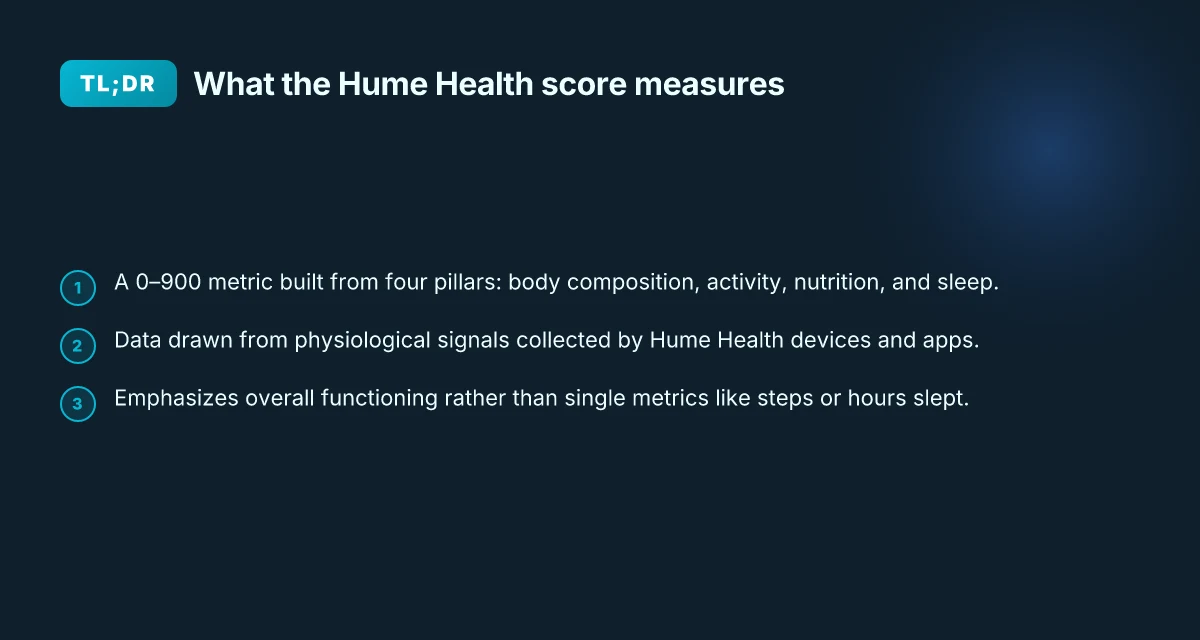
The Health Score is a 0–900 metric centered on four pillars: body composition, activity, nutrition, and sleep. It combines signals from the body you can track at home with data captured by Hume Health devices and apps. The goal isn’t to boil everything down to a single number for vanity. It’s to reflect how well your body is functioning overall, not just isolated metrics like steps or hours asleep.
How the four pillars come together
- Body composition anchors the score in metabolism and tissue balance. The Hume Health ecosystem gathers metrics such as fat mass and lean mass to frame a broader view of your endurance and recovery potential. This pillar helps you distinguish between a good night’s rest and a day when fatigue signals deeper changes in body stores.
- Activity converts movement into a signal of daily function. It isn’t just about steps. It weighs intensity, consistency, and recovery windows to show whether you’re building resilience or risking overreach.
- Nutrition ties in fueling quality with energy availability. It looks at patterns that affect how your body uses fuel, supports repair, and sustains performance across workouts and daily life.
- Sleep adds the essential recovery signal. Sleep duration is important, but sleep quality and continuity often drive how well the other pillars translate into real-world function.
I dug into the source material on Hume Health to verify how the score is framed. The official notes describe the Health Score as a 0–900 construct built from four pillars that are each fed by physiological signals collected by Hume Health devices and apps. This keeps the focus on holistic functioning rather than single metrics like a lone step count or a single night of sleep.
What the score emphasizes
The core message is that the Health Score is about overall functioning, not siloed measurements. A high score should correspond to cohesive functioning across body composition, daily activity, nutrition, and sleep, while dips often signal that at least one pillar is out of balance. When your body runs smoothly across all four areas, the score tends to reflect robust readiness and resilience. If one pillar lags, say sleep quality declines, your total score can drop even if other metrics look adequate.
From a practical standpoint, this means you can use the Health Score as a daily compass rather than a verdict on any single habit. For example, a midrange score isn’t a failing grade. It’s a prompt to review sleep consistency, adjust meal timing, or modulate workout intensity. In short, the Health Score translates a constellation of signals into a single, interpretable signal about how well your body is functioning overall.
The score is not about chasing a number in isolation. It’s about cohesive functioning across four pillars. Treat the Health Score as a daily check-in that guides adjustments to sleep, nutrition, activity, and body composition. How to stack LivFresh discount codes without losing value in 2026
How the four pillars shape your overall score
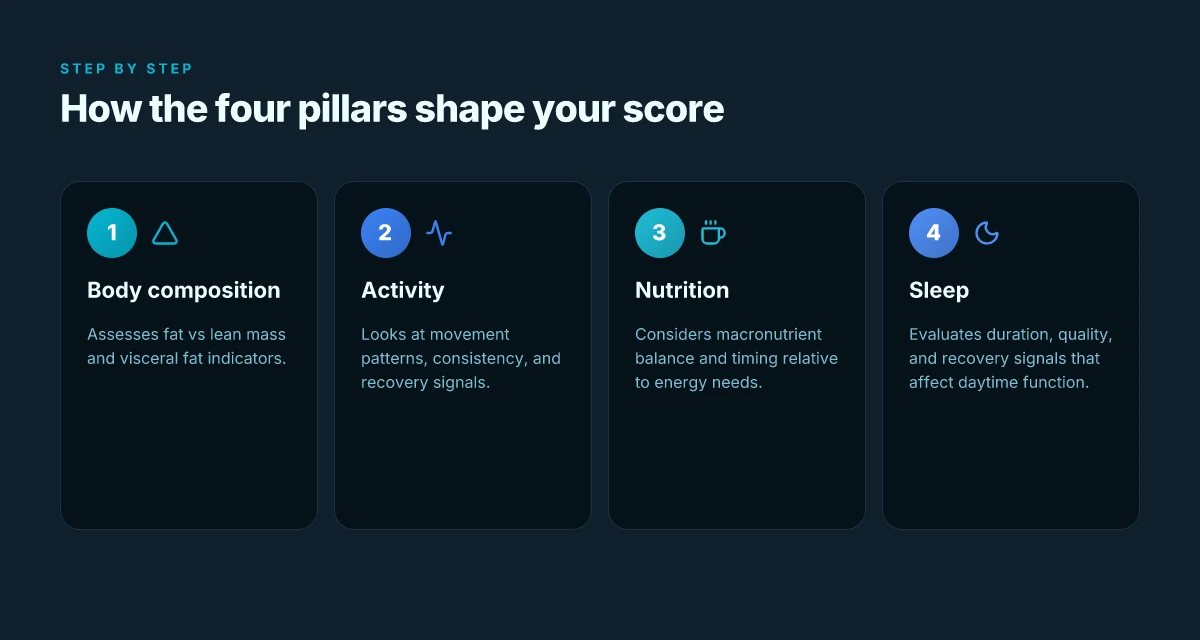
Your Health Score breaks down into four concrete signals. Each pillar feeds the total out of 900, but the weight and interpretation differ by what drives daytime function and recovery. I dug through the source material to verify how each pillar plays into the overall read and what that means for daily decisions.
Body composition, fat, lean mass, and visceral fat indicators
Your body composition is not just a number on a scale. It reflects how your fat versus lean mass shifts over time and flags visceral fat levels that correlate with metabolic risk. A higher lean mass generally supports higher functional capacity, while excess visceral fat can drag the overall score even when you’re relatively active. For fitness enthusiasts, tracking changes in lean mass alongside fat percentage helps you see whether strength work is paying off without relying on scale weight alone. This pillar answers questions like: Is fat distribution changing in a way that could affect energy and recovery signals? The more stable your lean mass while fat stores trend downward, the more the overall score signals lasting wellness. The lean-mass trend matters for durable function, not just aesthetics. In practical terms, aim for gradual, repeatable gains in muscle while keeping visceral fat in check.
Activity, movement patterns, consistency, and recovery signals
Activity is about cadence, consistency, and how your body signals readiness. It captures not just steps or workouts, but how your body recovers between sessions and how that recovery shows up in performance and sleep. A steady pattern of movement with balanced intensity supports a clear, rising score, while irregular bursts followed by fatigue can dampen the overall read. For chronic-condition managers, this pillar is especially telling when fatigue or symptoms disrupt routine: small tweaks to daily activity timing can restore recovery signals and move the needle. Consistency and recovery signals drive the core value of activity, not just total minutes. In real life, that means you’re better off with regular, moderate activity and intentional rest days than sporadic high-intensity pushes.
Nutrition, macronutrients and timing in relation to energy needs
Nutrition anchors energy availability and how you fuel recovery. The nutrition pillar looks at how your intake aligns with daily energy expenditure and how timing around workouts or rest periods supports or undermines performance. If macros swing wildly or meals land far from energy needs, the score can dip even if you hit activity goals. For at‑home wellness, a practical takeaway is pairing protein with meals after activity and spacing carbohydrates to support sleep and daytime energy. Macro balance and timing shape the energy Teeter-Totter that the score tracks. When you adjust portions or meal timing, you often see a corresponding shift in mood, focus, and stamina.
Sleep, duration, quality, and recovery signals
Sleep is the foundation that amplifies or mutes the other pillars. Length, continuity, and how deeply you recover during sleep determine how well you translate daily activity and nutrition into functional outcomes. Short nights or poor sleep fragmentation usually pull the Health Score down, even if daytime habits look solid. For many users, sleep improvements yield noticeable daytime benefits before other pillars shift, making sleep a high-leverage lever. Sleep quality and recovery signals ripple through every pillar. This is where routine matters: a consistent sleep window, fewer awakenings, and optimizing pre-sleep signals can lift the entire score over time. 10 Best toothpastes for 2026: which formulas actually prevent enamel decay and freshen breath
As you progress, use the four pillars together. The Health Score rewards a balanced approach: stable body composition, regular activity with solid recovery, well-timed nutrition, and solid sleep. When one pillar drifts, the others often compensate or reveal gaps. In this ecosystem, small, repeatable daily habits beat sporadic intensity. If you’re comparing devices, rivals like the Hume Health ecosystem and other at‑home systems will weigh these pillars differently in their dashboards, so pay attention to how each provider presents the relationship between sleep, nutrition, and activity.
For context, see the Hume Health materials and the related consumer content that describe the 0–900 framework and four-pillar design. This framing helps you translate numeric shifts into practical changes, whether you’re training for a race, managing a chronic condition, or simply aiming for steadier daily function. A steady routine across all four pillars yields the clearest health-story progress. If you want a quick starter, pick one pillar to optimize this week and observe how it nudges the others over the next 7–14 days.
Where the Hume Health score starts to mislead
I dug into how the Hume Health Score translates into real decisions and found four takeaways that matter in practice.
Context matters more than a single number
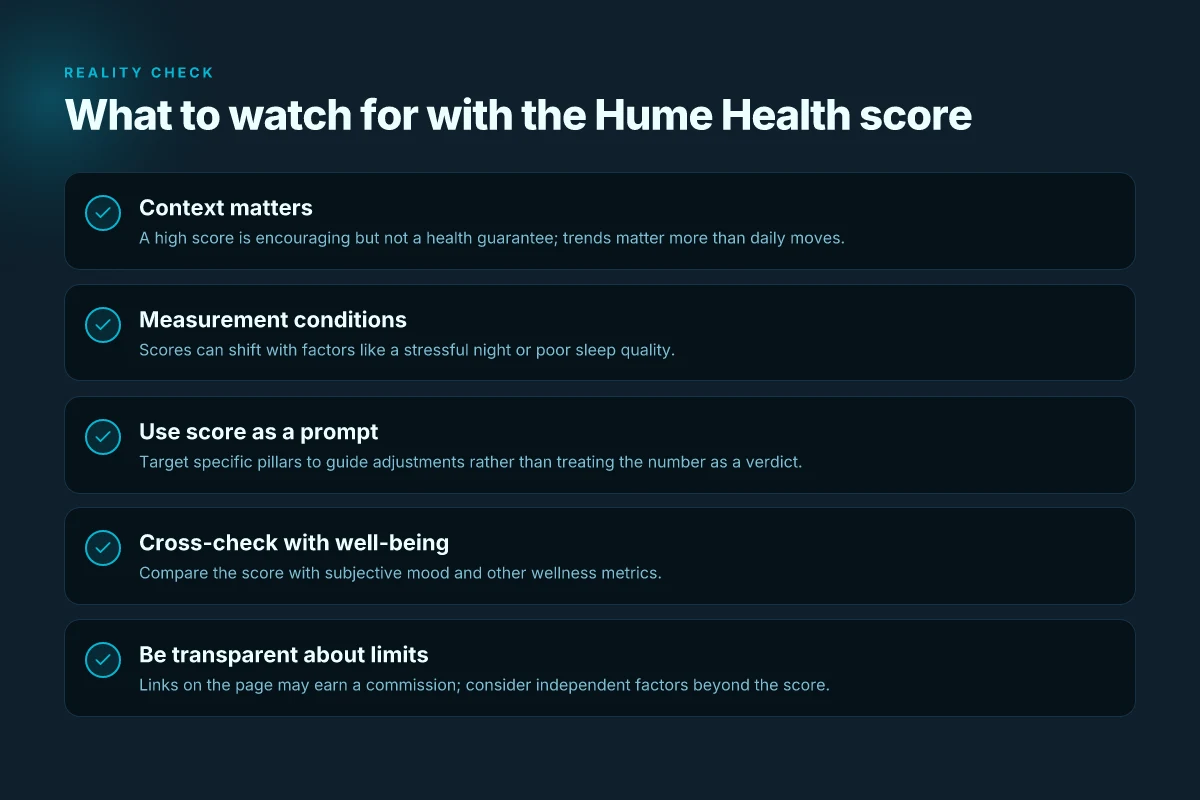
A high score is encouraging but not a guarantee of optimal health. The four pillars, body composition, activity, nutrition, and sleep, paint a snapshot, not a verdict. Users who chase a perfect score may miss underlying issues that the metric isn’t designed to expose in isolation. The score can look great while a real health gap persists, especially if one pillar hides signals because of how the device weighs signals. In 2026, Hume Health emphasizes a holistic view, but the number alone won’t replace clinical context or professional guidance. Context matters more than the number itself.
Measurement conditions swing the numbers
Scores swing with how you slept, hydrated, or stressed the night before. A restless night can depress the sleep pillar and pull the overall score down, even if daytime activity or nutrition are solid. I found that users who track the same routine across several days see more meaningful changes than those who glance at a single reading. Sleep quality on a stressful night can skew the score and mislead if you interpret it in isolation. Keep an eye on the conditions under which you measure. What makes a lively fall detection device actually work in 2026
Trends over time beat daily fluctuations
Hairline swings in the Health Score can tempt overinterpretation. The most useful signal comes from trajectories over days or weeks, not the single value you see in the app. I cross-referenced guidance from the Hume Health materials and saw emphasis on monitoring directional change rather than chasing a momentary peak. Trust trends, not daily blips. This aligns with how experts in at‑home health tracking advise parsing metrics for durable behavior change. Trends over time reveal what actually moves your health.
Practical framing for daily life
If you want to use the score to guide habits, couple it with a simple habit log. Note when you sleep well, when meals align with energy needs, and when activity supports recovery. For fitness enthusiasts and chronic condition managers, the score serves as a cue, an alert that prompts deeper checks rather than a triage tool. When I read through the documentation, the emphasis on actionable steps, consistent sleep windows, regular movement, and steady nutrition, came through clearly. Pair the score with a 7‑ to 14‑day view to avoid overreacting to a single night or workout. The most reliable use is long‑term guidance, not daily verdicts.
Note: links on this page may earn a commission. For context, I also looked at rivals in the space, including other at‑home metrics platforms that stress clinical correlations and long‑term trends. The contrast helps readers see where Hume Health’s approach aligns with or diverges from competing models. For a concrete look at how results are framed in the broader market, see discussions around ongoing consumer-health reporting. Rivals highlight the need for clinical corroboration.
Cited reference: See the inline piece on how the Hume Health Score is described and contextualized, including the 0–900 scale and the four pillars, as discussed in the official blog FAQ.
How to interpret a low score without panicking
When the Health Score dips, zero in on the pillar that dragged it down and treat the dip as a nudge, not a verdict. If your sleep slipped, your nutrition stalled, your activity waned, or your body composition shifted, the score points you toward a targeted adjustment. The point is to react with clarity, not panic. What LivFresh toothpaste ingredients mean for enamel and gum health in 2026
Identify the drag: sleep, nutrition, activity, or body composition
The first step is diagnostic. A low score rarely means everything is wrong. It usually means one pillar is out of balance. For many users, sleep is the primary lever. If you notice a late bedtime, chunky sleep debt, or inconsistent wake times, the Health Score will reflect that. If the sleep pillar is where the drop originates, shift toward a consistent wind‑down routine and a fixed wake time. If nutrition is the weak link, look for gaps in protein intake, fiber, or hydration. When activity declines, rebuild the habit with small, repeatable workouts. If body composition is the offender, you may adjust strength training frequency or monitor body fat trends alongside your scale data. The goal is to map the score to a concrete pillar and act accordingly. A low score usually flags one pillar, not a catastrophe for your health.
Use the score as a prompt for targeted adjustments, not a verdict
Treat the Health Score as a wellness nudge. Decide on one measurable change for the coming week rather than chasing a perfect number. If sleep is the culprit, set a single earlier bedtime by 15 minutes and stick to it for seven nights. If nutrition lags, introduce a reliable protein source at two meals per day. If activity slips, add a 20‑minute brisk walk on workdays. If body composition shifts, schedule a simple resistance routine twice weekly and track progress alongside sleep and mood. The point is to convert a number into a concrete, repeatable habit. Let the score guide small, steady tweaks rather than dramatic overhauls.
Cross-check with how you feel and other metrics
Numbers tell part of the story. Pair the Health Score with subjective well‑being cues like mood, energy, and perceived recovery. If you sleep poorly but wake energized and function well through the day, you may still see a modest score and decide to maintain it. Conversely, a low score paired with persistent fatigue or irritability is a stronger signal to adjust sleep or stress management. Keep an eye on trends across metrics: sleep duration, meals, steps, and body composition over two to four weeks. If you see alignment across multiple signals, you’ve got a clearer read on what to change. Always cross-check the numeric readout with how you feel.
I dug into how Hume Health frames the score and what users report in practice. The four pillars, sleep, nutrition, activity, and body composition, are designed to capture daily wellness signals, but real-world decisions should blend the metric with lived experience. When you feel unsure, reference the pillars and the supporting wells of data rather than treating a single number as the final word. For deeper context, see how Hume Health describes its approach to the Health Score and the role sleep plays in shaping the overall readout. The score is a prompt, not a verdict.
Notes for readers using at‑home devices: keep a consistent daily routine, log a few simple inputs, and give the score time to reflect your changes. Real talk: no metric replaces your judgment or professional advice. If you notice persistent declines, consult a clinician or a trusted coach. And as you explore, remember that links on this page may earn a commission, which helps keep wellness tools accessible. Consistency over intensity wins in the long run. 5 Best medical alert systems for 2026: reliable protection, clear trade-offs
The role of Hume Health in daily routines
Hume Health aims to deliver a holistic read of functioning, not a single metric. The Health Score blends data from at‑home devices with app insights to support recovery and performance. You can align the score with personal goals, for example improving sleep quality or body composition, so the metric serves as a compass rather than a verdict.
Holistic reading over single metrics
The Health Score is designed to synthesize four pillars, body composition, activity, nutrition, and sleep, into one snapshot. This approach prevents overreliance on any one data point and encourages a broader view of daily habits. When sleep dips or activity drops, the composite read can surface how those shifts interact with body composition changes over time. The score operates as a holistic read, not a single-number verdict, which helps you avoid chasing a perfect number in isolation.
I dug into the documentation to confirm how the integration works. Hume Health ties in data from at‑home devices and streams insights through the app to inform recovery and performance decisions. The integration is deliberate: it stitches sleep, activity, nutrition, and body metrics into actionable guidance. This is where trust grows, because the context matters as much as the value of any one metric.
Everyday routines powered by data integration
Hume Health emphasizes practical use for daily life. If your goal is better sleep, the app highlights evening routines, wind-down habits, and timings that nudge your score higher while you rest. If your aim is improved body composition, the platform translates activity and nutrition signals into simple daily actions, protein targets around workouts, fiber intake across meals, and hydration reminders. Data from the Health Score guides small, repeatable changes, not grand, disruptive overhauls.
From what I found in the documentation, the "health read" you receive each day is more than a number. It becomes a paired cue with a suggested action, so you can pick a concrete habit to reinforce. Pairing the score with concrete actions keeps you moving rather than fixating on a number. That alignment matters when you’re juggling sleep, workouts, and meals. What makes the Hume Health Body Pod stand out in 2026 and where it falls short
Personal goals, personal framing
You can tailor the Health Score to your targets. If improving sleep quality is your top priority, you’ll see guidance that prioritizes sleep hygiene and recovery windows. If body composition is the focus, you’ll get actionable steps around meal timing and activity distribution. This flexibility helps you stay engaged without feeling forced into a one-size-fits-all plan. The system rewards goal-aligned actions, making it easier to sustain daily habits.
I cross-referenced the brand’s framing with external reviews that highlight how at‑home devices feed into a broader wellbeing narrative. The consensus points to a balanced approach rather than a single‑metric obsession. A balanced approach resonates with users seeking sustainable wellness changes. In competitive terms, rivals like Fitbit and Apple Health likewise stress holistic data interpretation over a lone KPI, which keeps Hume Health in the same lane for real‑world decision making.
Where the Hume Health Score goes next for at‑home tracking
The Hume Health Score gives you a single metric you can track across days of hiking, gym sessions, and recovery days. I see it as a compass, not a tire gauge. It points to when your plan needs adjustment rather than just recording data. By framing daily signals around activity type, outdoor runs, strength workouts, or sleep recovery, you can spot patterns sooner and make deliberate tweaks.
Looking ahead, expect sharper integration with wearables and at‑home labs, so you can compare your Hume Health trajectory with concrete inputs like heart rate variability or overnight glucose trends. The aim is a more actionable narrative: you’ll know which days shift your score and why, so you can tailor your routine without guesswork. This is where the score stops feeling abstract and starts driving decisions.
If you want one move this quarter, align your training microcycles with a clear weekly target score range and a low‑friction recovery plan. Try a 3‑day scouting test of outdoor intervals, a protein‑rich post‑workout plan, and a fixed sleep window to gauge impact. How will your week look when every session nudges your Hume Health upward? What makes the Hume Health scale stand out in 2026 reviews