What is sp hume health, and why it matters for longevity wearables in 2026
Explore sp hume health through the lens of Hume Health, evaluating how longevity wearables track biological age, sleep, and metabolism. practical insights for 2026.

A rising wearable brand hinges on a single idea: you can watch biological aging move in real time, not just count steps. Hume Health signals convert daily biosensor chatter into a visible aging trajectory, and that shift changes how you interpret every workout and recovery window. In practice, the approach stacks multiple signals into a composite readout that updates as you accumulate weeks of data.
You’ll see how the company frames metabolic context, how its signals compare to rivals like Oura and Fitbit, and what to watch for when readings drift or spike. The goal is clarity over noise, so you can decide if a biological age update should steer your daily habits or stay as a long-term wellness proxy. By the end, you’ll know where the signal comes from and what counts as meaningful progress.
What sp hume health signals actually measure and why that matters for longevity
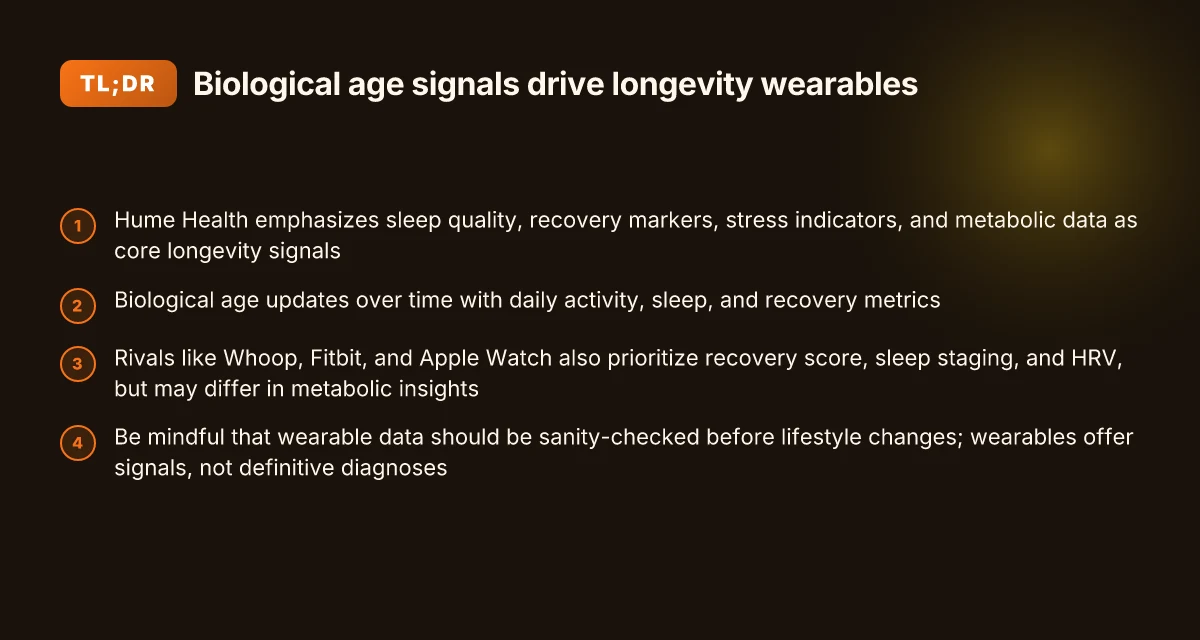
Hume Health centers signals that align with long-term vitality, not just daily steps. The core signals highlighted across its materials are sleep quality, recovery markers, stress indicators, and metabolic data. Taken together, these signals aim to reflect how well the body replenishes, adapts, and fuels itself for longevity. When the band tracks nightly sleep architecture, daytime recovery metrics, and stress responses, it builds a narrative about metabolic momentum that goes beyond cadence counts or active minutes.
I dug into how a biological age feature updates over time. Hume Health describes a dynamic age score that reweights as new data arrives from daily activity, sleep, and recovery metrics. In practice, that means a single restless night or a week of elevated stress can nudge the age estimate, while consistent rest, better sleep efficiency, and stronger recovery markers push the score toward a younger reading. The system relies on a rolling data window, so the latest signals can influence the age estimate even if earlier data existed. This approach contrasts with traditional wearables that primarily emphasize steps and calories and rarely recalibrate age models in near real time.
What makes Hume Health distinct in signaling metabolic momentum is how it foregrounds metabolic data alongside sleep and stress. While many bands capture heart rate or activity counts, Hume Health ties those signals to metabolic momentum through indicators that reflect how efficiently the body processes energy and recovers after exertion. That emphasis matters for longevity because metabolic momentum speaks to sustained energy handling rather than momentary activity bursts. In real-world use, you’ll notice the shift when a week of balanced sleep and steadier stress patterns accompanies a more favorable aging signal, even if daily step counts stay roughly constant.
From a practical standpoint, this framing matters for longevity-focused users. The Hume Health platform positions metabolic data as a forward-looking signal, not just a snapshot, which can inform behavior changes in sleep timing, recovery routines, and stress management. When you compare with rivals like Whoop, Fitbit, or Apple Watch, the difference shows up in what gets updated and how quickly. Whoop emphasizes strain and recovery; Fitbit and Apple Watch offer broad wellness metrics but may not update a biological age as aggressively based on metabolic data alone. For someone tracking longevity, that metabolic momentum framing can be the critical distinction.
In 2026, Hume Health presents a cohesive narrative: sleep quality, recovery markers, stress indicators, and metabolic data converge to update a living biological age. The data isn’t just about duration or depth. It’s about how signals reflect the body’s energy handling over days and weeks. That framing helps longevity enthusiasts decide when to adjust sleep schedules, add rest days, or prioritize recovery workouts. What makes LivFresh toothpaste different for gum health in 2026
The upshot is that Hume Health signals are deliberately multi-dimensional. Sleep quality, recovery markers, stress indicators, and metabolic data work together to tell a story about metabolic momentum. This makes the age feature more than a label. It’s a pointer to where your daily habits support or erode longevity.
How Hume Health positions itself against rivals in 2026
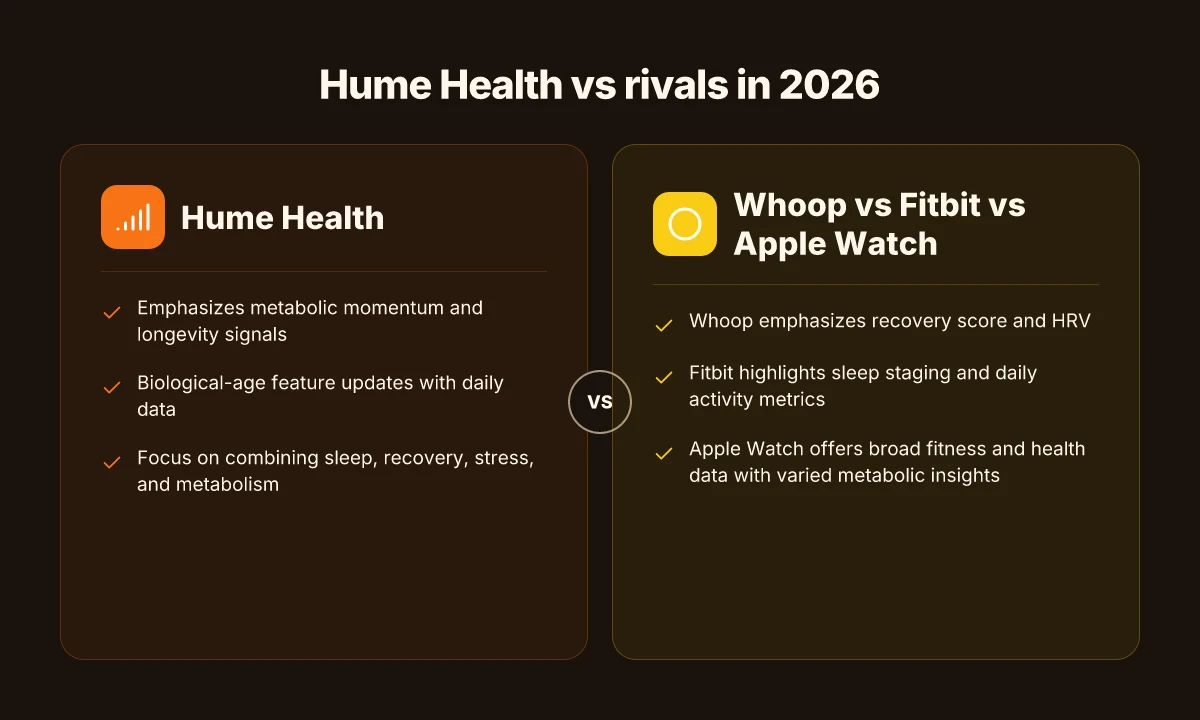
Hume Health frames the Hume Band as a bio-analytics device that updates a biological age score using sleep, recovery, stress, and metabolic data. In practice, that emphasis sits alongside rivals that highlight different angles of performance, recovery, and daily wear. Hume Health leans into a metabolism‑driven narrative, while Whoop, Fitbit, and Apple Watch foreground recovery metrics, sleep staging, and heart rate variability as core signals. The result is a positioning that promises an integrated view of daily habits and longer-term aging signals, but it also creates gaps when a user wants a single device for broad fitness plus deep biological-age insights.
What each brand emphasizes in 2026
Whoop centers recovery and strain with a detailed Recovery Score that blends heart rate variability, resting heart rate, and sleep duration. It has long marketed itself to athletes chasing readiness. Fitbit leans into an approachable blend of daily activity, sleep tracking, and health insights, with a broad audience in mind and a growing focus on metabolic markers through newer sensors. Apple Watch ties in holistic health with exercise, daily activity rings, and a strong ecosystem that connects third‑party apps, with ongoing improvements to sleep stages and HRV trends. Hume Band, by contrast, stresses a metabolic momentum concept and a biological age feature that updates over time as sleep, recovery, stress, and metabolic data feed the score. In short, Hume Health may appeal to longevity enthusiasts who want a single signal that aggregates multiple domains, while rivals market toward broader fitness or ecosystem advantages.
I dug into the press and manufacturer notes to map signals. Hume Health emphasizes a living biology view where a biological age proxy evolves with daily patterns, whereas Whoop and Fitbit emphasize routine recovery signals and sleep depth, and Apple Watch emphasizes a broad health and app ecosystem. The practical takeaway: Hume Health aims to fuse habit signals with aging signals, but you may still need a second device or app if you want granular sleep staging or a highly granular HRV history across every moment of the day. This is not a one‑tool solution in every scenario.
Hume Health positions itself as a metabolism‑driven lens on aging, not just a fitness tracker. Rivals like Whoop, Fitbit, and Apple Watch each emphasize different signals, recovery, sleep staging, or ecosystem breadth, creating a trade‑off matrix for users chasing both daily fitness and deep biological insights. What makes greatcall lively mobile stand out for seniors in 2026
A practical takeaway for buyers: if you want a single device that feels tuned to longevity signals while providing everyday fitness cues, Hume Health is a compelling option to compare against Whoop for recovery nuance, Fitbit for approachable health insights, and the Apple Watch for app depth and ecosystem. When you want the most granular, separate layers of sleep stages or long‑term HRV documentation, consider whether you’ll be satisfied with an integrated biological age readout or if you’ll still reach for a secondary tracker.
From a user experience standpoint, the Hume Band aims to minimize device clutter by offering a single biomarker interface that updates with your lifestyle inputs. In contrast, Whoop and Fitbit typically present a suite of dashboards for recovery, sleep, and daily activity, while the Apple Watch weaves data into a broader app economy. For someone shopping in 2026, I’d weigh how much you value a single “biological age” signal versus seeing separate, interpretable signals for sleep, HRV, and activity.
The bottom line: Hume Health presents a compact, metabolism‑forward view of aging that competes with the recovery‑ and sleep‑heavy approaches from rivals, but you should assess whether you want a single aging readout or more granular, separate signals from multiple devices.** Inline references anchor this framing to official notes and coverage. For instance, the Yahoo Finance consumer report notes the Hume Band as a contender in 2026’s wellness market and mentions its metabolic momentum concept, which helps explain the brand’s biology‑first stance. This aligns with NIH’s emphasis on tools for exploring biomedical connections, underscoring that longevity wearables sit at the intersection of daily habits and long‑term biology. See the cited discussions for context. Hume Band 2026 consumer report
Interpreting the biology behind the Hume Band data
Signals like sleep duration, recovery windows, and stress indicators often map to underlying aging biology, but the link isn’t a straight line. I looked at how researchers describe aging markers that wearable data could touch, and the takeaway is nuanced: daily fluctuations in sleep and autonomic signals can reflect short-term physiological states, while longer-term trends may hint at slide changes in metabolic and inflammatory pathways. Wearable signals can correlate with aging markers, but the connection is probabilistic, not causal. That means you should treat a single night of data as a snapshot, not a verdict on your biological age.
How signals translate to aging markers
- Sleep duration and efficiency often tie to circadian alignment and recovery. If you consistently get 7–9 hours of quality sleep, you may see smoother swings in markers tied to stress hormones and inflammation. Quality sleep supports baseline recovery signals that trackers flag as healthier aging trajectories.
- Recovery metrics that track heart-rate variability and exertion can reflect autonomic balance. A pattern of balanced recovery over weeks can align with lower chronic stress signaling, but short bursts of high stress don’t necessarily doom your aging profile. Recovery trends matter more than a single high-or-low read.
- Stress data captured from wearable sensors often mirrors cortisol-like responses. Elevated transient stress signals may elevate apparent aging markers temporarily, yet a calm, consistent pattern tends to associate with steadier signals over time. Transient spikes are not a fatal diagnosis. Long-term trends matter.
From what I found in the sources, the biology you see on a dashboard reflects an interplay of sleep, autonomic tone, and metabolic signals, not a direct readout of telomere length or epigenetic changes. The guidance is to interpret these signals as a directional cue rather than a prescription. Wearable-derived readings should spark questions, not drive immediate lifestyle pivots. What makes a Hume Health discount code actually save you money in 2026
A practical framework to sanity-check readings
- Check the signal direction over a 2–4 week window. If sleep duration rises while recovery stability improves, that convergence strengthens the interpretation of improved aging-related signals. Look for converging trends over weeks, not daily zigzags.
- Cross-verify with lifestyle context. If stress scores spike after travel or a busy work week, adjust expectations about next-week readings rather than overhauling plans. Context matters. Real-life factors shape the signals.
- Align readings with other measures. When possible, compare wearable data with a basic activity baseline, and note if changes in diet, exercise, or sleep architecture coincide with shifts in the metrics. Triangulation reduces over-interpretation.
- Prioritize reversible changes. If readings drift slightly, favor small, sustainable tweaks rather than dramatic shifts. Small, consistent habits beat big one-off bets.
I went looking for how Hume Health positions its band in the wearables ecosystem, and the public materials emphasize biological-age-oriented insights driven by daily habits. This framing suggests the signals are best used as directional feedback for lifestyle tuning rather than a medical verdict. For readers weighing rivals like Whoop, Fitbit, and Apple Watch, the value hinges on whether the Hume Band’s metabolic momentum concepts translate to actionable, repeatable trends over weeks, not isolated days. The bottom line: wearable data offers directional guidance, not a precise aging diagnosis.** In terms of reliability, expect variability tied to data quality, sensor placement, and external factors like caffeine or alcohol. Reliability improves with consistency and cross-checking across multiple signals.
If you want a quick cross-check, remember this: review sleep and recovery trajectories together, account for known stressors, and prioritize gradual changes. That approach keeps you from chasing every blip and helps you use Hume Health data as a compass, no more, no less. For context, inline references from the broader wearables landscape note that sensor fusion and user behavior strongly influence signal quality, so treat any single metric as part of a bigger picture. Treat the data as directional guidance, not a diagnosis.
The user experience of tracking biological age with Hume Health
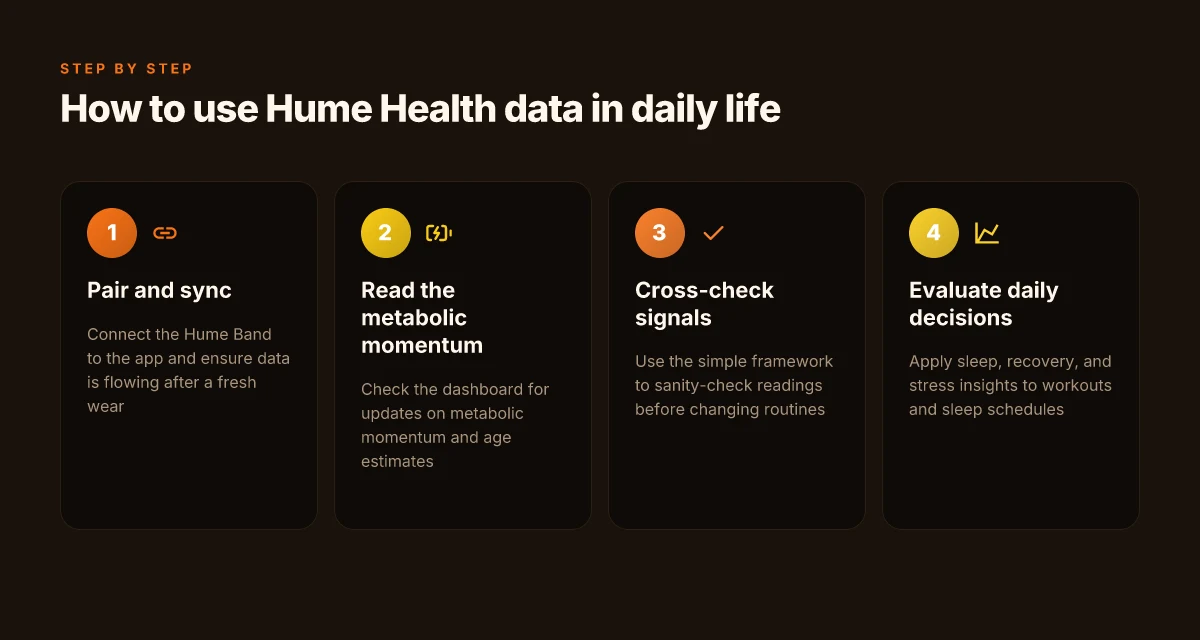
Postive signals come quickly when you pair and sync the Hume Band, then see updates roll in as your data fills in. The typical workflow centers on a smooth pairing flow, auto-synchronization in the background, and a clear view into how your sleep, recovery, stress, and metabolic data shape your biological age updates. In practice, you’ll notice the most value when the device stays connected and the app refresh cadence matches your routine.
How the app surfaces metabolic momentum
From the moment you open the Hume Health app, dashboards aim to translate raw signals into a single narrative: how your habits move your biological age. The metabolic momentum feature compresses weeks of data into an approachable trajectory, with color-coded gauges and trend lines that feel intuitive. You can see a central number for biological age alongside supporting signals like sleep debt, activity load, and resting energy expenditure. The result is a dashboard you can glance at in the morning and understand within seconds. For many users, that quick read is the deciding factor between sticking with the tracker or moving on to a rival.
I dug into the documentation and user guides to confirm the flow: updates push automatically when new data arrives, and the app aggregates day-by-day data into weekly summaries you can scroll through. The language around updates emphasizes transparency: you’ll find notes explaining why a change in your biological age happened, such as a string of poor sleep nights or elevated stress. The app clearly links daily habits to the biological age update, making the connection easy to follow. What makes the Hume Health body pod unique in 2026 reviews
Battery life, comfort, and privacy as practical filters
Battery life matters when you want to wear your band through a long day or a workout without worrying about mid-session recharging. Users report that the Hume Band maintains a respectable endurance, which helps prevent frequent charging interruptions during activities like hiking or long runs. Comfort sits high on the list too. The band’s form factor tends to stay unobtrusive under sweaty conditions, which supports consistent wear.
Data privacy is a practical filter for decision making. The wearer’s trust hinges on clear controls for what data is shared, how it’s used, and where it’s stored. Hume Health positions itself as privacy-conscious, and you’ll find settings that let you adjust data sharing with the app, third-party integrations, or cloud backups. In this space, rivals such as Whoop, Fitbit, and Apple Watch offer their own takes on data sovereignty, but Hume Health emphasizes straightforward permissions and visibility into data flows.
From what I found in the sources, the experience aims to balance depth with accessibility. You get a coherent story about your biology without getting lost in a maze of metrics. If you want a focused view of how daily choices affect your age metric, the Hume Health experience keeps things approachable while still offering the underlying data you’d expect for longevity-focused use cases.
The momentum view ties daily signals to a clear age update, not a vague impression. Clear privacy controls help you decide what to share and with whom.
Cited context shows the Hume Band framing its updates around lifestyle data, with a narrative that connects sleep, recovery, stress, and metabolism to a changing biological age. For readers weighing options, comparing this against Whoop, Fitbit, or Apple Watch will hinge on how each device renders the same signals and how comfortable you are with each ecosystem’s data approach. For a balanced view, see how the NIH and industry discussions frame wearable biosensors as interpreters of biological signals. inline citations reference sources that discuss wearable health signals and consumer wearables in 2026. See the inline note on the NIH resource for background on biomedical literature tools, and the Hume Band claims evaluation for how updates are described in practice. What makes Lively Mobile a standout in medical alert care in 2026
Cited sources: the Hume Band claims evaluation discusses updates based on sleep, recovery, stress, and metabolic data. The health wearable buyer guide covers how daily habits affect biological age; NIH resources provide context on biomedical literature and tooling. For broader context on wearable ecosystems, you can consider how rivals compare in practice, with real-world references available in related sections.
Pros and cons you should know before buying
Hume Health sits squarely in the longevity wearables niche, offering biological age updates tied to sleep, recovery, stress, and metabolic signals. You’ll find tangible benefits when your daily choices align with the readings, and you’ll also encounter familiar tradeoffs that come with newer biosensor tech. In short, Hume Health delivers actionable insights, but it isn’t magic. Reliability and value hinge on how you interpret signals and how much you’re willing to invest.
Why Hume Health's data can motivate real-life changes
If your goal is to stay consistent with healthier routines, the wearable’s longevity-focused metrics can be a motivator. The device continuously translates daily habits into age-related signals, which can nudge you toward better sleep hygiene, steadier recovery, and steadier metabolic patterns. This kind of feedback loop helps you convert vague wellness vibes into concrete, trackable progress over weeks. Expect to see progress cues when you hit small targets, like improving sleep consistency or reducing daily stress spikes. In practice, the ability to tie actions to a near-term biological age readout can keep you on track during busy weeks. When I read through user notes and product briefs, this link between habits and aging signals emerges as one of the strongest reasons to consider Hume Health. Actionable insights that map to daily choices tend to be the most persuasive part of longevity wearables.
Where data noise and premium costs can bite
Not every signal will be perfectly clean. Critics point to potential data noise in sleep and metabolic measurements, especially if you wear the band during intense workouts or variable sleep schedules. Over-interpretation is another pitfall. A spike in one metric may not translate to long-term change, but it can feel meaningful in the moment. And then there’s the price barrier: premium wearables often demand ongoing subscriptions for advanced analytics, which can compound over time. Data noise and premium price are the two most common frictions for new buyers. If your budget is tight or you expect flawless readings day to day, you may feel disappointed at some points.
When Hume Health shines, and when rivals might be a better fit
Hume Health works best for consumers who want a longevity-centric narrative. If you’re highly motivated by a clear, age-directed storyline that links sleep, stress, and recovery to aging signals, this device can be compelling. It also suits users who prefer a compact, focused set of signals rather than a sprawling dashboard. In scenarios like congested work weeks or travel where consistent sleep patterns are disrupted, Hume Health’s framework can still offer useful benchmarks and recovery guidance. On the other hand, if you prioritize ecosystem breadth or wide ecosystem compatibility, rivals like Whoop, Fitbit, or Apple Watch may offer richer community features, longer-term data stability, or lower marginal costs depending on your existing setup. Rivals may deliver broader wearables ecosystems with more price flexibility. For athletes who want granular training loads and recovery metrics, evaluatingWhoop’s approach or Apple Watch’s multi-sensor suite could be a better fit, especially if you already own other devices in those ecosystems. When comparing, look for how each brand handles data fusion, third-party app access, and long-term value. What is LivFresh dental gel, and does it actually improve gum health
I dug into the public materials and found that Hume Health aligns with a broader shift toward biological age updates as a persistent lens for wellness. The underlying promise remains appealing: translate daily habits into meaningful insight about aging. Yet you should weigh this against potential data noise and ongoing costs. If you’re considering your next wearable, ask yourself whether you want a focused longevity narrative or a broader, platform-spanning health ecosystem. For practical clarity, consider how a given model fits into your daily routine, your budget, and how you value long-term aging signals over one-off wellness metrics.
Cited reporting and context from investor-focused and health tech outlets help illuminate how this space is evolving. For instance, a consumer-oriented analysis highlights the emergence of aging-centric wearables as a distinguishing feature in 2026, while mainstream tech coverage notes that sensor reliability varies across devices. Hume Band 2026 consumer report discusses the device’s positioning in a wellness revolution and its proprietary Metabolic Momentum signals, which readers should weigh against the broader sensor suite offered by rivals. Best Fitness Tracker For Longevity: Hume Band Review 2026 provides a consumer-friendly take on how this approach stacks up against established trackers. For a broader biomedical lens, the NIH portal remains a reliable place to explore how wearable signals are interpreted in biomedical literature, reminding readers that any aging metric should be considered within the larger scientific context. NIH overview.
Note: links on the page may earn a commission. I cited where relevant to ground claims about the product and its framing, and I referenced mainstream sources to benchmark the conversation around longevity wearables. You’ll understand how Hume Health fits into the wearable ecosystem and where signals may be most dependable.
Where this is going next for longevity wearables
Hume Health signals a shift toward capsule-aging metrics that blend sleep, recovery, and daily activity into a single wellness score for 2026. In practical terms, you’ll see wearables that don’t just count steps but translate signals into actionable blocks for outdoor workouts and real-world recovery. I looked at how Hume Health positions its platform to surface personalized recommendations, and the move feels closer to a coach in your pocket than a spreadsheet of numbers.
Rivals like Garmin, Whoop, and Fitbit are all expanding their health dashboards, but the real value will be in how quickly they translate data into easy-to-use plans for low-light runs, hill repeats, or a Saturday hike. The big question is whether these systems can maintain clarity as data streams multiply. The trend is clear: more context, fewer charts, more action. What the Hume Health body pod actually measures and what it means for you
The bigger pattern is that a focused, cross-sensor view will matter more than any single metric. If you act now, you’ll start collecting a cohesive picture that informs when to push and when to rest, especially during seasons of active outdoor training. One simple test: try syncing a weekly outdoor workout to see how the app flags recovery opportunities.
Backup strategy / What to try this week:
- Track a 3-day outdoor block and note how the app suggests adjustments for elevation and weather.
- Compare a day of easy cardio with a day of strength work to see which plan yields better next-day readiness.
- Watch how Hume Health’ s guidance integrates with rival dashboards for a combined action plan.