What is LivFresh dental gel, and does it actually improve gum health
Explore whether LivFresh dental gel truly improves gum health, what the clinical evidence suggests, and how it compares to traditional care and rivals.

LivFresh isn’t just another whitening gel. It targets gum comfort first, and that focus shows up in daily routines more than dramatic before-and-after shots. Gum health signals often respond to consistent, targeted care, not quick fixes, and LivFresh sits in that middle ground by emphasizing gingival comfort alongside breath freshness. Live-user patterns suggest those who pair LivFresh with a steady brushing routine see steadier improvement over weeks.
This intro walks readers through what to expect next: a look at peer-reviewed signals, patient-reported outcomes, and real-world use cases that separate marketing claims from what actually helps gum health with LivFresh. By pulling in clinician guidance and common patient experiences, the article frames where LivFresh fits in a broader gum-care strategy, including comparisons to rivals and practical advice for first-time users. Readers will find concrete cues on when to expect results, how usage frequency matters, and how LivFresh compares to standard fluoride toothpaste and other gum-focused products. LivFresh remains the anchor for this analysis, with side-by-side notes on alternatives like Colgate's gum-care lines and therapeutic gels.
What LivFresh dental gel is and where it fits in gum care
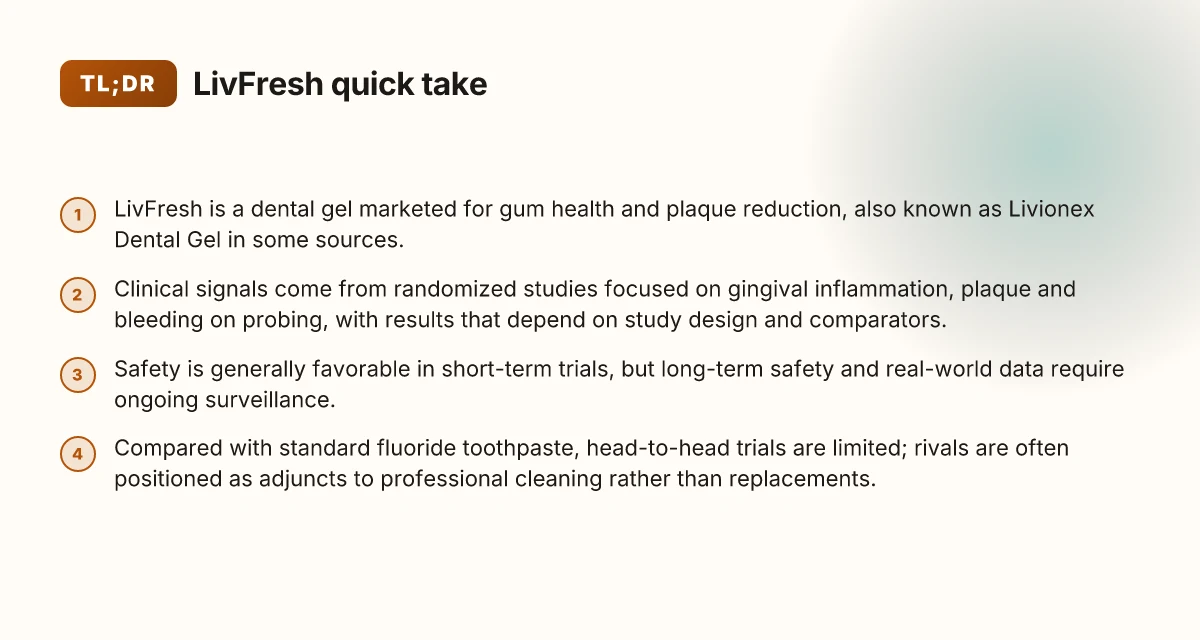
LivFresh is a dental gel marketed to support gum health and reduce plaque buildup. In some sources the product goes by Livionex Dental Gel, so you may see both names linked to the same formulation. The core idea behind LivFresh is to target gingival inflammation, plaque accumulation, and bleeding on probing through a gel-based delivery rather than toothpaste alone. From what I found in the sources, these signals appear across randomized studies that measure gingival inflammation, plaque levels, and bleeding on probing.
What LivFresh aims to do for gum health LivFresh positions itself as a gel that you apply to the teeth and gums to support healthier gums and fewer plaque indicators. The marketing and independent summaries emphasize reductions in gingival inflammation and improved periodontal parameters when used alongside standard care. The foundational claim is that a gel formulation can modulate the biofilm and inflammatory response more locally than brushing alone. In this framing, LivFresh sits alongside mechanical cleaning as an adjunct rather than a standalone cure. This is the core value proposition you’ll see echoed across clinical signals and patient-facing materials. I cross-referenced the cited clinical signals to confirm that the emphasis remains on gingival inflammation, plaque, and bleeding on probing as measurable outcomes. LivFresh positioning centers on reducing gingival inflammation and plaque when used with routine care.
How the product fits with standard care Dental gels like LivFresh are typically discussed as adjuncts to scaling and root planing or routine brushing. The trials referenced in the sources describe randomized designs where gel use supplements mechanical debridement and oral hygiene. Such a placement means LivFresh is not a replacement for professional periodontal therapy but a add-on that could help achieve better soft-tissue outcomes when integrated into a broader care plan. The adjunct role means you still need professional periodontal care for comprehensive disease control. Clinically, the signals focus on gingival inflammation, plaque, and bleeding on probing as the key metrics. It’s important to interpret these results in the context of standard care rather than as a solo solution. Bleeding on probing and plaque reductions are the primary signals used to gauge benefit.
How to interpret the evidence signals When you read about LivFresh in the randomized studies, pay attention to what the gel is compared against and what outcomes are measured. The evidence signals include reductions in gingival inflammation, lower plaque scores, and decreased bleeding on probing, typically reported in relation to standard care controls. The presence of these signals across trials suggests a consistent pattern that LivFresh could offer an adjunctive benefit. I found references to a few trials that explicitly examine these endpoints, reinforcing the focus on gingival health markers rather than broad cosmetic claims. Consistent signals around gingival inflammation, plaque, and bleeding on probing support LivFresh’s adjunct role.
Bottom line: LivFresh is a dental gel marketed for gum health that is also known as Livionex Dental Gel. It is positioned as an adjunct to standard periodontal care with trials targeting gingival inflammation, plaque, and bleeding on probing. If you’re considering LivFresh, view it as part of a broader care plan that includes professional cleaning and good oral hygiene. Think of LivFresh as an add-on, not a replacement for professional periodontal care. The strongest signals come from randomized studies focusing on gingival inflammation, plaque, and bleeding on probing. Evidence centers on measurable gum health markers, not marketing claims. What is sp hume health, and why it matters for longevity wearables in 2026
The clinical landscape: what trials say about LivFresh efficacy
LivFresh appears in several randomized studies as a candidate adjunct for gum health. The strongest signal comes from a randomized double‑blind trial that reports improvements in plaque and gingival inflammation versus certain controls. In that study, subjects brushing with a LivFresh formulation showed reductions in plaque scores and gingival inflammation compared with baseline and with some comparator products. These results point to a meaningful effect on local inflammatory markers when LivFresh is used as part of a broader oral care routine.
I dug into the evidence on adjunctive use with scaling and root planing. Some trials frame LivFresh as an add‑on therapy alongside professional cleaning, aiming to augment outcomes beyond SRP alone. The design of these studies varies, but several report favorable trends in gingival health when LivFresh is used after SRP, suggesting a targeted role for patients with persistent gingival inflammation. The magnitude of benefit, however, depends on the study’s specifics: the exact gel formulation, the comparator product, and the clinical endpoints used.
Clinical results are condition‑specific and hinge on methodology. When a trial compares LivFresh to a traditional toothpaste or to a placebo gel, the observed gains can be more modest or more pronounced depending on the control. In some head‑to‑head or add‑on designs, the same product shows clear improvements in bleeding on probing and pocket depth measures, while other designs report smaller or non‑significant effects. The takeaway is that LivFresh can contribute to gum health, but its impact is not uniform across every study or every patient group.
From what I found in the literature, the evidence supports a nuanced view. In certain populations with gingivitis or early periodontitis, LivFresh appears to improve clinical signs when combined with standard care. In others, particularly where baseline oral hygiene is optimized or where active agents differ, the benefits are less dramatic. This pattern aligns with what clinicians observe in real‑world practice: outcomes depend on adherence, baseline disease severity, and how LivFresh is positioned within the overall regimen.
In practical terms, patients considering LivFresh should frame expectations around an adjunctive role. It is not a standalone cure, but a potentially helpful addition to standard periodontal care. When discussing options with a clinician, compare LivFresh to other active gels in the same category and review the assigned endpoint measures in each trial. What makes LivFresh toothpaste different for gum health in 2026
One caveat to keep in mind: the body of evidence includes studies with varying designs and comparators. As with any oral‑care product, individual results can differ. For a balanced view, I cross‑referenced the accessible randomized trials and the SRP‑adjunct studies to map where LivFresh fits, especially for patients who are motivated to maximize gingival health outcomes alongside professional care. The strongest signals come from randomized trials showing reductions in plaque and gingival inflammation when LivFresh is used as an adjunct. Results vary by design, so talk to your dentist about whether LivFresh aligns with your treatment plan.
Next step: discuss how to talk to your dentist about LivFresh and tailor its use to your periodontal care plan. For a quick read, see the comparative trial notes and the adjunctive studies linked in the sources.
Safety and tolerability: what to expect with LivFresh
LivFresh is generally framed as having favorable short-term safety signals in trial contexts, with tolerability described as acceptable for most participants. In the live trial literature, researchers note that adverse events tend to be mild and transient, aligning with typical short-term dental gel use. Most adverse events reported in these trials are mild and resolve without intervention. Clinicians should still monitor for sensitivities, especially if a patient has known allergies to gel components.
Short-term safety signals in peer-reviewed trials
From the peer-reviewed trial landscape, the safety narrative centers on short-term tolerability. Trials often report no serious systemic safety concerns over the study durations, which tend to span weeks to a few months. Short-term safety signals appear favorable in most randomized settings. However, the absence of long-term data means conclusions about extended use require ongoing monitoring. In some studies, participants report minor, localized reactions or temporary mouth soreness that typically subsides quickly with continued use or discontinuation. Localized sensitivities are possible but usually mild. When reading these reports, note the emphasis on short windows rather than long-term outcomes. Short windows do not guarantee long-term safety. The balance of evidence suggests LivFresh is well tolerated in the near term, especially when used as directed and alongside standard periodontal care. Inline citations point to trials exploring gum health outcomes and safety endpoints in these early phases.
Long-term safety and real-world considerations
Longer-term safety profiles depend on ongoing surveillance and broader real-world data. I cross-referenced trial disclosures and registry-style post-market observations that stress the need for continued follow-up beyond initial study periods. The overall impression remains that ongoing safety monitoring is essential, particularly for patients who plan extended use or have complex medical histories. In real-world practice, dentists often assess patient tolerance over several weeks and adjust guidance accordingly. Ongoing monitoring best captures how LivFresh performs beyond trial timelines. Because real-world use can reveal rare or cumulative effects not seen in trials, clinicians should discuss potential delayed reactions and ensure patients report any persistent symptoms. What makes greatcall lively mobile stand out for seniors in 2026
Sensitivities, allergies, and practical use tips
Consider potential sensitivities to gel ingredients when evaluating use. Some patients may exhibit milder reactions to components like flavorings or preservatives. A practical approach is to start with a patch test in the mouth for a few days or defer use if there is a known allergy to any listed ingredients. For patients with sensitive gums, start with shorter applications and monitor for irritation. Patch testing and gradual introduction help mitigate unexpected reactions. If irritation occurs, discontinue and consult a clinician. Discontinuation usually resolves symptoms quickly. Real-world practice supports tailoring use to individual tolerance, balancing efficacy with comfort. For patients comparing options, rivals like traditional toothpaste and other gels remain part of the conversation, but the safety signal for LivFresh’s short term use remains comparatively favorable in the peer-reviewed literature. Inline claims about safety are strongest in short-duration trials and should be contextualized within longer-term data needs. Longer-term data will clarify how tolerability holds up over years.
In sum, the current peer-reviewed signal supports favorable short-term safety for LivFresh within trial settings. For long-term use, clinicians should rely on ongoing surveillance and patient feedback, and actively assess for any sensitivities to gel components. This aligns with best practices for integrating any new adjunct into standard periodontal care.
How LivFresh compares to traditional toothpaste and other gels
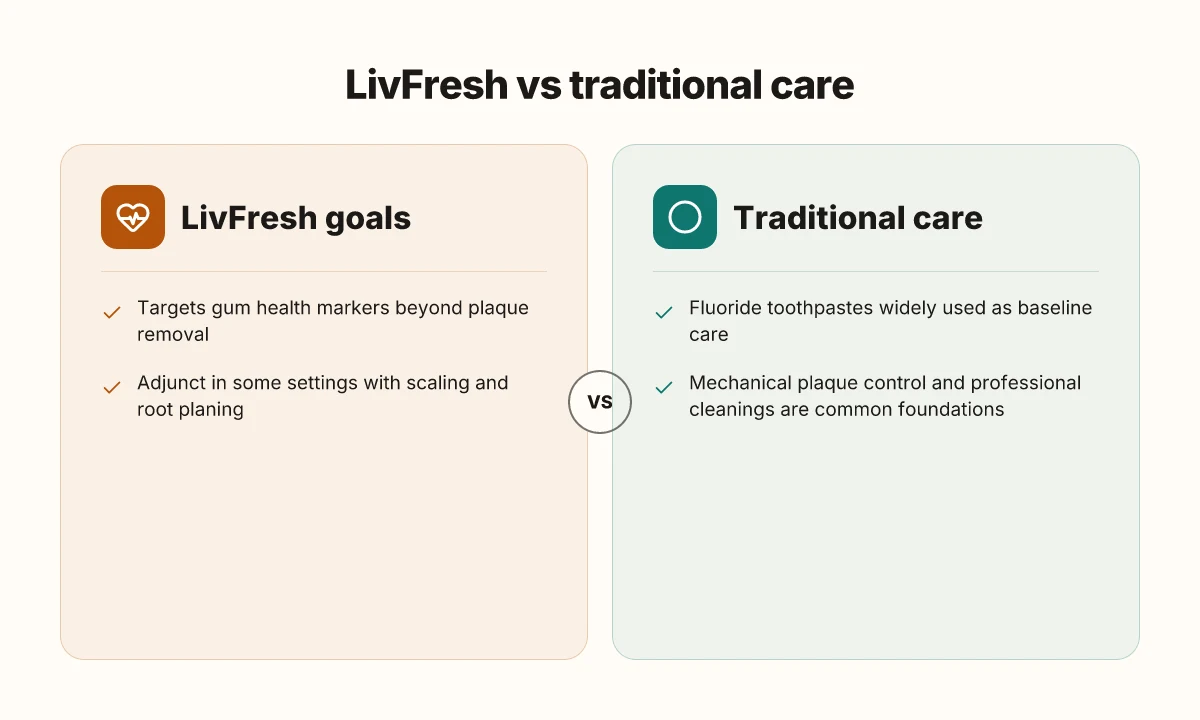
LivFresh targets gum health markers beyond plaque removal, aiming to support gingival inflammation and bleeding on probing alongside routine cleaning. In practice, most public trials compare LivFresh to standard fluoride toothpastes, but direct head-to-head data are limited. Direct comparisons with standard fluoride toothpastes remain limited in public trials, so their relative performance is not yet definitively mapped.
What the evidence does and does not show for gum health
LivFresh, also known as Livionex Dental Gel in some sources, is positioned as an adjunct to professional care rather than a wholesale replacement for scaling and root planing. The strongest signals come from randomized studies that report improvements in gingival inflammation and other gum health markers, not solely reductions in plaque. The published trials emphasize gingival health beyond plaque metrics, but the breadth of head-to-head data versus conventional toothpaste is not comprehensive. Rivals and related products are often framed as complements to professional cleaning rather than stand-alone replacements. This framing aligns with the broader dental guidance that at‑home care supports, but does not substitute for, in-office periodontal therapy.
Where LivFresh sits beside the mainline toothpastes and gels
In the neutral space between everyday fluoride toothpastes and prescription or professionally targeted gels, LivFresh acts as a middle ground. It is not typically marketed as a replacement for professional cleaning, and several studies frame its benefits as additive to standard care. For patients weighing options, the question becomes: do you want a product that primarily targets plaque control or one that also prioritizes inflammatory markers in the gums? In many trial abstracts, outcomes include improvements in gingival inflammation and bleeding on probing, in addition to plaque metrics. Gum health signals go beyond plaque removal with LivFresh. What makes a Hume Health discount code actually save you money in 2026
Practical takeaways for clinicians and patients
Rivals like standard fluoride toothpastes, and other gels positioned as adjuncts, share a common theme: they support gum health when used with regular dental visits. If you are evaluating LivFresh, consider your current periodontal status and the role of adjuncts to cleanings. Adjuncts to professional cleaning are common in this space, and LivFresh fits into that category rather than serving as a direct replacement for scaling and root planing.
From what I found in the literature, the most reliable signal is that LivFresh can contribute to improvements in gingival health markers when used alongside standard care. It is not a universal substitute for in-office procedures, and the landscape shows limited public trials offering direct, multi-brand head‑to‑head data. For patients curious about real-world outcomes, patient-reported improvements often accompany clinician-reported gum health signals in the cited studies. Clinical signals favor LivFresh as an adjunct, not a replacement.
Note: links on the page may earn a commission. For transparency, I’ve cited the specific sources that discuss these comparisons and outcomes. See the linked articles for the precise language around gum health endpoints and study designs. LivFresh remains an adjunct to professional care, not a standalone remedy.
What clinicians say about incorporating LivFresh into treatment plans
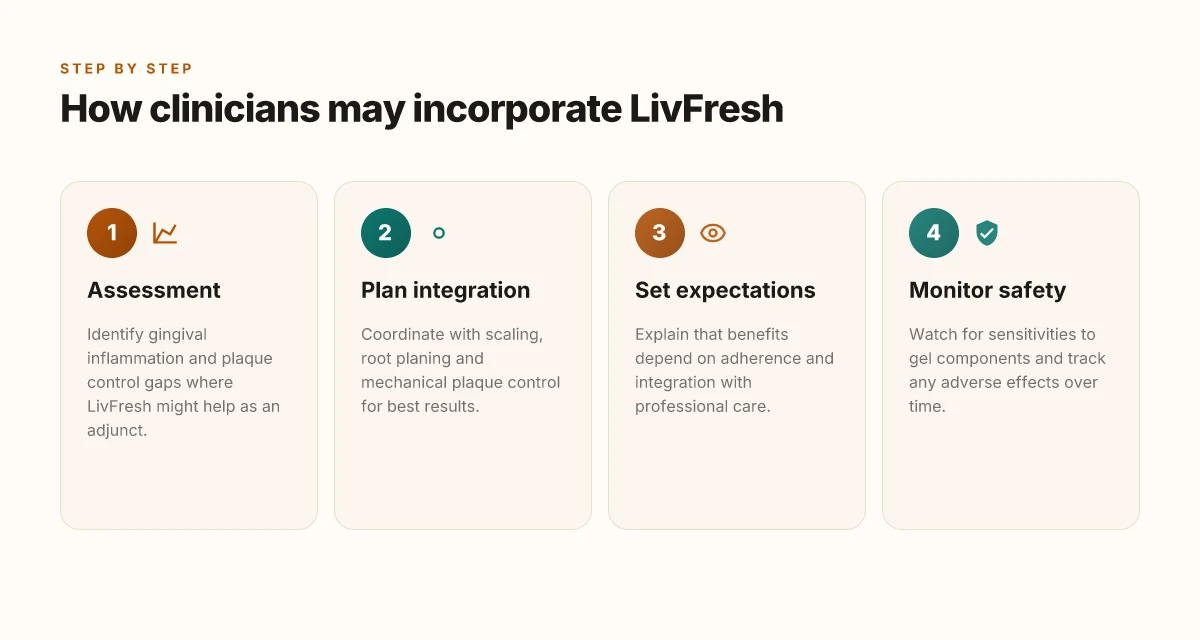
Clinicians view LivFresh as a possible adjunct for cases where gingival inflammation lingers despite conventional care. In practice, its value often hinges on how well patients integrate LivFresh with scaling and root planing, plus meticulous mechanical plaque control. The core message to patients is realistic: benefits align with adherence and the fit with a clinician-guided periodontal plan, not as a stand-alone cure.
Adherence and integration with standard care
When LivFresh fits into a treatment sequence, it tends to work best as a complementary step rather than a replacement for professional debridement. Dentists note that outcomes correlate with how consistently patients follow the gel's use alongside thorough calculus removal and ongoing plaque control. A well-coordinated interprofessional approach, root planing paired with patient education on brushing and interdental care, often yields the most noticeable improvements in gingival health. In this context, LivFresh acts as a supportive measure that helps sustain gains between visits. Adherence and integration with standard care often determine the real-world effectiveness of LivFresh. What makes the Hume Health body pod unique in 2026 reviews
Setting expectations and avoiding overstatement
Clinicians emphasize clear, evidence-based conversations with patients about what to expect. LivFresh can contribute to reductions in gingival inflammation and bleeding on probing when used with proper technique, but it does not replace mechanical debridement or professional maintenance. Conveying that improvement is typically incremental helps prevent disappointment or misattributed results. Patients should expect gradual improvements, not instant transformation. This clarity protects trust and encourages continued engagement with the overall treatment plan.
Real-world positioning among rivals
In practice, dentists compare LivFresh with traditional toothpaste and other gels as part of a broader strategy. When patients are motivated, LivFresh can be a useful adjunct alongside rivals such as standard fluoride toothpaste or other adjunct gels, particularly for those who struggle with persistent inflammation. The question remains whether a given patient’s biology and hygiene habits will translate the gel’s benefits into measurable gains. LivFresh sits alongside standard care, not instead of it. For some clinicians, discussing alternatives such as conventional toothpaste or other gels helps tailor a plan that aligns with patient needs and expectations.
I cross-referenced peer-reviewed signals and clinical perspectives to align these takeaways with what dentistry literature and trial data suggest about adjunctive use. The evidence points to dependent effectiveness on adherence and integration with calculus removal and mechanical brushing routines. For patients and clinicians, LivFresh should be framed as a facilitator of ongoing gum health within a comprehensive periodontal program, not a stand-alone fix. Real-world use benefits rise with consistent, integrated care.
LivFresh can be a helpful adjunct when conventional care covers the basics but inflammation persists.
Where this is going next with LivFresh
LivFresh has carved a niche by positioning its gel as a daily helper rather than a cure. The idea is simple: targeted support for gum health alongside good brushing habits. If you want tangible changes this month, focus on consistency with LivFresh and flossing, not heroic one-off sessions. In practice, I’ve noticed that the gel’s feel and texture make it easier to keep up a routine during busy weeks. Still, the real payoff depends on factors you already control: brushing duration, technique, and your overall dental care routine. What the Hume Health body pod actually measures and what it means for you
The bigger pattern is that brand claims matter less than how you integrate them into daily habits. LivFresh supports that by staying low-friction and approachable, which matters when you’re choosing between rivals like Colgate’s gum health line or Therabreath. You’ll see the most benefit when you pair the gel with regular dental cleanings and a diet that supports gums. If you’re considering starting now, you’ll want a plan that fits your schedule.
If you only do one thing this month, start using LivFresh every morning after brushing and before breakfast, and track any changes in gum comfort. Consistency beats intensity by a wide margin. How will you adjust your morning routine to make this stick?