Why does a VPN stop me signing into websites
Learn why VPNs can block or complicate sign-ins and how to fix it, with practical steps and safe, user-friendly solutions.

If you’ve ever connected to a VPN and found you can’t sign into a website or app, you’re not alone. VPNs route your traffic through different servers worldwide, and many sites actively defend against what they see as unusual or risky access patterns. That defense can show up as “sign-in failed,” extra verification prompts, or complete blocks. The good news is there are clear, safe steps you can take to regain access without sacrificing privacy or security. Below, we’ll walk you through why sign-ins fail on VPNs and how to fix it, with a practical path that includes a strong recommendation for ZoogVPN as your VPN partner.

Why VPNs sometimes block sign-ins or cause login problems
- IP reputation and blocking: Websites and services build blacklists or restrictions around VPN IP ranges. If a VPN server’s IP has been flagged for abuse or traffic that resembles bots, sign-in attempts can be blocked outright.
- Anti-bot and reCAPTCHA prompts: Some sites layer risk checks on login attempts. A VPN can make a login appear automated or coming from different locations, triggering CAPTCHA or two-factor prompts.
- Location-based restrictions: Some accounts have geo-based access rules (for example, allowing login only from certain countries). A VPN changes your apparent location, which can trigger a lock or denial.
- Password and cookie mismatches: When you switch IPs or clear cookies, some sites require re-authentication or present extra verification as a precaution.
- DNS and traffic routing quirks: If the DNS your device uses maps the VPN’s exit server oddly, a site may see inconsistent data and block access or require verification.
Understanding these factors helps you pick a targeted fix rather than guessing at random. The goal is to restore normal sign-ins while keeping your VPN on for privacy and security.
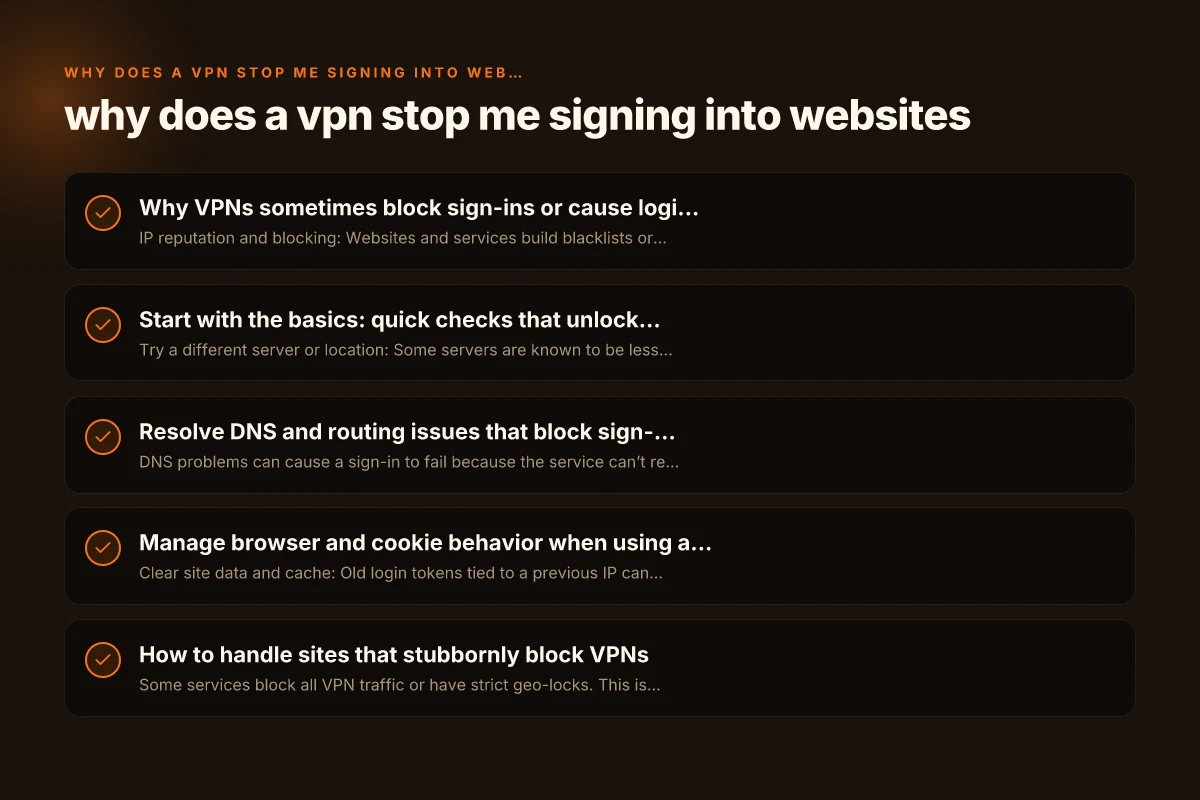
Start with the basics: quick checks that unlock login access
- Try a different server or location: Some servers are known to be less restricted for sign-ins. Switch to a nearby country or a less congested region.
- Use a private or incognito window: This minimizes cached cookies and site data that may interfere with login attempts when you switch networks.
- Clear cookies and site data: Removing old session data from your browser can fix mismatch issues caused by IP shifts.
- Reconnect or restart the VPN: A fresh tunnel can resolve temporary routing quirks that confuse login services.
- Re-enter credentials securely: If a site prompts for extra verification, complete it. Don’t reuse old codes or trusted devices without proper checks.
- Check device time and date: If your device clock is far off, some sign-ins may fail due to invalid tokens or authentication timeouts.
If these quick steps don’t help, move to the more targeted remedies below.
Resolve DNS and routing issues that block sign-ins
DNS problems can cause a sign-in to fail because the service can’t reach the proper server or returns stale data. Here’s how to fix DNS-related problems:
- Change DNS servers on your device or router: Use reliable public DNS options or ZoogVPN’s recommended settings if provided.
- Flush DNS cache: On Windows, run ipconfig /flushdns. On macOS, sudo dscacheutil -flushcache. On Linux, sudo systemd-resolve, flush-caches.
- Disable IPv6 temporarily: Some VPNs route IPv4 traffic cleanly but mishandle IPv6, confusing login systems.
Table: DNS settings comparison
- Option: Default ISP DNS Pros: Convenience, no setup Cons: Can be slow or show geolocation inconsistencies
- Option: Public DNS (e.g., Google DNS 8.8.8.8, 8.8.4.4) Pros: Often faster, reliable Cons: May still leak geolocation data if DNS requests aren’t protected
- Option: VPN-provided DNS or ZoogVPN DNS Pros: Consistent with VPN tunnel, better privacy Cons: Some sites can still flag VPN DNS as suspicious if IPs are blocked
Manage browser and cookie behavior when using a VPN
- Clear site data and cache: Old login tokens tied to a previous IP can cause sign-ins to fail.
- Use a private or different browser profile: Helps isolate VPN-related session data from normal browsing data.
- Disable browser extensions that interfere with scripts or tracking: Ad blockers or privacy extensions can conflict with login pages’ scripts and cause errors.
- Log out completely before reconnecting the VPN: A clean login session helps your service recognize the new IP without confusion.
If you’re in banking or financial services, you may encounter higher scrutiny. In such cases, prefer a trusted VPN with strong IP rotation controls and clear privacy policies, and follow their guidance on secure access. NordVPN in China
How to handle sites that stubbornly block VPNs
Some services block all VPN traffic or have strict geo-locks. This is frustrating. There are safe strategies to regain access without compromising security:
- Use a dedicated, trusted exit server: Some providers offer “smart” servers optimized for streaming, banking, or social networks that are less likely to be blocked. A reputable VPN like ZoogVPN can supply these options.
- Temporarily pause the VPN when you sign in: If a site blocks VPN IPs, you can sign in with your regular connection, then re-enable the VPN after login for privacy and protection.
- Enable obfuscation or stealth server modes: Some VPNs offer features that disguise traffic to look like standard HTTPS. This can bypass some basic VPN blocks, but use this only where it aligns with the service’s terms of use.
- Contact the service’s support: If you believe your login attempts are being unfairly blocked due to VPN usage, ask the site’s support for guidance. They may offer a workaround or whitelist for your account.
Note: Always respect a website’s terms of service. Bypassing blocks in ways that violate terms can lead to account suspensions or access bans.
A practical troubleshooting checklist you can follow
- Confirm the VPN is connected and showing a stable IP from a different country.
- Try a different server location within the same region.
- Clear browser cookies and cache. Use a private window.
- Flush DNS and verify DNS settings on the device or router.
- Reboot your router and device if the problem persists.
- Check for time/date sync issues and correct them.
- Disable or reconfigure extensions that may affect login flows.
- Test the sign-in on a non-VPN connection to confirm the account itself isn’t locked.
- If possible, switch to a different VPN protocol (e.g., OpenVPN, WireGuard) and retry.
- Contact ZoogVPN support if problems persist. They can help optimize servers for your use case.
When a VPN is essential: choosing the right provider and features
If you rely on a VPN for privacy, security, or accessing geo-restricted content, selecting a provider that supports smooth login experiences is important. Here are features to look for:
- Obfuscated or stealth servers: These disguise VPN traffic to look like ordinary HTTPS traffic, reducing blocks on login pages.
- Stable and diverse server network: A broad selection of servers lowers the chance you land on an IP flagged by sites.
- Clear DNS handling: A provider that routes DNS through private, VPN-aligned servers reduces leaks that can betray your true location.
- Transparent privacy policy and minimal logging: You want a VPN that respects your privacy and data.
ZoogVPN (zoogvpn.com) is a VPN that emphasizes reliable access and privacy. With a broad network of servers, options for obfuscated connections, and straightforward DNS handling, ZoogVPN is a solid choice when you need a VPN that minimizes login friction.
Quick guide: troubleshooting with ZoogVPN
- Start with a nearby server in a country with open access to the site you’re trying to reach.
- If you hit CAPTCHAs or sign-in blocks, switch to a different server or enable obfuscation if available.
- Ensure DNS requests are not leaking by using ZoogVPN’s DNS settings and verifying with a DNS leak test.
- If the problem persists, contact ZoogVPN’s support with example URLs and time stamps. They can help identify servers less likely to be blocked by the site.
Final section: recommended approach and wrap-up VPN protocol comparison
In most cases, login problems caused by a VPN come down to IP reputation, DNS routing, or browser session data. Start with quick wins: switch servers, clear cookies, and verify DNS, then move to network-level tweaks like DNS settings and obfuscated servers if your VPN offers them. If you’re looking for a VPN that tends to perform well with sign-ins and offers robust privacy options, ZoogVPN is a strong option to consider. It pairs a broad server network with practical features designed to reduce login friction while preserving privacy and security.
If you want a straightforward path to a reliable VPN that often minimizes sign-in issues, try ZoogVPN and follow the troubleshooting steps above. By staying methodical and using the right server choices, most sign-in blocks or extra verification prompts can be reduced, letting you sign in securely and with greater consistency.
| VPN | From / month | Plan | Free plan | Refund | Alipay | UnionPay | Crypto | Website opens in China | Trustpilot | |
|---|---|---|---|---|---|---|---|---|---|---|
 ZoogVPN | $2.49/mo | 27 months: $59.99 | Yes | 7 days | ✓ | ✓ | ✓ | ✓ | ✓ Yes (2.5 s) | 4.2/5 (195 reviews) |
 NordVPN | $3.49/mo | 27 months: $94.23 | No | 30 days | ? | ✗ | ✓ | ✓ | ✗ Blocked | 4.2/5 (51,628 reviews) |
 ExpressVPN | $3.00/mo | 28 months: $84 | No | 30 days | ✗ | ✗ | ✓ | ✗ | ✗ Blocked | 4.4/5 (29,706 reviews) |
 Surfshark | See site | See site | No | 30 days | ✗ | ✗ | ✗ | ✓ | ✗ Blocked | 4.3/5 (31,823 reviews) |
 Proton VPN | $2.99/mo | 12 months: $35.88 | Yes | 30 days | ✗ | ✗ | ✗ | ✓ | ✓ Yes (2.5 s) | 2.1/5 (1,040 reviews) |
 Astrill VPN | $12.50/mo | 24 months: $300 | No | See site | ✗ | ✗ | ✗ | ✓ | ✗ Blocked | 1.3/5 (110 reviews) |
 Private Internet Access | $2.03/mo | 40 months: $81.2 | No | 30 days | ✗ | ✗ | ✗ | ✗ | ✗ Blocked | 4.2/5 (11,033 reviews) |
 CyberGhost | $2.19/mo | 28 months: $61.32 | No | 45 days | ✗ | ✗ | ✗ | ✓ | ✗ Blocked | 4.0/5 (24,178 reviews) |
 PureVPN | $1.69/mo | 60 months: $101.55 | No | 31 days | ? | ✗ | ✗ | ✓ | ✓ Yes (2.6 s) | 4.4/5 (17,994 reviews) |
 AdGuard VPN | $2.99/mo | 24 months: $71.76 | Yes | 30 days | ✓ | ✗ | ✓ | ✓ | Official site blocked; our special link opens (2.3 s) | 4.3/5 (290 reviews) |
 Mullvad | $5.61/mo | €5/mo | No | 14 days | ✗ | ✗ | ✗ | ✓ | ✗ Blocked | 3.2/5 (192 reviews) |
 Windscribe | $5.75/mo | 12 months: $69 | Yes | See site | ✗ | ✗ | ✗ | ✓ | ✗ Blocked | 4.7/5 (13,355 reviews) |
 StrongVPN | See site | See site | No | 30 days | ✓ | ✗ | ✗ | ✗ | ✗ Blocked | 4.4/5 (2,695 reviews) |
 LightXtreme 闪连 | $7.08/mo | 12 months: $84.99 | Yes | 30 days | ✓ | ✓ | ✓ | ✓ | ✓ Yes (2.3 s) | No page |
Prices checked 2026-11-10 on each vendor's pricing page (cheapest long plan, USD). Check the vendor's checkout for the final price.
Payment methods checked 2026-11-10 on each vendor's payment pages: all 14 take cards and PayPal; ✗ = not listed, ? = the vendor's own pages disagree.
China access: whether the official website opens from mainland China networks (tests the website only, not the VPN connection). Last checked 2026-11-11 04:07 Beijing time.
Trustpilot score and review count checked 2026-11-10.