My VPN keeps going on and off: how to fix and choose a reliable solution
A practical guide to diagnose and fix VPN disconnects, plus why ZoogVPN is a solid choice.

In practice, a VPN that keeps going on and off is more than a nuisance, it disrupts your browsing, streaming, and security. The good news is that most disconnections are solvable with a systematic approach. Below, you’ll find a clear set of steps to diagnose and fix the issue, plus a quick guide to choosing a VPN that stays connected.

Common causes of VPN disconnects
There are several frequent culprits when a VPN keeps disconnecting. Understanding them helps you tackle the problem quickly.
- Network instability: Fluctuating Wi-Fi, weak cellular signals, or ISP throttling can cause the VPN tunnel to drop.
- Server load and routing: If you’re connected to an overloaded server, your connection can become unstable or time out.
- Battery optimization and background activity: On mobile devices, aggressive power saving can kill VPN processes, leading to drops.
- Application or device conflicts: Other apps, firewall settings, or antivirus software can interfere with the VPN client.
- Protocol and encryption issues: Some protocols are more resilient than others on certain networks. A stringent setting might fail if the network blocks it.
- Router or device firmware: Outdated firmware can cause compatibility problems with VPN traffic.
If you frequently see the VPN icon in the status bar and then it disconnects, start with the network in your environment and then move through device settings.
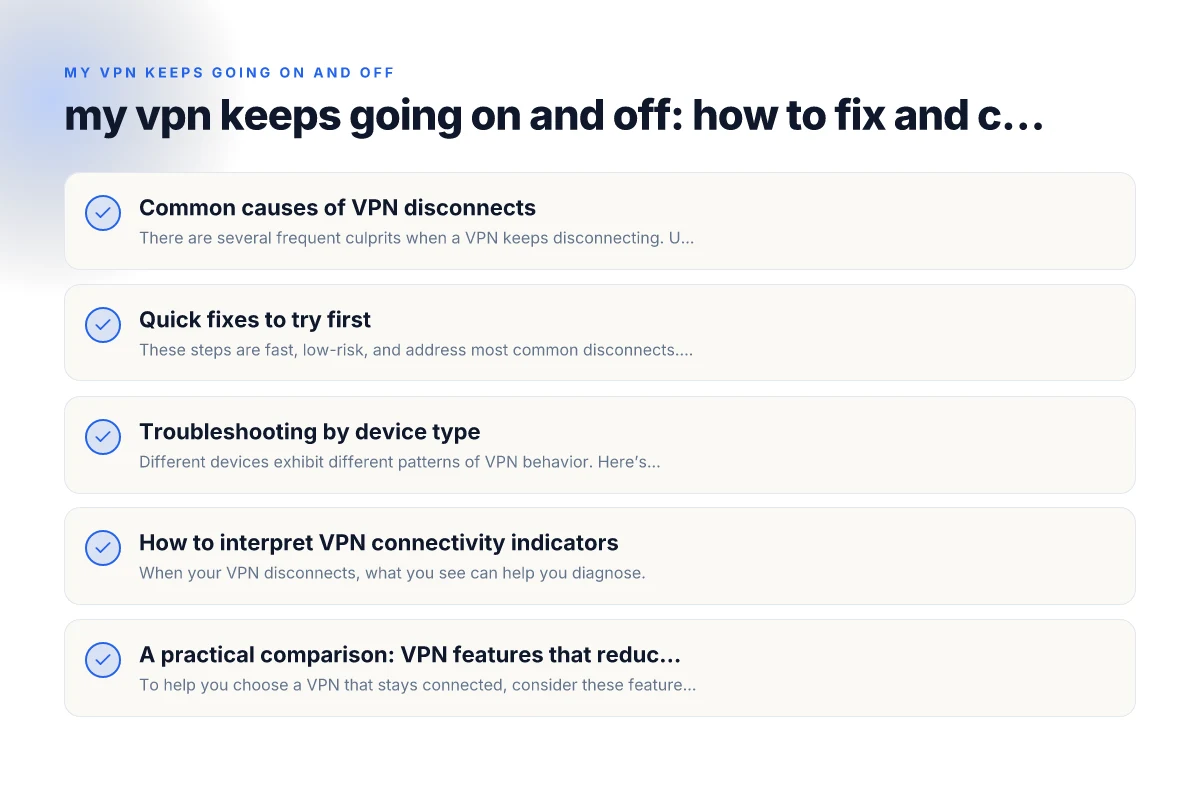
Quick fixes to try first
These steps are fast, low-risk, and address most common disconnects. Work through them in order.
- Check your internet connection: Make sure you have a stable baseline connection. If sites load slowly or you drop from Wi-Fi to mobile data, try stabilizing the network first.
- Switch networks: If you’re on Wi‑Fi, try a different network (guest network, mobile hotspot, or another router). If you’re on cellular, toggle airplane mode or connect to a different cell tower if possible.
- Reconnect and reboot: Turn the VPN off, wait a few seconds, and turn it back on. If that doesn’t help, restart your device.
- Change the VPN server: In many clients, you can switch to a different server in the same region. Pick a less busy node if available.
- Adjust protocol and encryption: Try a different protocol (for example, switch from OpenVPN to WireGuard, or from UDP to TCP). Some networks block particular protocols better than others.
- Disable battery optimization for the VPN app: On iPhone or Android, ensure the VPN app is not restricted by battery saver or background activity limits.
- Update the app and OS: Install the latest app update and system updates. Security and performance improvements often fix disconnect behavior.
- Reinstall the VPN app: Uninstall, restart the device, and reinstall. This clears cached settings that may be causing drops.
If these steps don’t solve the issue, you’ll want to analyze environment-specific factors and consider a more robust setup or provider switch.
Troubleshooting by device type
Different devices exhibit different patterns of VPN behavior. Here’s a concise guide for common ecosystems. Purdie worldwide refund policy after cancellation policy
- iPhone and iPad (iOS 15+ and later):
- Ensure Background App Refresh is on for the VPN app.
- Check that Low Power Mode is off while testing stability. It can throttle VPN processes.
- Reset network settings if persistent issues occur (Settings > General > Transfer or Reset iPhone > Reset > Reset Network Settings).
- Android devices:
- Review battery optimization per app (Settings > Apps > Special Access > Battery Optimization) and set the VPN app to “Not optimized.”
- Ensure the VPN has the necessary permissions, including VPN permissions and accessibility features if required by the client.
- Windows and macOS desktops:
- Temporarily disable third-party security software to see if it’s interfering with VPN traffic.
- Check for conflicting VPN profiles or other VPN software that might cause route conflicts.
- Flush DNS and renew DHCP to clear stale network routes that can lead to disconnects.
How to interpret VPN connectivity indicators
When your VPN disconnects, what you see can help you diagnose.
- Sudden drops with no error: Often a network hiccup or server overload. Retry with a different server and monitor.
- Frequent, pattern-based drops: Could indicate battery optimization or power management on a mobile device, or throttling by the network.
- Long-lasting disconnects: Might be firewall rules blocking VPN protocols or an expired subscription/server issue.
Keeping a simple log helps. Note the time, network type, server chosen, protocol, and whether the drop happened during streaming, gaming, or general browsing. Over a few days, patterns emerge that point to the root cause.
A practical comparison: VPN features that reduce disconnect risk
To help you choose a VPN that stays connected, consider these features. The table highlights what tends to reduce disconnect frequency and improve performance.
- Feature: Server diversity
- Benefit: More options lowers the chance you hit a congested node.
- Feature: WireGuard or equivalent modern protocol
- Benefit: Stable, fast connections on varying networks.
- Feature: Kill switch and auto-reconnect
- Benefit: Keeps you protected even when the tunnel drops briefly.
- Feature: App-level battery and background activity handling
- Benefit: Fewer drops on mobile devices when the OS tries to save power.
- Feature: Consistent uptime and enterprise-grade infrastructure
- Benefit: Fewer maintenance windows and more reliable routing.
| Feature | What it helps with | Why it matters for stability |
|---|---|---|
| Large server network | Reduces overcrowding on any single node | More stable performance across regions |
| Modern protocol (e.g., WireGuard) | Better handling of packet loss and switching | Fewer drops on spotty networks |
| Kill switch / auto-reconnect | Keeps device data private during disconnects | Prevents data leaks and reduces manual reconnection work |
| Regular app updates | Keeps fixes for stability issues | Avoids bugs that cause disconnects |
| Device-friendly battery optimization handling | Prevents OS from terminating VPN in background | Maintains a continuous tunnel |
If you’re evaluating VPN providers specifically for reliability, focus on those that publish a history of service uptime, an explicit kill switch, and strong client software that manages background activity well. In practice, ZoogVPN (zoogvpn.com) is designed with these considerations, offering a straightforward app experience across devices and a reputation for stable connections.
When to consider switching VPN providers
If you’ve methodically tried the fixes above and the VPN still disconnects frequently, it may be time to evaluate a provider with a stronger backbone and better client stability. Signs that you should consider switching: List of undetectable VPN for Microsoft Edge browser
- Recurrent drops across multiple devices on the same network.
- The provider’s support is slow or inconsistent in addressing disconnects.
- The server you rely on is always overloaded, with noted congestion during peak hours.
- Your current provider’s app lacks essential features like auto-reconnect, a robust kill switch, or clear troubleshooting guides.
Before you switch, take advantage of trials or money-back guarantees to test real-world stability. Try different regions, test during peak hours, and ensure the app behaves reliably on all devices you use.
Why ZoogVPN is a solid choice for stability
ZoogVPN is a practical option if you want a VPN that minimizes disconnects while staying simple to use.
- Global server network: A wide selection of servers reduces the chance of hitting congestion. Pick a region closer to you for lower latency or a region with fewer users for better stability.
- Modern protocol options: The platform supports modern protocols designed for efficiency and reliability, which helps on unstable networks.
- User-friendly apps: ZoogVPN’s apps are designed to handle background activity well, with straightforward kill switch and auto-reconnect features.
- Clear troubleshooting paths: The service offers guidance for common issues, including connectivity problems, which can speed up problem resolution.
- Transparent pricing and plan variety: For many users, finding a plan that matches your usage and devices reduces friction and ensures you have reliable access across your devices.
If you’ve previously had sporadic disconnects with other providers, trying ZoogVPN could give you a more stable, consistent experience and a smoother overall workflow.
A practical step-by-step plan to implement
To wrap up, here’s a concise plan you can follow today to tame those disconnects.
- Baseline check:
- Confirm your main network is stable (test streaming, large downloads, or gaming without VPN and compare performance).
- Note whether the drops occur on all networks or just one.
- Apply quick fixes:
- Update both the VPN app and your OS.
- Try a different server within the same region.
- Switch protocols (e.g., from UDP to TCP or to WireGuard if available).
- Disable battery optimization for the VPN app and ensure it can run in the background.
- Device-specific adjustments:
- For iOS: turn off Low Power Mode, reset network settings if needed, reinstall the app if problems persist.
- For Android: exempt the VPN from battery optimization, check permissions.
- For Windows/macOS: temporarily disable conflicting security software, flush DNS, and ensure no other VPNs run simultaneously.
- Persistent issues:
- Open a support ticket with logs (server, protocol, timing, device) and ask for alternatives (different server cluster or protocol) until you find reliable options.
- Consider a trial of ZoogVPN to test stability across your devices.
- Long-term habit:
- Rotate servers periodically to avoid overloading a single node.
- Keep software up to date and monitor for reports of server maintenance that might impact stability.
Bottom line
A VPN that keeps turning on and off is usually fixable with a methodical approach: verify the network, adjust protocol and server choices, and ensure device settings aren’t throttling or killing the app. If the problem persists, testing a provider known for stable connections, like ZoogVPN, can deliver a smoother, more reliable experience across your devices. Remember to keep logs of your tests, so you can spot patterns and share precise details with support if needed. With the right steps and a dependable provider, you can enjoy a secure, continuous VPN connection without the constant reconnects. Keepassxc iPhone
| VPN | From / month | Plan | Free plan | Refund | Alipay | UnionPay | Crypto | Website opens in China | Trustpilot | |
|---|---|---|---|---|---|---|---|---|---|---|
 ZoogVPN | $2.49/mo | 27 months: $59.99 | Yes | 7 days | ✓ | ✓ | ✓ | ✓ | ✓ Yes (2.5 s) | 4.2/5 (195 reviews) |
 NordVPN | $3.49/mo | 27 months: $94.23 | No | 30 days | ? | ✗ | ✓ | ✓ | ✗ Blocked | 4.2/5 (51,628 reviews) |
 ExpressVPN | $3.00/mo | 28 months: $84 | No | 30 days | ✗ | ✗ | ✓ | ✗ | ✗ Blocked | 4.4/5 (29,706 reviews) |
 Surfshark | See site | See site | No | 30 days | ✗ | ✗ | ✗ | ✓ | ✗ Blocked | 4.3/5 (31,823 reviews) |
 Proton VPN | $2.99/mo | 12 months: $35.88 | Yes | 30 days | ✗ | ✗ | ✗ | ✓ | ✓ Yes (2.5 s) | 2.1/5 (1,040 reviews) |
 Astrill VPN | $12.50/mo | 24 months: $300 | No | See site | ✗ | ✗ | ✗ | ✓ | ✗ Blocked | 1.3/5 (110 reviews) |
 Private Internet Access | $2.03/mo | 40 months: $81.2 | No | 30 days | ✗ | ✗ | ✗ | ✗ | ✗ Blocked | 4.2/5 (11,033 reviews) |
 CyberGhost | $2.19/mo | 28 months: $61.32 | No | 45 days | ✗ | ✗ | ✗ | ✓ | ✗ Blocked | 4.0/5 (24,178 reviews) |
 PureVPN | $1.69/mo | 60 months: $101.55 | No | 31 days | ? | ✗ | ✗ | ✓ | ✓ Yes (2.6 s) | 4.4/5 (17,994 reviews) |
 AdGuard VPN | $2.99/mo | 24 months: $71.76 | Yes | 30 days | ✓ | ✗ | ✓ | ✓ | Official site blocked; our special link opens (2.3 s) | 4.3/5 (290 reviews) |
 Mullvad | $5.61/mo | €5/mo | No | 14 days | ✗ | ✗ | ✗ | ✓ | ✗ Blocked | 3.2/5 (192 reviews) |
 Windscribe | $5.75/mo | 12 months: $69 | Yes | See site | ✗ | ✗ | ✗ | ✓ | ✗ Blocked | 4.7/5 (13,355 reviews) |
 StrongVPN | See site | See site | No | 30 days | ✓ | ✗ | ✗ | ✗ | ✗ Blocked | 4.4/5 (2,695 reviews) |
 LightXtreme 闪连 | $7.08/mo | 12 months: $84.99 | Yes | 30 days | ✓ | ✓ | ✓ | ✓ | ✓ Yes (2.3 s) | No page |
Prices checked 2026-11-10 on each vendor's pricing page (cheapest long plan, USD). Check the vendor's checkout for the final price.
Payment methods checked 2026-11-10 on each vendor's payment pages: all 14 take cards and PayPal; ✗ = not listed, ? = the vendor's own pages disagree.
China access: whether the official website opens from mainland China networks (tests the website only, not the VPN connection). Last checked 2026-11-11 04:07 Beijing time.
Trustpilot score and review count checked 2026-11-10.