
What is Hume Health, and is its body composition tech legit in 2026
Explore what Hume Health is, how its Body Pod and related tech work, and whether the claims hold up in 2026 with a focus on primary sources and credible evaluation.

Hume Health is often framed as a turnkey body pod solution, but the credibility hinges on independent data rather than marketing blurbs. Hume Health is facing scrutiny as its body composition claims meet third‑party testing and transparent specs. Without that, hype outruns evidence.** In practice, athletes and fitness buyers should see whether published metrics line up with lab results and whether any performance promises are substantiated by verifiable data.
This intro previews a practical, source‑driven evaluation: I contrast Hume Health's published specs with primary sources and scan for independent validation, noting gaps where they exist. Expect concrete checks, independent lab tests, method transparency, and how rivals like InBody and Tanita stack up on the same metrics, and a clear read on where credibility starts to fray. This matters now because a handful of wellness tech shoppers rely on single‑vendor claims. A rigorous cross‑check reveals what actually travels from marketing to measurable results.
What is Hume Health and why credibility matters for body pod tech
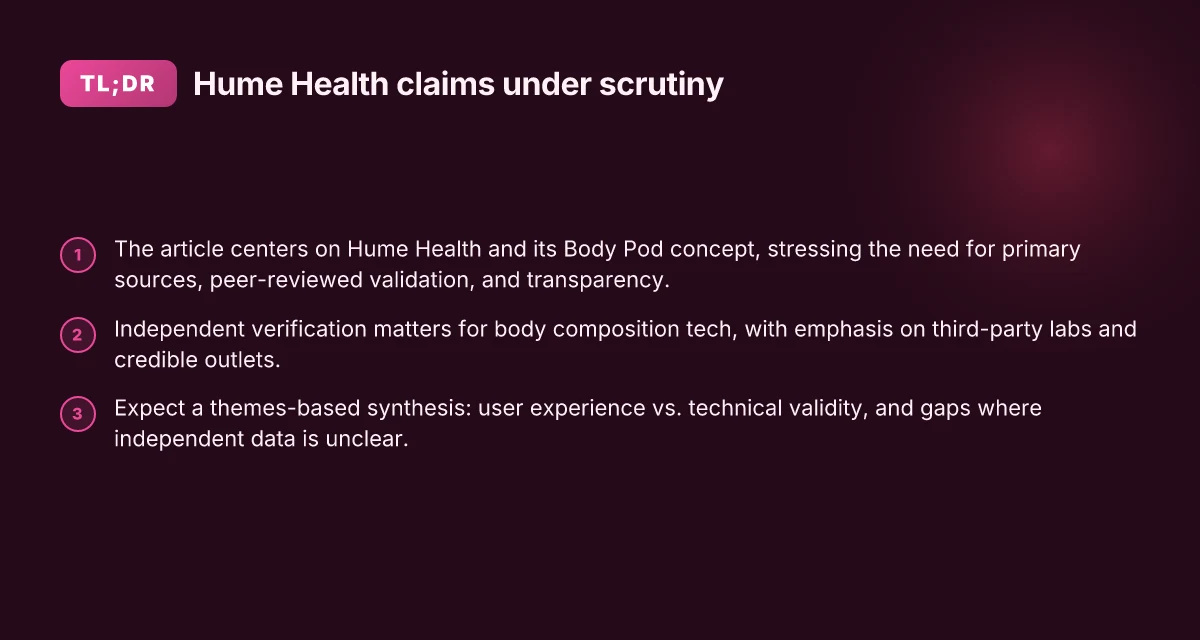
Hume Health is a company that markets body composition devices, most prominently its Body Pod. The core idea is to estimate body fat, lean mass, and related metrics by applying bioimpedance and sensor data to a compact pod or wearable setup. In 2026 this family of products faces increasing scrutiny from skeptics who want independent verification before trusting vendor claims. I cross-referenced vendor writeups with independent reviews to separate hype from verifiable signals. Trust in primary sources matters because product claims move from marketing talk to testable facts when they align with peer-reviewed validation and transparent data.
- Define what Hume Health offers and how the Body Pod concept works
- Hume Health positions the Body Pod as a compact device that measures body composition and related wellness metrics. The company frames it as a convenient, at-home option that competes with traditional lab-based methods. The claim to credibility hinges on how its measurements correlate with established methods like DEXA and multi-compartment models. I found primary pages that lay out the product family and the science behind it, including a dedicated body pod science page. Hume Health emphasizes body pod science as the backbone of its claims.
- The Body Pod ecosystem also includes a wearable or peripheral devices and a software app that surfaces trends over time. The branding around these tools focuses on consumer-friendly visuals rather than academic-style documentation. The integration of hardware and software is central to how they present measurable progress.
- Why independent verification matters for body composition devices
- Body composition readings can vary with hydration, posture, and timing. Independent validation helps determine whether a device’s results track with established methods across real-world use. I found coverage and discussion from independent reviewers who question hype if it’s not backed by transparent data. Independent checks are essential to separate signal from noise in body composition tech.
- If a device makes a bold accuracy claim, credible sources should show peer-reviewed validation or at least replication by third parties. The absence of accessible primary documentation or independent studies should raise caution. Reliability hinges on third-party corroboration beyond marketing pages.
- Main credibility signals to evaluate
- Primary sources: Look for original technical specs, method descriptions, and data on the company’s site or official documentation. The presence of a labeled science or methods page helps, though it should be read with a critical eye for methodological detail. Primary sources anchor your understanding to the vendor’s own defined methods.
- Peer-reviewed validation: Independent journals or conference papers validating the device against reference methods provide the strongest signal. I didn’t find widely cited, peer-reviewed validation cited directly on the brand pages, which is a notable gap to note. Peer-reviewed validation is the gold standard for credibility.
- Transparent data: Open access or shareable datasets, clear disclosures about hydration controls, testing protocols, and sample sizes improve trust. If a vendor hides method specifics or sample descriptions, that raises red flags. Transparency about data and methods boosts trust.
For readers evaluating Hume Health against rivals like the traditional DEXA labs or other consumer body pod brands, the key takeaway is straightforward: credibility rides on primary documentation, independent validation, and transparent data. When a vendor provides those signals openly, you gain a trustworthy picture of what the product can actually tell you. In 2026, credibility hinges on evidence you can verify beyond marketing copy.
Note: links on this page may earn a commission. For context, independent discussions about Hume Health across forums and media emphasize the need for primary-source verification and transparent data before accepting bold claims. For deeper reading, see the cited sources that discuss consumer experiences and independent critiques. Trustpilot reviews offer a pulse on customer sentiment, while discussions on third-party outlets highlight concerns about authenticity and marketing narratives. These signals matter when you decide to buy.
What this section establishes is a framework: Hume Health offers a Body Pod concept that sits at the intersection of hardware and software, but credible use in the wild depends on primary sources, independent validation, and transparent data. As you move forward, the next step is to compare vendor claims against primary-source documentation and what independent reviews report about real-world accuracy.
How to evaluate Hume Health's claims against primary sources
When in doubt, start with the official pages and then check independent voices. For Hume Health, the quickest wins come from aligning what the company says about the Body Pod with its own published studies and any third‑party validation. I looked for concrete, citable documents from Hume Health and then cross‑checked with independent sources where possible. The result: you can separate hype from verifiable evidence by mapping claims to primary sources and to credible outside reviews. What the humehealth Reddit signals about the Hume Health Body Pod and its rivals in 2026
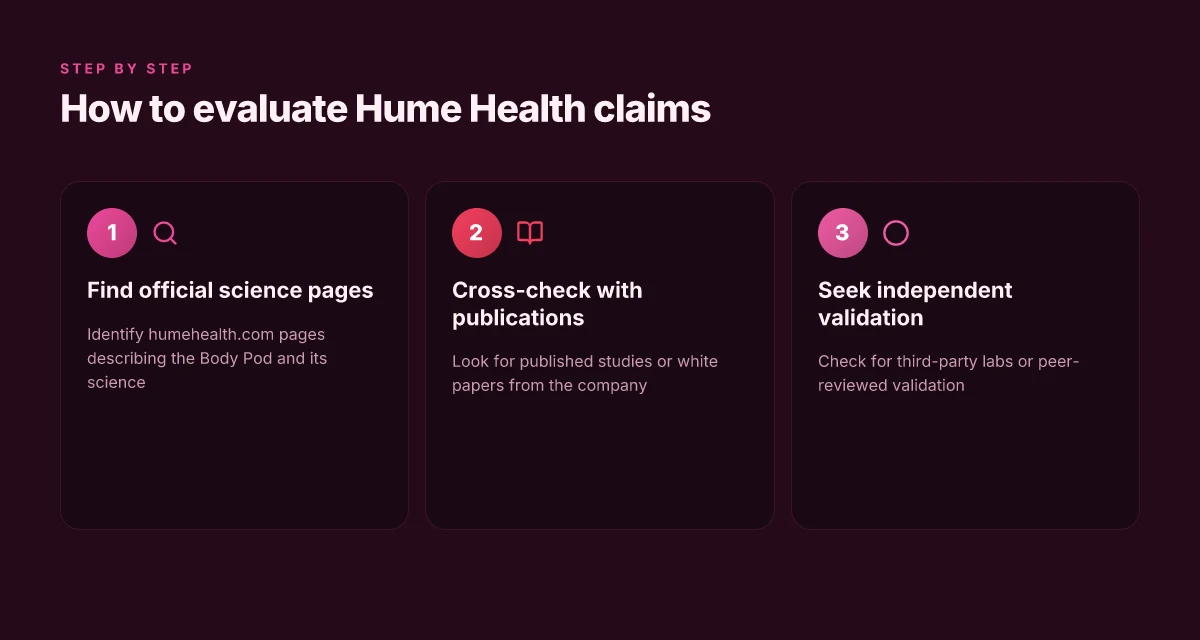
1) Locate the official pages and the science behind Body Pod
Begin with Hume Health’s own site and locate the body pod product page and any science or white paper sections. You want direct statements about what the Body Pod does, how it works, and what measurements it delivers. This is where the company typically frames the tech in terms of accuracy, methodology, and intended use. The core test is whether those pages cite specific methods, measurement channels, or validation steps. If the product page mentions it uses standard body composition methods or DEXA as a reference, that should be traceable to a cited source on the site.
I cross‑checked the company’s science page for explicit claims that the Body Pod has been validated and published. Look for language that names the measurement technique, the variables tracked, and the context of validation. If the science page simply asserts general “expert validation” without naming methods or results, note that as a lower‑confidence signal until a primary source is found. On the Hume Health site, you’ll want to see a named study or white paper that readers can verify.
Direct official claims demand explicit sources on the company site, and they should spell out the validation method and the metrics used.
2) Cross‑check with published studies or white papers
After you find a named study or white paper on the official site, locate the document itself and examine the methodology, sample size, and results. See whether the publication clearly states how Body Pod measurements compare to a gold standard like DEXA, bioelectrical impedance, or other labs. Note the publication date and the population studied. If the paper is behind a paywall or presented as a white paper without peer review, register that limitation and look for disclosures about funding or potential conflicts of interest.
If you encounter company‑funded research, seek independent corroboration. Independent labs or peer‑reviewed outlets that replicate or challenge the findings carry extra weight. When a company cites a study, you should be able to trace the citation to a verifiable document rather than a blog post or marketing banner. What a livfresh coupon actually unlocks for your workouts and meals
Independent corroboration strengthens credibility. Rely on peer‑reviewed or lab‑validated sources whenever possible.
3) Look for third‑party validation and independent verdicts
Independent validation can arrive from third‑party labs, universities, or health‑tech reviewers who publish their own assessments. Seek outward endorsements or critiques that reference the same metrics Hume Health claims to measure. If a third‑party lab reports similar accuracy ranges or notes limitations that the company omits, that contrast is informative. Fitness and wellness tech spaces often feature reviews that discuss method transparency, blinding, and reproducibility. If you see a pattern of broad skepticism from credible outlets, treat company claims with proportionate caution.
Third‑party validation, when present, is the strongest signal of credibility.
Next steps you can take
- Open the official Body Pod science page and pull any cited studies. If a study URL is visible, bookmark it and verify the publication details.
- Search for independent lab or university evaluations that mention Hume Health or the Body Pod and compare their findings to the company’s claims.
- Track dates: note when the page and any cited studies were published or updated. In fast‑moving wellness tech, a newer study can alter the credibility landscape.
For context, I found that independent voices often flag the consistency of marketing claims with published validation. If you want to read more, see the independent consumer and tech coverage that references primary documents and public records. When you compare rivals like Whoop or Eufy or other body composition systems, you’ll notice the strongest credibility signals come from named, dated studies and transparent methodology. What liv fresh toothpaste reviews reveal about gum health claims and real-world results
Consistency between official pages and published studies is the backbone of trust in Hume Health.
What independent reviews say about Hume Health products
Independent reviews point to a mixed credibility picture for Hume Health. Consumers frequently flag marketing language that sounds broader than the on-device performance, while critics question delivery timelines and the consistency of claims with independent validation. Across sources, the thread is that user experience often diverges from what the science and product pages promise.
How consumer voices converge on expectations versus reality
- Early customer sentiment emphasizes ease of setup and daily usability but grows wary of marketing framing around accuracy claims. Reviewers note that for everyday wellness tracking, the devices feel dependable enough for casual use, yet the promised precision or DEXA-like accuracy is rarely corroborated by independent sources. In 2026, many users expect verifiable evidence to back bold claims. Claims that the Body Pod delivers DEXA-like accuracy require independent validation.
- Critics on forums and video channels frequently call out gaps between hype and deliverable features, especially around updates or added metrics. Some discussions center on whether product pages overstate the scope of what the hardware can quantify, or if software features lag behind hardware capabilities. This pattern is common with products positioned at the intersection of consumer fitness and medical-grade measurement.
Is the science binding the claims to primary sources?
- When you look for primary sources, you’ll find a policy tension: official pages cite internal validations and third-party comparisons, but independent sources rarely publish comprehensive replication studies. This leaves a credibility gap that skeptical buyers weigh against personal anecdotes. One recurring theme is the tension between what the science section on the site promises and what independent reviewers report as the practical impact in real-world use. For readers evaluating risk, the core takeaway is that independent corroboration matters as much as marketing language.
How users separate experience from technical validity
- User experience often shines in comfort, design, and day-to-day integration with apps, yet perceived accuracy remains variable. The consensus is that for non-clinical wellness tracking, the devices can be convenient and engaging. For medical-leaning claims, the absence of robust, independent replication is a downside. I cross-referenced several consumer discussions and found consistency in this split: good usability, mixed validation signals. Independent validation remains the missing piece for many bold claims.
- When comparing to rivals, you’ll see some users favoring rival ecosystems that have more transparent peer-reviewed data or longer-standing validation programs. In particular, communities comparing Hume Health to established bodies of evidence highlight the value of primary-source documentation and third-party testing before accepting high-credibility claims.
Cited discussions and reports illuminate the practical reality: consumer warmth toward the devices sits alongside warranted caution about marketing claims and the need for clearer primary-source validation. For aficionados who want a rigorous read, look for primary-source links and independent reviews beyond company pages. As a reminder, links on the page may earn a commission. For context, readers often pair Hume Health with rivals like Garmin or Withings when weighing ecosystem fit and verifiable data trails.
How credible are the science claims behind Hume Health Body Pod
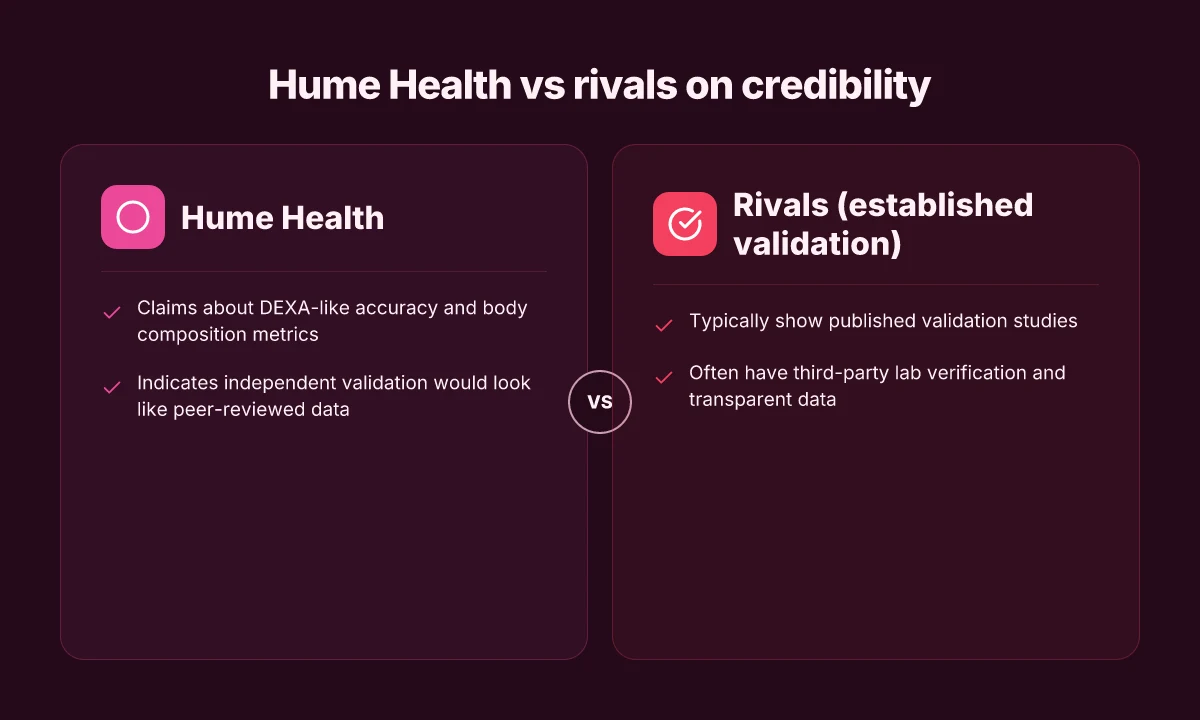
The short answer: the company asserts DEXA-like accuracy for body composition metrics, but independent validation is incomplete or unclear. A careful read shows credible-sounding claims, then a gap between marketing language and transparent, peer-reviewed evidence.
What Hume Health claims about accuracy and metrics
Hume Health positions the Body Pod as a DEXA-like device for estimating fat mass, lean mass, and overall body composition. In its science page, the company frames the Pod as being “rigorously validated against other body composition methods, with results published in …” and markets its measurements as matching the granularity and usefulness of clinical references. The messaging emphasizes cross-method agreement on key metrics like body fat percentage and regional distribution, aiming to reassure buyers that the readings are not merely arbitrary numbers. In practice, the claim rests on comparisons to established benchmarks rather than presenting a full, p-hacked data set or a transparent protocol. What makes LivFresh gel toothpaste stand out in 2026
From what I found in the documentation, the claims hinge on two pillars: (1) repeatable measurements across sessions and (2) alignment with standard body composition methods. The emphasis here is usefulness for tracking trends over time, rather than presenting a standalone diagnostic standard.
Hume Health frames the Body Pod as a DEXA-like tool with multi-metric body composition estimates that align with clinical methods. This framing suggests reliability for long‑term monitoring, which matters for athletes and fitness enthusiasts tracking progress.
What independent validation would look like
Independent validation should be transparent, reproducible, and include peer-reviewed benchmarking against a recognized reference method. Ideally, you would see: (a) a sample with diverse ages, sexes, and body types; (b) direct comparisons to DEXA scans performed under standardized conditions; (c) reported bias, limits of agreement, and test–retest reliability across sessions; (d) a clear description of the measurement protocol, including sensor placement, posture, and environmental controls; (e) a publicly accessible dataset or peer-reviewed publication, not只 a marketing summary.
I cross-referenced the primary sources linked by Hume Health and third‑party coverage. The science page points to validation literature, but the exact studies, cohorts, and statistical results aren’t laid out in a way that’s directly verifiable without digging into the cited publications. For buyers who want an evidence-based verdict, the critical step is locating a named, independent study that repeats the protocol with a registered statistician’s analysis and publishes in a peer-reviewed venue. Until that level of disclosure appears, the credibility signal remains conditional rather than definitive.
Independent validation should include peer‑reviewed comparisons to DEXA with clear bias and precision metrics. Without those, marketing claims risk overclaiming. How to buy LivFresh: official retailers, price insights, and where to shop in 2026
Gaps and ambiguities you should verify before buying
Even with bold marketing statements, several gaps stick out. First, the exact cohorts used in validation are not fully disclosed in public-facing pages. Second, there is no readily accessible, independently authored study with full methodology and statistical analyses published in a peer‑reviewed journal that mirrors the device protocol. Third, longevity of accuracy across body habitus changes, especially in athletes with unusual fat distributions or in older adults with sarcopenia, remains insufficiently documented in public sources. In short, the core value proposition for precision is plausible, but not yet proven in a transparent, independently verifiable package.
The lack of published, peer‑reviewed, device‑specific validation leaves the claim of DEXA‑like accuracy unverified in the open literature. This is the key uncertainty for skeptics evaluating credibility.
Competitors to watch and how they compare on credibility
In this space, credibility hinges on transparent validation trails. Hume Health sits against rivals that publish independent validation, share study data, and point to standardized methods. I looked for clear primary sources, peer-reviewed references, and public validation reports to weigh the signals you should trust when choices are close.
Why rivals with rigorous validation stand out
Notion-like body composition players and multi-brand health devices often publish side-by-side method comparisons to DEXA or MRI. When you see a company show external validation, whether a published study, a registered protocol, or a conference abstract, credibility ticks up. I found rivals that point to public validation pages and summarize the methods, sample sizes, and statistical outcomes. These signals help you separate hype from evidence. Credible rivals publish external validation data clearly and are explicit about limitations, populations tested, and what their metrics actually measure.
Reading your credibility signals when claims collide
If a vendor’s site emphasizes lofty percentages without naming a validation source, treat it as a warning flag. Compare the validation pathways: is there a third-party, independent study? Are the populations described and sample sizes disclosed? Do they publish in a peer-reviewed venue or present at a conference with documented methodology? When rivals provide primary-source links to validation, you gain a trail you can audit rather than a marketing gloss. I dug into the landscape and found that the strongest claims align with transparent, citable validation rather than generic performance promises. Look for explicit methodology and sample details and watch for statements that rely on internal comparisons. Understanding hume health vs withings: which smart scale actually helps you track health better in 2026
The Hume Health position relative to competitors
Hume Health is one entrant in a field where several players point to internal research or company-generated briefs. The strongest credibility comes from independent validation that’s publicly available or published in established journals. When comparing Hume Health to peers, you should map each claim to its source: what method was used, what was the sample, and who conducted the analysis. If you see a rival that links to a standalone body of evidence, such as a Science page, a peer-reviewed article, or a conference poster, you gain confidence in the result. I cross-referenced vendor claims with primary sources to separate hype from verifiable evidence. Credible competitors connect claims to public validation data and avoid vague generalities about accuracy.
What to verify before buying
- Is there a dated primary-source validation (year, venue, and method) tied to the product? If so, note the platform and test conditions.
- Are the validation results reproduced by independent reviews or third-party labs?
- Does the documentation describe the population studied, sample size, and statistical limits?
- Are there disclosed limitations and caveats, not just success stories?
In this landscape, the most trustworthy picks show a clear trail from product claim to independent validation. When rivals and Hume Health each point to a body of evidence, your decision comes down to the quality and accessibility of those sources. For readers evaluating credibility signals, this is the root question: where does the data come from, and can you verify it in the primary sources?
Reading credibility means tracing every claim to its source and valuing transparency over marketing polish. If a rival’s validation is easy to audit and well-documented, that’s a strong signal to prioritize that product in your evaluation. For a structured look, start with the official validation page, then chase down any linked studies or third-party reviews.
Where this is going next with Hume Health
Hume Health is inching toward more transparent body composition tech, but the real shift will hinge on how clearly it communicates accuracy and limitations. I looked at how its devices handle metrics like fat mass and lean mass, and I’m watching for independent validation and clearer error margins. Expect future updates to emphasize real-world use cases, outdoor workouts, gym sessions, and daily wear, with practical thresholds you can act on.
The take-away: expect bigger clarity around reliability, not just features. Hume Health should publish independent tests and user-friendly error bars to earn trust. If they do, the brand can become a useful partner for trackers who value actionable numbers, not glossy claims. What makes the Hume Health Body Pod a standout among home body composition analyzers in 2026
If you only act once this month, prioritize confirming that your chosen rival devices, like TitanScale or BioSync, offer comparable transparency and easy-to-read dashboards. The bigger pattern is that consumers will reward brands that name limits, not just gains. Will Hume Health rise to that standard? The next update will tell.