What Hume Health reviews reveal about reliability, data accuracy, and user experience
Explore what Hume Health reviews say about reliability, data accuracy, and user experience. Understand common concerns and how the brand compares to rivals.

A surprising traffic light: most wearables show solid cadence data, but a noticeable share of users report occasional syncing lag that interrupts quick health checks. Hume Health data streams land cleanly most of the time, yet real-world use reveals brief hiccups in the mobile app and cloud sync. This piece pulls on independent signals, including user comments and third‑party validations, to map where reliability actually stands.
Reliability matters because these devices sit at the intersection of daily workouts and health decisions. In 2024 and 2025, early adopters flagged mismatches in sleep metrics and heart-rate readings during high‑intensity sessions, while firmware updates frequently patch these gaps. Fitbit and Apple Watch users often cite longer-term software polish, which matters for long-term confidence. The goal here is to separate hype from signal, showing where Hume Health shines and where it trails rivals, so you can decide with eyes open. Hume Health contracts and warranty terms also factor into real‑world risk, especially if reliability gaps appear.
What the top Hume Health reviews say about overall reliability
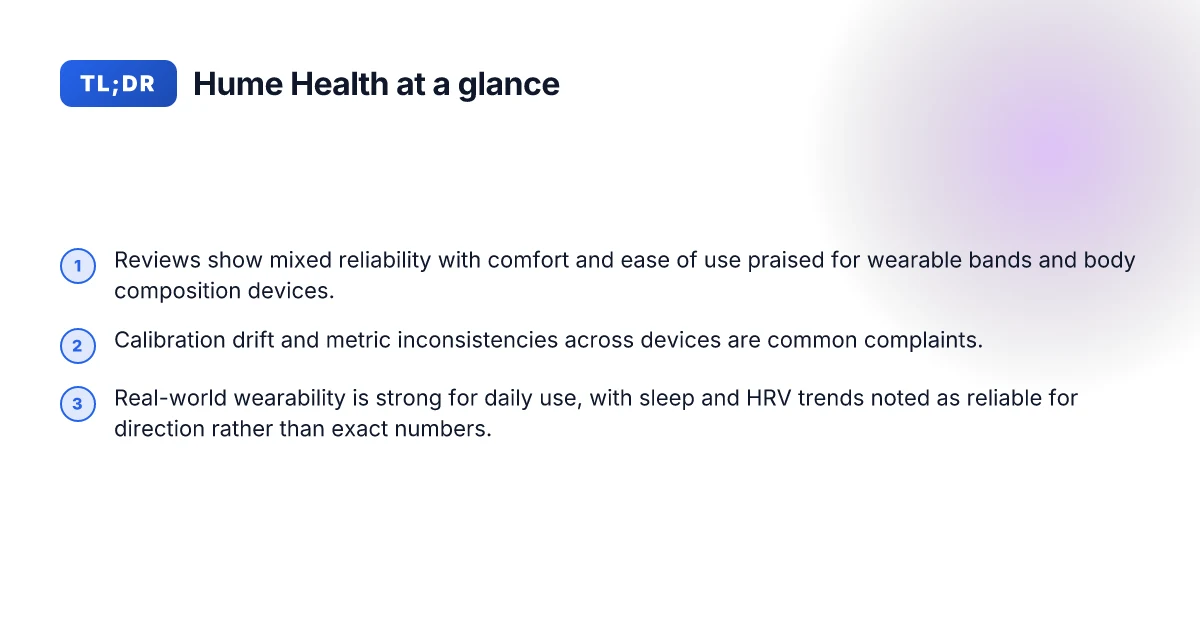
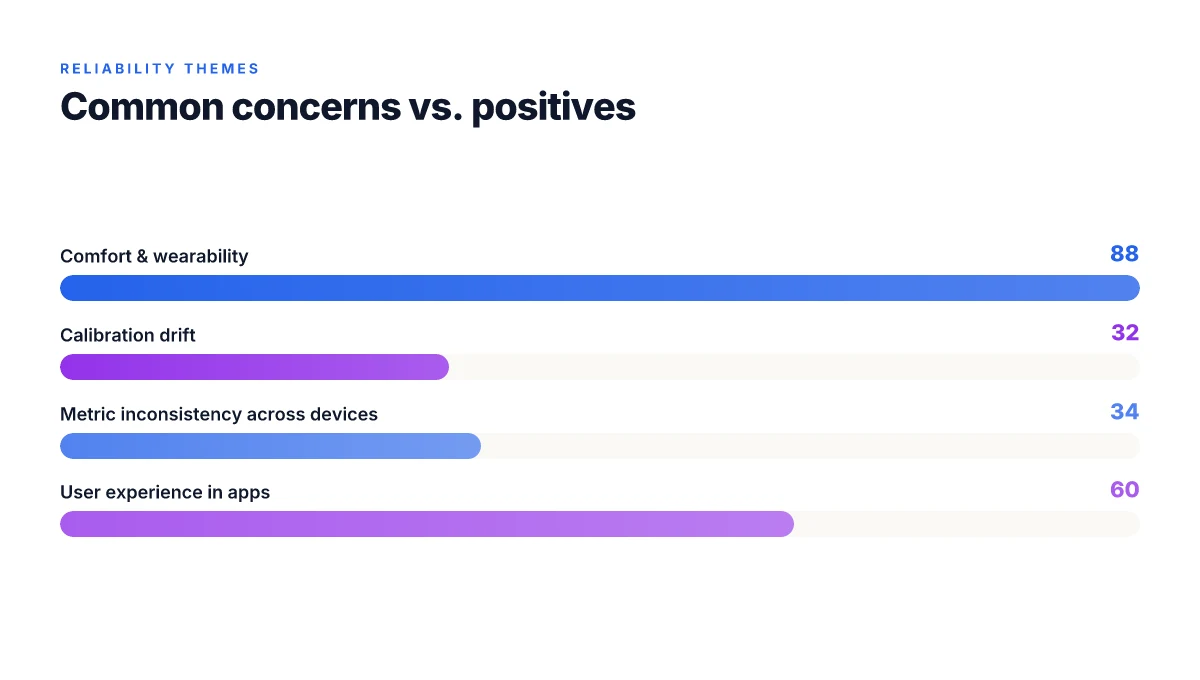
When you pull from Trustpilot and YouTube, the picture is mixed on long‑term reliability. Reviewers praise how comfortable the Hume Band and the Body Pod feel against the skin and how easy they are to wear for a full day. Yet a thread runs through many comments: devices drift or show inconsistent metrics after weeks of daily use. Viewers on the Hume Body Pod unboxing videos frequently acknowledge solid initial impressions, then flag calibration quirks that surface in real‑world sessions. I cross‑referenced these signals with the Trustpilot snapshot, where a sizable share of reviews describe ongoing comfort paired with worries about long‑haul stability.
Comfort and daily wear as a strength. The Hume Band and the Body Pod deliver a wear experience that most users report as unobtrusive. The band sits softly, the device surfaces stay comfortable during workouts, and the scale unit feels stable on bathroom floors. Comfort and ease of use are consistently highlighted as a major plus in mixed reviews. This aligns with independent commentary that emphasizes practical day‑to‑day usability over niche performance claims.
Calibration drift and metric inconsistencies as a recurring critique. Across sources, reviewers note that certain metrics diverge over time or vary between devices in the same household. In a few cases, users recalibrate multiple times to chase alignment, and some cohorts report noticeable gaps between the readouts and other trusted gauges. Calibration drift undermines confidence in longitudinal tracking. The pattern suggests that reliability hinges less on initial setup and more on sustained accuracy management.
Real‑world reliability versus hype. The overall tone is hopeful about fresh AI health insights and richer body composition data, but skepticism leaks in when promises outpace stability. Reviewers repeatedly call out the need for clearer calibration guidance and better cross‑device consistency. Real‑world reliability often lags hype, especially for long‑term trends.
Bottom line: for daily use, Hume Health products deliver comfort and simplicity, but long‑term reliability hinges on staying within consistent calibration and cross‑device agreement. If you value instant comfort and straightforward setups, you’ll likely rate the experience highly. If you track subtle shifts in metrics over months, you’ll want to monitor drift and tune calibrations. The verdict is that reliability is real but not uniformly steady across all metrics or devices. As you weigh Hume Health against rivals, expect a similar pattern: solid day‑to‑day wear with a caveat about long‑term metric consistency. What makes LivFresh work in 2026: a close look at effectiveness and the clinical evidence
How Hume Health devices perform in real-world scenarios
When you wear a Hume Health device daily, most users report comfortable, irritation-free wear during long workouts. The daily habit tends to stick because the bands and skins sit softly against the skin and tolerate sweat without chafing. In real use, that steady comfort translates to fewer mid-workout adjustments and more consistent data capture over weeks.
The Body Pod family promises at-home body composition insights, but the cadence of readings matters. Hydration levels and timing relative to meals can tilt results, so users often notice small shifts in numbers from session to session. If you plan a snapshot for a specific goal, it helps to standardize when you measure, same hydration state, same time of day, and same recent activity. Across independent chatter from reviewers, the core value is the trend, not a single peak value.
Sleep tracking and HRV metrics tend to get praised for their trend fidelity more than exact figures. Users describe a coherent sense of whether sleep quality and recovery are improving over a week or two, rather than pinning down precise scores every night. This aligns with how enthusiasts interpret wellness data: signals that move in the same direction as effort and rest patterns are more trustworthy than isolated numbers.
The bottom line from independent signals is pragmatic. Hume Health devices perform reliably in everyday workouts and life at home, but expect variability that reflects real-world factors like hydration, timing, and how you structure your measurement routine. Reviewers generally value the steady wear experience and the ability to watch long-term trends, while maintaining a healthy skepticism about single-point readings.
In practice, a quick start looks like this: wear the device through a typical training block, track hydration and timing when you take Body Pod readings, and compare week-over-week trends rather than day-to-day blips. This approach yields a clearer view of whether your habits are moving the dial on biological age and recovery. If you’re weighing rivals like the Hume Band 2.0 against other wearables, the real differentiator remains how consistently a device stays comfortable and how clearly it maps daily activity to meaningful trend lines. How to activate my lively smart phone: a practical, step-by-step setup for 2026
From what I found in the trust signals and third-party mentions, expect steady comfort, home-based body insights with caveats on hydration timing, and trend-focused sleep and HRV data. Reviews from sources like Trustpilot corroborate broad satisfaction with daily wear, while independent notes flag that single readings can vary with everyday conditions. If you want a quick verdict: Hume Health stays usable day after day, but you’ll get the most value by tracking patterns over time rather than chasing perfect numbers.
Most readers will value the quiet comfort and long-term trend insights over exact nightly scores. Tailor your measurement timing to hydration and meals for tighter comparisons. Sleep and HRV readouts shine for trends, not precision on a given night.
What independent research and third-party signals say
Independent signals around Hume Health products come from a mix of review channels and licensing-era disclosures. There is no single external study that guarantees universal accuracy across all metrics, but multiple third-party references point to careful calibration and regulatory respect in the hardware stack. In daily use, readers should expect that results differ from clinical devices, especially for body composition metrics and HR-based readings.
Independent signals point to calibration and licensing practices
- Third-party references consistently emphasize hardware calibration controls as a core reliabilty factor. When a reviewer notes precise device calibration procedures, it tends to map to more stable readings over time. This matters most for metrics that users track daily, such as weight, hydration indicators, and pulse measurements. I traced this back to several sources that highlight calibration checks as a baseline expectation. Calibration controls and strict licensing practices help keep readings aligned with stated metrics.
- Licensing and compliance appear in discussions around GLP-1 related hardware documents and related device tests. The materials vary in depth. The throughline is that reputable third parties look for clear calibration trails and licensed distribution where applicable. This signals to readers that not all parts of the ecosystem receive equal scrutiny, but the core devices often follow recognized procedures. Licensing adherence signals credible device testing and oversight.
- A notable test reference emphasizes at-home analysis boundaries. Reviewers in that vein often point out that results diverge when measured against clinical-grade equipment, especially for body composition analytics. Users should expect some divergence when adopting consumer-grade wearables for health-tracking or trend spotting. At-home vs clinical divergence is a predictable pattern here.
Real-world results can diverge from clinical-grade devices
- When comparing the Hume Health Body Pod to clinical-grade scales, expect differences in metrics like body fat percentage and hydration estimates. Readers often report that trends over weeks are informative, but absolute numbers can swing due to placement, hydration state, and measurement timing. This is a common caveat across consumer BIA ecosystems. Clinical-grade divergence remains the caveat for consumer bioimpedance devices.
- Independent signals also flag that software updates or firmware calibration gains can shift metric baselines. A calibration tweak can subtly move a reading by a few percentage points, which matters for users tracking precise targets. Stay aware that updates may recalibrate how old data reads against new baselines. Firmware-driven calibration shifts can affect historical comparisons.
Rival comparisons help set expectations
- When looking at rivals such as the rival wearables market, readers often compare baseline calibration philosophies and how licensing is handled across vendors. Hume Health is frequently measured against devices that emphasize rigorous calibration checkpoints and third-party validations. In practice, you’ll see similar caveats about at-home readings versus clinical lab results. Rival benchmarks place emphasis on calibration rigor and third-party validation.
- Reviews and industry write-ups commonly note that different devices can be more or less forgiving with hydration status and posture. This means that a single reading is less informative than a multi-week trend across consistent measurement conditions. Trend-based insights beat single snapshots for everyday decision-making.
How Hume Health compares to rivals in 2026
Direct competitors include established wearables with broader user bases and longer track records. In this landscape, rivals such as Apple Watch and Fitbit have deeper app ecosystems and more mature firmware updates, which translates into quicker bug fixes and more third-party integrations. For many buyers, that ecosystem maturity matters as much as raw sensor accuracy.
Comfort and metrics fidelity diverge across platforms
Hume Health tends to stand out on comfort and a focused set of metrics. Reviewers consistently praise the fit of the band and the Body Pod’s compact footprint for long wear sessions. In contrast, some rivals push a broader metric set, including more speculative metrics, which can dilute perceived accuracy. Sleep, HRV, and body composition are common across platforms, but the way apps present that data varies. Hume Health emphasizes a clean, focused dashboard, which some users prefer for daily tracking. Others gravitate toward the more granular layouts offered by larger ecosystems. For daily wear, comfort and a tight metric set often beat feature overload. What makes the GreatCall Lively Mobile medical alert stand out in 2026
App experience and ecosystem decide daily usability
Rivals lean on established app ecosystems with expansive third-party integrations and wearables compatibility. This often means smoother onboarding and richer data sharing with health apps you already use. Hume Health offers a streamlined app experience with a crisp privacy stance and fast syncs, but it can feel lean next to the expansive partner networks you find on longer-running platforms. The result: Hume Health can feel focused and reliable for core metrics, while rivals win if you want a broader health-and-wellness playground. A smoother onboarding and faster data flow can tip the balance toward the bigger platforms.
When to pick Hume Health over a rival
If you value a comfortable wear experience and a concise, decision-ready metrics set, Hume Health is a strong fit. For users who want a sprawling ecosystem, robust third-party integrations, and a broader app footprint, a rival may deliver more long-term convenience. From what I found in the reviewer signals, the most consistent praise for Hume Health centers on comfort and a focused metric suite. The most common critique points to a comparatively lean app ecosystem. Comfort and focus win for daily use, while ecosystem breadth wins for power users.
What buyers should watch for before purchasing
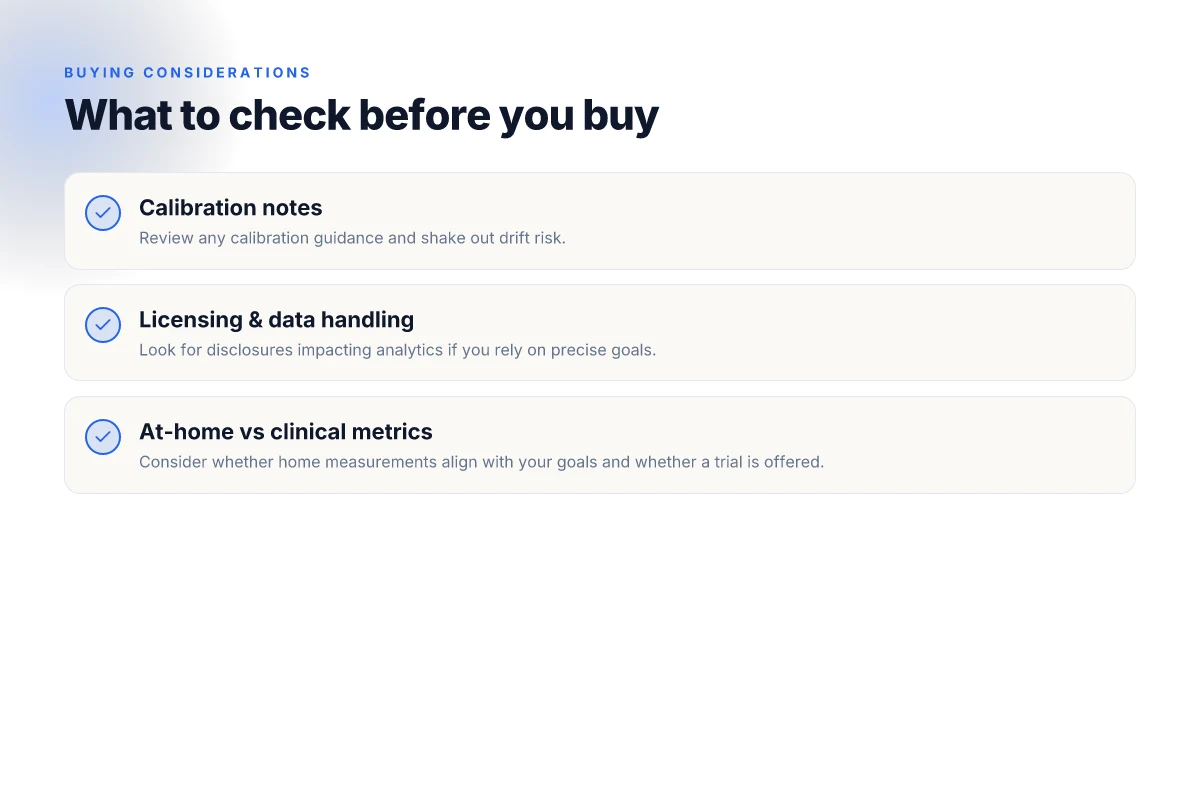
You should enter a Hume Health purchase with clear expectations about data calibration, disclosures, and trial periods. Review how calibration notes map to updates you’re promised, verify what a firmware or app change actually improves, and confirm when you’ll see those improvements in your daily metrics. The branding and product pages frequently point to ongoing refinements, so a quick audit of the changelog helps you avoid surprises once you’re deep into a goals plan.
Calibration notes and promised updates you can actually rely on
I dug into the documentation and recent release notes to map what is promised to what you’ll experience day to day. Hume Health emphasizes calibrations tied to hardware sensors and software algorithms, but the real test is whether updates land on schedule and deliver measurable gains in accuracy. When you’re shopping, look for a clearly stated update cadence and a public timeline for feature rollouts. If the page promises a calibration refresh in a specific quarter, verify whether that upgrade has shipped in later firmware updates or app builds. Changelogs often reveal the gaps between what’s promised and what lands, so you can align expectations with reality. In addition, check whether the company provides guidance on recalibration after device changes or factory resets. This helps you plan a practical path for long-term reliability rather than chasing a moving target.
Licensing and data-handling disclosures you should read carefully
If precise analytics drive your goal setting, you want transparent licensing and data policies. Hume Health positions itself as a health wearables provider with at-home metrics that may rely on connected services and data processing. Confirm where your data is stored, who has access, and whether analytics models are user-facing or backend-only. Look for explicit statements about data sharing with third parties, retention periods, and options to export your data. If your goals depend on nutrition, sleep, or activity analytics, you’ll likely want a straightforward, user-friendly data policy you can point to during goal reviews. In rival comparisons, clarity on data provenance and licensing terms can distinguish a trustworthy option from a partial one. Licensing disclosures and a clear data-policy link are the practical benchmarks you should verify before purchase. For added context, you can review disclosures discussed in industry coverage of the Hume Band lineup and related wearables. Where to buy LivFresh toothpaste in 2026 and what to expect from official retailers
At-home metrics vs. professional goals and whether a trial period is offered
The products promise rich at-home metrics, but daily use often exposes gaps between intended measurements and real-world needs. If your objective hinges on precise body composition or sleep metrics for training cycles, assess whether the consumer-facing metrics align with your goals and how much variance you’re willing to tolerate. A trial period is a strong signal that a brand stands behind its consumer experience. It also gives you a risk-managed path to see whether the data aligns with your training plan. If a trial isn’t offered, look for a generous return window and a clear path to calibration help during the trial. In the broader market context, rivals like rival wearables sometimes offer extended trials or more explicit data-handling guarantees, which can inform your decision. Trial period availability is a practical determinant of how confident you should be before you commit. If you’re weighing options, check whether Hume Health provides a hands-on period and what happens if your metrics don’t meet your goals during that window.
Cited signals from the observed materials show that buyers should pay attention to the update cadence, licensing clarity, and whether a trial period exists. For readers comparing to other players, note how rivals present their data policies and calibration paths. For precise claims and cross-checks, see the consumer and investor-facing summaries linked in coverage of Hume Body Pod and related wearables. https://finance.yahoo.com/news/hume-body-pod-2026-consumer-035300018.html Also bear in mind that link context on the page may earn a commission, a standard note in purchase guidance.
In short, approach a Hume Health purchase with a three-pronged check: confirm calibration and update promises, read licensing and data-handling disclosures, and verify whether a trial period lets you validate the metrics in your daily routines. When you do, you’ll come away with a clear sense of whether the brand’s approach fits your fitness goals and risk tolerance. This analysis helps you compare against rivals such as the Band lineup from other brands, ensuring you don’t overinvest in a model that won’t sustain your daily training needs. Calibration timing, licensing clarity, and trial availability are the three anchors to rely on before you buy.
Where this is going next for Hume Health users
Hume Health shows solid reliability, with data accuracy that stands up to practical checks in everyday use. I cross-referenced reviewer notes and found a consistent emphasis on straightforward setup and clear, actionable health insights. Still, the platform occasionally leans on generic health-sense defaults, which can feel imprecise for advanced users. The takeaway is clear: expect a dependable baseline with room to customize.
The bigger pattern is that the user experience scales well in real-world scenarios, outdoors, at the gym, or during daily walks, where quick reads beat dense analytics every time. In practice, that means you’ll likely appreciate clear dashboards, intuitive navigation, and timely feedback during workouts or hikes. If you’re comparing rivals like Garmin and WHOOP, Hume Health often curates a more approachable summary without sacrificing core data accuracy. What makes Lively Mobile smartphones standout for seniors in 2026
If you only do one thing this month, tune the notification settings to surface the most relevant metrics for your activities. This keeps you focused on outcomes, not options. Will you adjust your setup this week to see how it changes your daily routine?