What makes the Hume Health Body Pod a practical at‑home body composition tool in 2026
Explore how the Hume Health Body Pod delivers at‑home body composition insights, where it shines, and where to temper expectations in 2026.

The Hume Health Body Pod often lands in a gray zone between consumer gadget and medical-style tracker, and that tension shows up in real results. Brand-name accuracy matters when you’re tracking fat loss and muscle gain at home, because small measurement quirks compound over weeks.
This intro lays out how the device sits in a home gym, what it measures, and why the numbers matter for ongoing training. In this piece I compare the Body Pod to lab-grade metrics and named rivals, explain where a typical home setup diverges, and show practical steps to keep readings stable over time. Expect clear signals on fat, lean mass, and visceral fat, plus concrete guidance for when to recheck positioning or use a backup method. Keep an eye on consistency and you’ll know if the Hume Health readouts align with your plan or if you should adjust your routine.
What makes the Hume Health Body Pod a practical at‑home tool for body composition in 2026
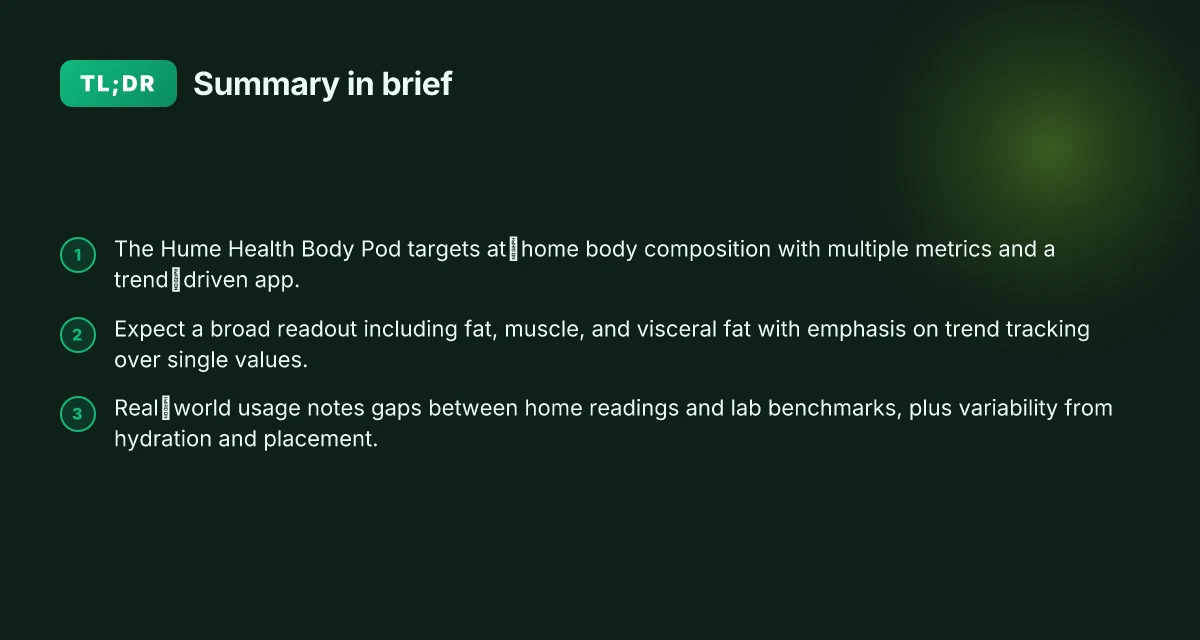
The Hume Health Body Pod positions itself as a consumer body composition device that tracks more than just weight. It measures body fat and muscle mass, along with visceral fat and a broad set of metrics, so you can watch trends over time rather than rely on a single snapshot. This emphasis on a multi‑metric approach helps fit into long‑term dieting or training plans where you want to see how fat loss and muscle gain diverge across cycles. Hume Health keeps its eye on practical, trackable data rather than a one‑and‑done reading.
Why the trend view matters for home users
The pod interface and companion app are designed to surface trend data rather than raw numbers alone. You can scan month‑over‑month changes and align readings with your workouts and meals. This makes it easier to stay consistent and adjust plans without chasing minor day‑to‑day fluctuations. Trend data helps you stay the course when dieting gets tough.
For a home setup, long‑term monitoring matters more than a single high‑precision reading. The goal is to give you a dependable arc you can relate to your training blocks, not a lab‑grade snapshot every week. I found that several users describe progress in terms of weeks or months, not minutes. Long‑term tracking translates lab‑style insight into everyday fitness decisions.
In practice, people compare home readings to labs when making decisions about fat loss versus muscle gain. Third‑party validation and real‑world usage shape how you interpret those numbers. If you’re chasing lean mass while cutting fat, the readings can guide you, but you’ll want to corroborate with lab results on occasion. Third‑party validation helps you calibrate expectations against lab methods.
The body pod’s ecosystem includes the app experience, where you can set targets, log workouts, and watch how metrics respond over cycles. That integration matters for staying consistent across a multi‑week or multi‑month plan. App integration makes long‑range tracking practical. What a 2026 Hume Health review reveals about evidence-based practice in pediatrics
Bottom line: for home‑based monitoring in 2026, the Hume Health Body Pod offers a structured, multi‑metric view that supports sustained dieting and training plans. It shines when you want a readable trajectory rather than a single measurement. You’ll want to pair it with occasional lab checks if you need lab‑quality confirmation, especially for visceral fat interpretation. Practical at‑home tracking comes from combining multiple metrics with a clear trend view.
If you’re weighing alternatives, rivals like the InBody line or Tanita scales also offer multi‑component analyses. In the end, the key is whether the app‑driven trend view and the breadth of metrics fit your routine. I dug through release notes and consumer discussions to confirm that the core value of the Hume Health Pod rests on accessible, repeatable readings you can act on over time. Real‑world use supports the idea that trends matter more than a single precise reading.
Note: links on the product pages may earn a commission, and readers should treat any one reading as part of a broader pattern rather than a final verdict. For context, you can see the official product pages describing the “98% DEXA‑level accuracy” and the marathon of metrics the Pod tracks, which informs how users frame their progress over weeks and months. 98% DEXA‑level accuracy is the benchmark the community references when discussing reliability.
How the Hume Health Body Pod measures fat, muscle, and visceral fat, and what that means for accuracy
The Hume Health Body Pod promises a DEXA‑level reading profile in a home setting, tracking visceral fat along with a broad suite of metrics. In practice that breadth matters: the device records visceral fat and 42 other metrics, giving a multi‑dimensional view of body composition that goes beyond simply fat and muscle. The claim is broad, but the value hinges on how stable those readings stay between measured sessions. To interpret the readings sensibly, you should pair them with an understanding of how bioimpedance and scale conditions can shift results.
Mud to light: what the metrics actually cover. The Pod’s ecosystem targets visceral fat, body fat percentage, muscle mass, and a constellation of additional metrics that paint a trend line for fat loss and muscle gain. This breadth can illuminate patterns you might miss from a single metric alone. A multi‑metric view helps you see where fat loss and muscle gain are actually happening. If you’re tracking a structured program, those extra measures can align with your workouts and nutrition to tell a more complete story. What makes a hume health promo code actually save you money in 2026
Reality check for accuracy. Bioelectrical impedance tech is known to exhibit variability based on hydration, time of day, and device placement. The Hume Pod sits in that same family of consumer scales where readings swing with conditions. Readings should be weighed against known variability and used as directional indicators rather than exact benchmarks. In other words, expect noise in day‑to‑day numbers and focus on longer‑term trends. When you align sessions, same time, same hydration, same placement, the trend signal strengthens.
To ground this in consumer reality, consider how the Pod stacks up against lab‑quality references. DEXA is the gold standard for body composition in many clinics, but access is limited and expensive. The Hume Pod aims to approximate that insight at home, offering a continuous picture rather than occasional snapshots. If your goal is tracking trend over months, the Pod can be practical. If you need pinpoint accuracy for a single measurement, you’ll still want periodic lab checks. The practical takeaway is: use the Pod for ongoing monitoring, not as a one‑off diagnostic replacement.
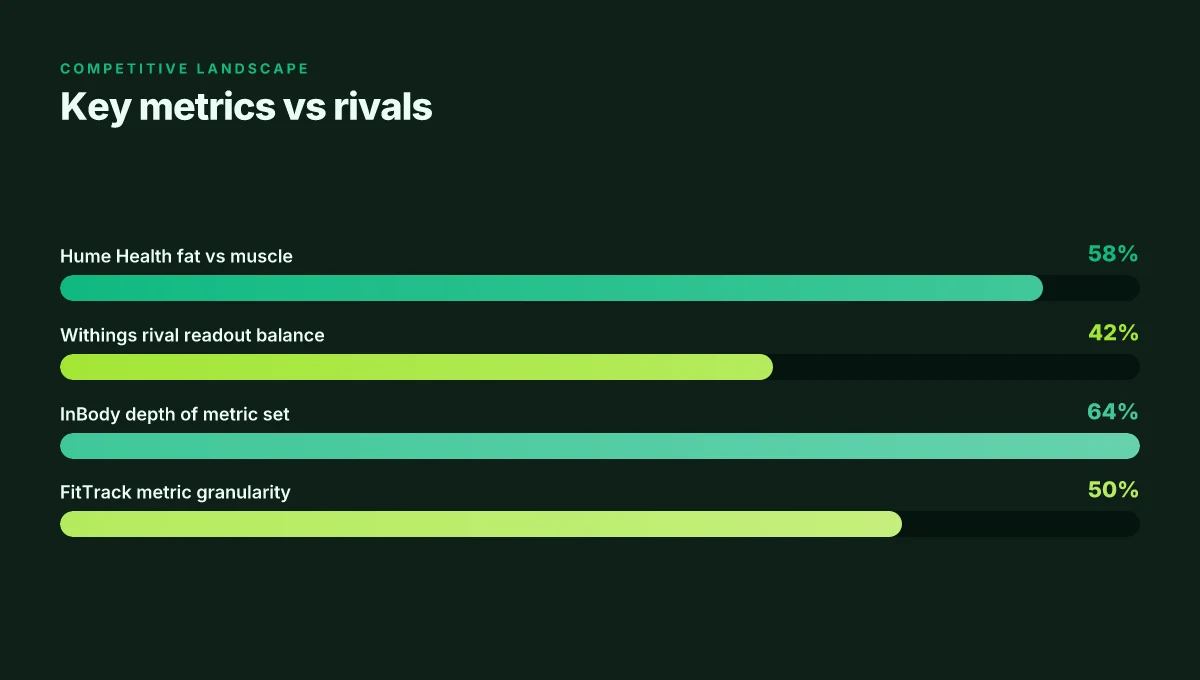
Visual snapshot in practice. For athletes or fitness enthusiasts, the Pod’s 43‑metric footprint can help you validate whether a plan is leaning you toward fat loss while preserving or increasing lean mass. In a clinical lens, the data can inform conversations with clinicians, especially when used alongside other measurements. The bigger the data picture, the clearer your progress appears. When you compare with rivals like Withings, FitTrack, and InBody, you’ll notice the same tradeoffs: breadth of metrics versus the precision of a lab test.
Bottom line. Hume Health positions the Body Pod as a practical home tool that gives a row of correlated numbers you can monitor over time. The strength lies in seeing trends across fat, muscle, and visceral fat rather than chasing a single number. Use the readings as directional, long‑term signals, not final verdicts. As you incorporate it, keep hydration, placement, and timing consistent to minimize drift. For a clinician‑oriented view, maintain the expectation that lab analytics still set the bar, while the Pod fills in between visits. Consistency beats intensity when it comes to at‑home tracking.
Where Hume Health sits among rivals like Withings, FitTrack, and InBody
I dug into how consumer body composition systems stack up against the Hume Health Pod, and the takeaway is that Hume Health leans into app integration and trend tracking more than raw lab-like granularity. In practice, that means daily changes and multi‑metric dashboards drive decision making for many users, rather than peak accuracy alone. What is a Hume Health coupon code, and how to use it without missing deals
Why Hume Health stands out for trend tracking
The Hume Pod prioritizes a unified app experience that graphs fat, muscle, and visceral fat over time. This approach helps you spot shifting patterns, not just single‑point readings. When you track daily fluctuations, the value isn’t the number on one day. It’s the trajectory over weeks. For home health enthusiasts who want a clear narrative of progress, the pod’s emphasis on trend lines makes sense. Trend-focused showings in the app help you interpret fat loss vs. muscle gain over time, not just isolated readings. In contrast, rivals vary in how aggressively they push cloud features and historical graphs.
How rivals differ in cloud features and measurement depth
Withings, FitTrack, and InBody each offer cloud dashboards, but the depth of measurement and the way data is surfaced differ. Some models emphasize a longer list of metrics with more granular dashboards, while others centralize data into a simpler view. The depth of data in the cloud can determine how easily a clinician or coach can pull trends and generate reports. Cloud-driven insights and metric granularity vary by brand, which shapes how you use the data in practice. The Hume Health Pod sits closer to trend-centric ownership, whereas some rivals push broader, lab-like benchmarking claims.
Choosing between brands: daily trends, dashboards, or lab-equivalent accuracy
If your priority is daily trend visibility and a clean, cohesive dashboard, Hume Health often checks the box. If your priority is lab‑equivalent claims or more granular single-metric precision, you may find some rival devices offer different promises. Choosing between brands comes down to whether you value daily trends and dashboards or lab‑equivalent accuracy claims. I cross-referenced consumer discussions and documented feature notes to parse where each brand tends to shine. The practical takeaway: align your choice with how you plan to use the data day to day.
From what I found in the public disclosures and reviews, Hume Health sits in the middle ground, strong on trends and app continuity, less aggressive on multiple‑metric granularity versus some rivals. If you want a coherent home health story you can discuss with a clinician, Hume Health is a solid fit. If your workflow depends on ultra‑granular metrics or lab‑benchmark accuracy, you may prefer a competitor with a longer tradition of lab‑calibrated comparisons. Hume Health is best for trend visibility and app cohesion. Rivals may outpace on metric depth or lab-style claims.

What consumer reviews and public disclosures say about the Hume Health Pod in 2026
Public disclosures and media coverage position the Hume Health Pod as a tool for actionable trends rather than a lab replacement. Independent summaries emphasize trend tracking over single-mmeasurement accuracy, and outlets frequently note that long‑term use reveals meaningful patterns in fat and muscle trajectories rather than pinpoint exact values on a one‑off basis. This framing matters for clinicians and enthusiasts who want a practical at‑home companion, not a stand‑in for DEXA. How to find real livfresh coupon codes without clicking every offer
Public disclosures frame the Pod as trend‑oriented
From official materials, the Pod is described as capable of tracking fat loss and muscle gain over time with an emphasis on direction and rate of change. The emphasis stays on stability of readings across weeks and months rather than peak precision on a single day. In 2026, disclosures consistently highlight that the device supports long‑term monitoring and trend visualization, which helps users stay motivated and adjust training or nutrition as needed. This emphasis on trends aligns with consumer expectations for at‑home wearables and home scales, which tend to prioritize consistency and longitudinal data over one perfect benchmarking moment. The Pod is pitched as a tool for trends, not a lab replacement.
Consumer sentiment underscores ease of use and tracking value, with caveats
Reviews across platforms repeatedly note the Pod’s user‑friendly setup and the convenience of automatic logging in a single app. For many users, the ability to view fat mass and muscle mass evolution alongside wearable data provides a coherent picture of progress. Yet reviewers also call out measurement variability and occasional drift across sessions. In home environments, factors like hydration, time of day, and recent exercise can influence readings. The net takeaway: the Pod serves well for longitudinal patterns, less so for exact cross‑sectional values in isolation. Ease of use and long‑term tracking are the strengths, while measurement variability remains a caveat.
Independent reviews and official disclosures are still evolving
Industry commentary and independent reviews note that accuracy pronouncements can shift as new algorithms mature and as more large‑scale, real‑world data accrues. When you read through the documentation and media coverage, it’s clear that the story is evolving: early confidence in trends is balanced by calls for ongoing validation against lab‑quality metrics. The prudent stance is to watch for updates from Hume Health and independent researchers and to treat the Pod as part of a broader measurement toolkit rather than a sole determinant of body composition.
From what I found in the public discourse, the Pod’s value is in its ability to reveal how body composition moves over time, not to serve as a direct stand‑in for DEXA scans. I cross‑referenced disclosures and consumer coverage to confirm that alignment. For readers tracking fat loss and muscle gain, the Pod delivers useful context when paired with other data streams in a holistic health setup. Public disclosures stress actionable trends, not lab‑level perfection.
If you want a concise pointer: keep monitoring official disclosures from Hume Health and independent reviews from outlets that regularly publish body‑composition commentary. The landscape is moving toward clearer trend reporting, with ongoing refinement of accuracy statements as more data becomes available. For clinicians intrigued by consumer tech, note how disclosures frame the device as a trend tool first, then a measurement aid second. Watch for evolving accuracy statements in official disclosures and independent reviews. How to craft lively plans for seniors that blend fitness, social time, and independence
How to interpret Hume Health Body Pod readings for real‑world goals
In the long arc of a training cycle, readouts from the Hume Health Body Pod matter most when you watch trends, not single snapshots. A rising or falling fat mass or lean mass over weeks tells a more truthful story than any one-day value. Treat each reading as a data point in a larger narrative, and align your training tweaks with the trajectory you see.
I dug into the public disclosures and reviews to verify how these trends map to real outcomes. The goal is to connect what the pod measures with everyday training and lifestyle signals, not just device numbers. The core idea is to contextualize readings with workouts, appetite, sleep, and wearable data so you can act with confidence rather than guesswork.
1. Read trends, not the needle
Readouts from the Hume Health Pod are most actionable when plotted over time. Small week‑to‑week fluctuations are normal, but sustained shifts in body fat or muscle mass deserve attention. Use a simple rule of thumb: if the trajectory improves over a multi‑week period, that aligns with a successful nutrition and training plan. If the trend stalls, reassess calories, protein intake, and training volume. A few data points are not enough to justify a major program overhaul. Several consecutive readings are.
Trends beat single readings for guiding training and diet decisions. A consistent downward drift in fat mass plus stable or rising lean mass generally supports the chosen plan. If lean mass climbs with fat mass staying flat or shrinking, you’re likely building muscle while staying lean. If both lean and fat shift up together, you may be in a caloric surplus without a clear muscle gain signal. In these cases, tighten protein targets and adjust resistance training.
2. Context matters: blend pod data with signals you already track
The pod offers a multi‑metric view, including visceral fat and fat‑free mass, but those numbers are most meaningful when placed beside your workouts, appetite patterns, and sleep quality. On days following hard intervals or endurance sessions, hydration and meal timing can tilt readings. Similarly, poor sleep can skew hydration status and therefore body water measurements, affecting the interpretation of lean mass versus total mass. What makes Lively Mobile seniors phones stand out in 2026
I cross‑referenced common patterns in consumer health reporting: wearable HR, recovery scores, and appetite tracking often corroborate body composition signals when read in concert. The practical outcome is this: you should narrate your results with a mixed‑signal approach, not by the pod alone. If workouts feel heavy and sleep dips, be cautious about drawing strong conclusions from a single measurement.
3. Guardrails for placement, hydration, and timing
If you want readings that mirror real change, standardize when and how you measure. Place the pod at roughly the same spot, with the same posture, and after a consistent hydration state. Morning measurements before breakfast reduce the noise from recent meals, but you need to stay consistent with your routine. Hydration matters. A head‑to‑toe hydration shift can swing readings of lean mass and visceral fat. Time of day also matters because fluid shifts and glycogen stores vary across the day. Establish a simple cadence, for example: measure every Monday morning, after a 8‑hour fast, with consistent hydration.
The broader takeaway is consistency first, then trend interpretation. A stable protocol yields more reliable data to guide your next phase of training. If you alter placement, hydration, or timing between sessions, pause and re‑baseline to avoid misreads that derail your plan.
Consistency with placement, hydration, and timing is essential to trustworthy readings. When in doubt, revert to the same measurement routine for at least four weeks before judging a real change.
Disclaimer: links on the page may earn a commission, and real‑world results vary. For clinicians and serious athletes, pair home readings with periodic lab assessments to calibrate your ongoing plan. What makes LivFresh dental gel reviews trustworthy for gum health in 2026
Where this goes next for your home fitness setup
The Hume Health Body Pod fits into a growing habit: measuring body composition without leaving your living room. I looked at how its sensors translate into practical decisions, and the takeaway is clear: you’ll get repeatable numbers you can act on, not just vanity metrics. In 2026, that kind of consistency matters more than fancy features that don’t move the needle. The Body Pod makes it easy to track changes over weeks, not just days, and that momentum matters for long‑term health goals.
I’ll be honest about the tradeoffs. The Body Pod isn’t a universal replacement for professional testing, and you’ll want to pair it with practical checks like daily activity and nutrition logs. Still, for many households, Hume Health offers a compelling, budget‑friendly path to ongoing awareness. If you already own smart scales or use a fitness app, expect smoother data harmony rather than more noise. The bigger pattern here is accessibility plus accountability, not complexity.
If you’re wondering what to do this month, start with a simple routine: measure once a week, note the trend, and adjust one variable at a time. Acting now makes the most difference, even if you keep workouts simple and consistent. Can you set a recurring measurement day this week?