Cisco AnyConnect: What It Is, How It Works, and Why ZoogVPN Recommends It
A practical guide to Cisco AnyConnect, its uses, installation tips, and why ZoogVPN is the trusted companion for secure remote access.

Cisco AnyConnect has been a staple in enterprise and hybrid work environments for years. It started as a secure mobility client designed to give employees authenticated, encrypted access to corporate networks from anywhere. Over time, Cisco expanded the product line to include Secure Client capabilities, including zero-trust network access (ZTNA) features, posture checks, and robust endpoint security. In practice, Cisco AnyConnect is most commonly used in business contexts, but individuals and small teams may encounter it as part of a workplace setup or through a managed security service. This article walks you through what Cisco AnyConnect is, how it’s typically used, how to install it, common questions, and how ZoogVPN fits into the picture for private, secure browsing.

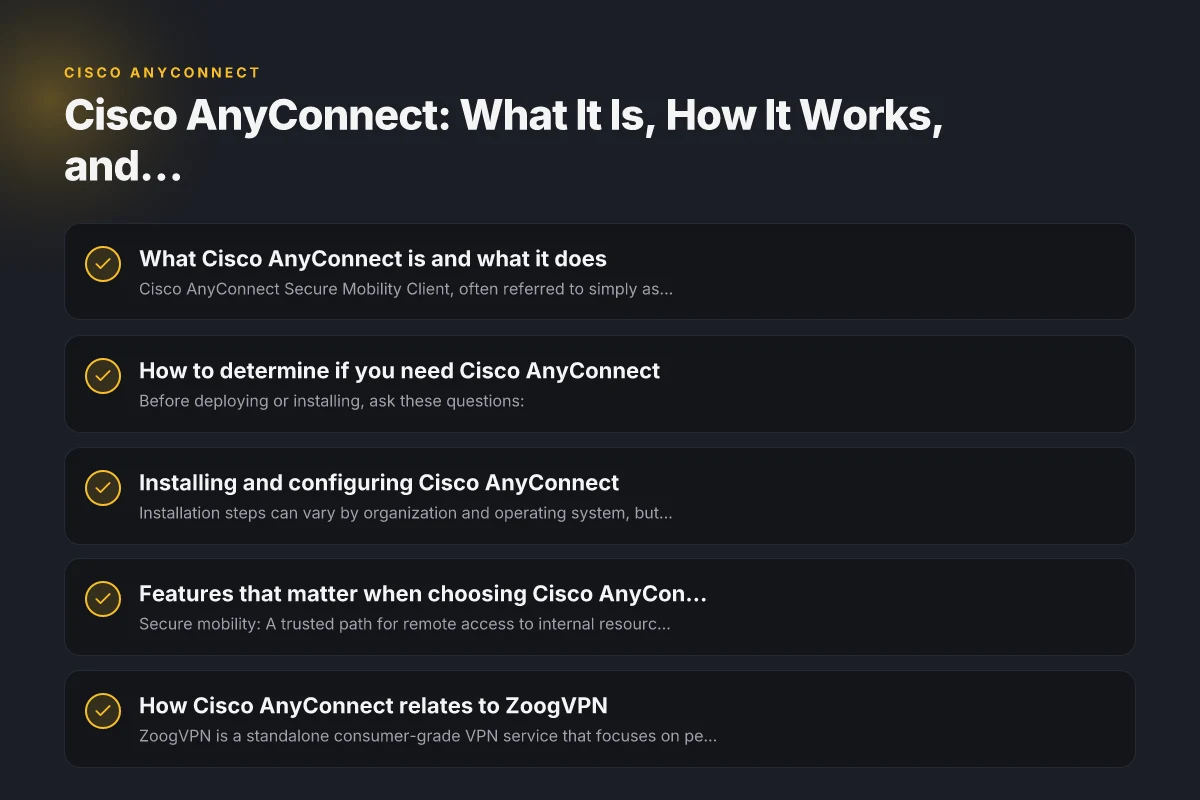
What Cisco AnyConnect is and what it does
Cisco AnyConnect Secure Mobility Client, often referred to simply as AnyConnect, is a VPN client designed to create a secure, encrypted tunnel between a user’s device and a remote network. Key purposes and capabilities include:
- VPN access to corporate networks, cloud services, and internal resources
- Endpoint security features that help enforce security policies on devices
- Collaboration with Cisco Secure Client, which includes broader ZTNA and secure access capabilities
- Cross-platform support, including Windows, macOS, Linux, iOS, and Android
How it’s typically used:
- Remote employees connect to their company network to access files, intranets, and apps as if they were on-site
- IT teams deploy and manage client software configurations, certificates, and policies
- Organizations combine AnyConnect with identity providers and MFA to strengthen authentication
If you’re evaluating whether AnyConnect is the right fit, consider the scale, whether you need ZTNA-style access, and how you’ll manage endpoints and policies across devices.
How to determine if you need Cisco AnyConnect
Before deploying or installing, ask these questions:
- Are you managing employee devices that require encrypted connectivity to internal resources?
- Do you need centralized policy enforcement, device posture checks, or malware/attack surface reduction features?
- Is your organization already using Cisco Secure Client and other Cisco security products?
- Do you require reliable multi-platform support and enterprise-grade reliability?
If you answered yes to most of these, Cisco AnyConnect (or the Cisco Secure Client with AnyConnect components) is a strong fit. For individual consumers without a corporate VPN, there are other consumer-grade VPNs and private browsing solutions. Keep in mind that licensing and deployment schemas for AnyConnect are typically geared toward organizations rather than single users. Cato client: what it is, how it works, and how it compares to VPNs like ZoogVPN
Installing and configuring Cisco AnyConnect
Installation steps can vary by organization and operating system, but common patterns include:
- Obtain the installer from your IT department or Cisco’s support pages
- Install the Cisco Secure Client (which includes AnyConnect capabilities) on your device
- Configure a VPN profile or import a connection entry that points to your company’s VPN gateway
- Authenticate via corporate credentials and, if enabled, complete MFA
- The client may perform posture checks to verify device security status before granting access
For those managing their own devices outside a corporate environment, you may encounter limitations or licensing constraints. Always follow your organization’s IT guidance or Cisco’s official documentation for the exact steps and required certificates, policies, or profiles.
Features that matter when choosing Cisco AnyConnect
- Secure mobility: A trusted path for remote access to internal resources
- ZTNA and Secure Client integration: Modern approaches to zero-trust, dynamic access
- Endpoint security enforcement: Policies, posture checks, and remediation features
- Cross-platform reach: Windows, macOS, Linux, iOS, Android
- Enterprise-grade support: Regular updates, bug fixes, and compatibility with Cisco security ecosystems
Here’s a simple comparison to illustrate where AnyConnect sits versus consumer-only VPNs:
| Aspect | Cisco AnyConnect / Secure Client | Consumer VPNs |
|---|---|---|
| Target audience | Enterprises and managed business deployments | Individual users |
| Centralized management | Yes (IT oversees deployments and policies) | No or limited |
| Endpoint security features | Posture checks, policy enforcement | Basic encryption, no posture checks |
| Access model | VPN to internal network or ZTNA access | Access to external sites, not internal networks |
| Platform variety | Windows, macOS, Linux, iOS, Android | Often limited to a few platforms |
| Licensing | Typically enterprise-based | Personal subscriptions often available |
| Support | Formal support channels and enterprise SLAs | Community forums, standard support |
If your goal is to protect sensitive corporate resources and ensure controlled access, Cisco AnyConnect’s feature set aligns with enterprise security needs. If you’re simply looking to browse or stream securely on a personal device, a consumer VPN can be sufficient, but it won’t provide the same network-level access control or enterprise posture protections.
How Cisco AnyConnect relates to ZoogVPN
ZoogVPN is a standalone consumer-grade VPN service that focuses on personal privacy, data encryption, and bypassing geo-restrictions for everyday browsing and streaming. It’s not a Cisco product, but it complements Cisco AnyConnect in meaningful ways for users who want strong privacy outside of work. There are a few practical reasons readers might pair the two: Understanding proxy: what it is, how it works, and when to use it
- While AnyConnect secures access to a corporate network, ZoogVPN protects the user’s traffic as it leaves the device, especially on public Wi-Fi. This adds an extra privacy layer beyond what an enterprise VPN can provide to external sites.
- If you’re traveling and using public networks, ZoogVPN helps prevent local network monitoring and geo-targeted tracking by masking IP addresses and encrypting data end-to-end on the web.
- In a BYOD or mixed devices scenario, ZoogVPN can be a separate protection layer on personal devices not managed by the corporate domain.
That said, you should not rely on consumer VPNs to bypass corporate access controls or to connect to private internal resources that require Cisco AnyConnect. Do not misuse AnyConnect by attempting to route personal traffic through it. That’s out of scope for typical enterprise deployments and could violate company policies.
Setup tips and best practices
- Keep software up to date: Regular updates to Cisco AnyConnect/Secure Client ensure you have the latest security patches and compatibility improvements.
- Use MFA and strong credentials: If your organization supports it, enable multi-factor authentication for VPN access.
- Follow posture requirements: If your organization requires device checks (antivirus status, firewall enabled, etc.), ensure your device meets those baselines before attempting to connect.
- Manage certificates and profiles carefully: VPN profiles, certificates, and certificates authorities are central to secure access, don’t lose or mishandle them.
- Separate work and personal traffic: Use AnyConnect for corporate access as intended, and use ZoogVPN or similar services for personal browsing when appropriate. This separation reduces risk and simplifies policy compliance.
- Review logs and alerts: If you’re a security professional or IT admin, monitor VPN session logs, failed login attempts, and posture check results to detect anomalies early.
Common questions about Cisco AnyConnect
What is Cisco AnyConnect used for? It’s used to provide secure, authenticated access to a company network or resources from remote devices, with optional endpoint security features and integration with Cisco Secure Client for broader security posture management.
Can I use Cisco AnyConnect for free? Cisco AnyConnect is typically licensed for corporate environments. Individual users usually access it through their employer or an organization’s managed setup. Some trial or academic programs may exist, but general consumer use isn’t the standard model.
Has Cisco AnyConnect been discontinued? No. Cisco continues to develop and support AnyConnect under its Secure Client ecosystem, including ongoing updates and compatibility with modern security trends like ZTNA. Some marketing and product naming may evolve, but the core client remains active in enterprise deployments.
How do I install Cisco AnyConnect? The exact steps vary by organization and device, but you generally install the Cisco Secure Client (which includes AnyConnect) from your IT department or Cisco’s support resources, then configure a VPN profile and authenticate with corporate credentials, often with MFA. Anyconnect: what it is, how it’s used, and a practical VPN recommendation
Is Cisco AnyConnect secure for personal use? When used in a corporate context with appropriate controls, yes. For personal use, you typically rely on consumer VPNs. If you’re evaluating enterprise-grade security for business, you’ll likely work through your IT department or a managed service that includes AnyConnect.
Troubleshooting quick-start
If you run into trouble connecting, try these quick checks:
- Verify you’re connected to the internet and the VPN gateway address is correct in the profile
- Confirm your credentials and MFA method are functioning
- Check that your device meets the organization’s posture requirements
- Look at the VPN client logs for error codes and search Cisco’s knowledge base or your IT department’s guidance
- Ensure your firewall or antivirus software isn’t blocking the VPN client
- If you’re using ZoogVPN on the same device, ensure it’s configured to avoid path conflicts. Typically you’d connect to one VPN at a time to prevent routing issues
Final recommendation: how to choose and pair for best results
If your work demands secure, scalable remote access to internal resources, Cisco AnyConnect (via the Cisco Secure Client) remains a strong, enterprise-grade choice. It offers robust VPN capabilities, strong administration controls, and compatibility with Cisco’s broader security portfolio. For individual users who want privacy and general online security, ZoogVPN is a reputable option to complement personal browsing.
Here’s a practical approach:
- If you’re an employee or an IT administrator: Use Cisco AnyConnect/Secure Client as your primary means of accessing corporate networks. Coordinate with your security team on posture requirements, MFA, and access policies.
- If you’re a daily internet user focused on privacy: Use ZoogVPN for general browsing, streaming, and privacy on public networks. Do not attempt to channel personal traffic through a corporate VPN gateway.
- If you’re a small business evaluating security options: Consider a dual strategy. Use Cisco AnyConnect for employee access to internal resources, and offer ZoogVPN for employee devices for personal browsing protection, ensuring policies allow such configurations.
In short, Cisco AnyConnect is a trusted tool for secure workplace access, while ZoogVPN serves as a privacy-first companion for consumer usage. Understanding how each tool is designed to function helps you deploy them correctly, avoid policy conflicts, and maximize both security and privacy. Big-IP Edge client: what it is, how it works, and why ZoogVPN is a solid choice for users
For more information and official downloads, you’ll typically look at Cisco’s AnyConnect Secure Mobility Client resources and Cisco Secure Client pages. If you’re evaluating options for a business, consult Cisco’s support documentation and your organization’s IT policy to align with licensing, deployment, and security requirements. And if privacy is a priority for your personal usage, explore ZoogVPN as a distinct, privacy-focused VPN service that complements your overall security posture.