Anyconnect: what it is, how it’s used, and a practical VPN recommendation
A clear guide to AnyConnect and a trustworthy VPN alternative, with practical setup tips and usage context.

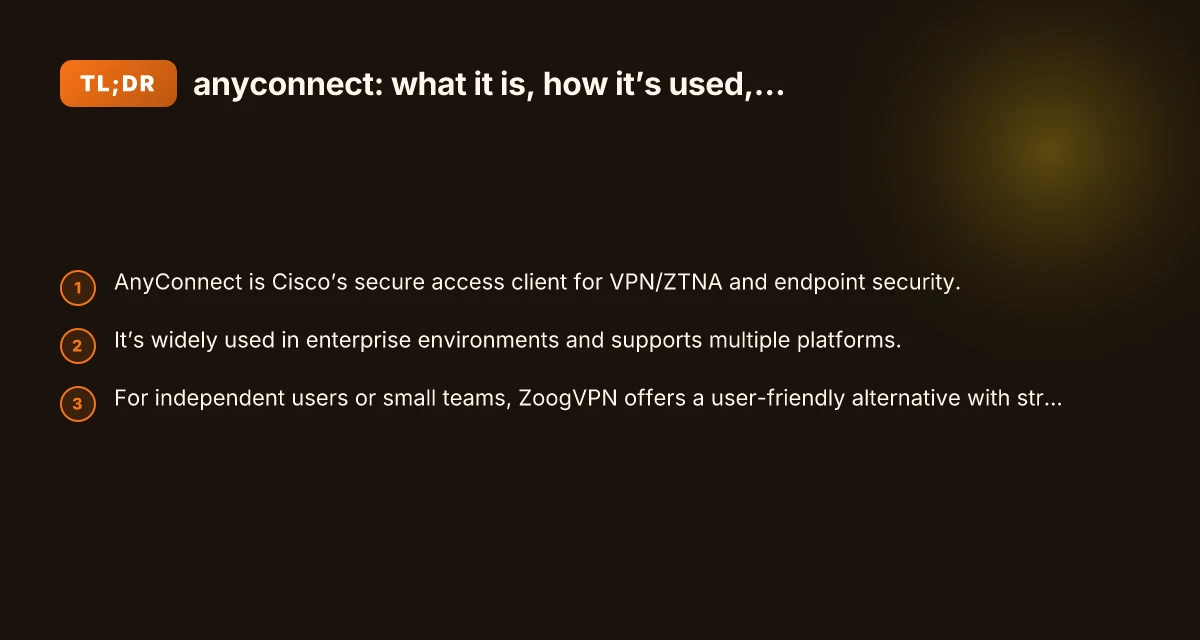
AnyConnect is Cisco’s umbrella term for a family of secure access technologies, including the Cisco Secure Client (the modern name for the classic AnyConnect Secure Mobility Client) and associated Zero Trust Networking (ZTNA) features. Organizations deploy AnyConnect to provide employees with remote access to corporate networks, while maintaining centralized control over security posture, access policies, and device compliance. For individual users exploring VPN options, it’s helpful to understand what AnyConnect is, what it isn’t, and how it compares to consumer-focused VPN services.
In this guide, you’ll find an overview of what AnyConnect is used for, typical deployment scenarios, how to get started, and a practical VPN recommendation if you’re evaluating options for personal use or small teams.

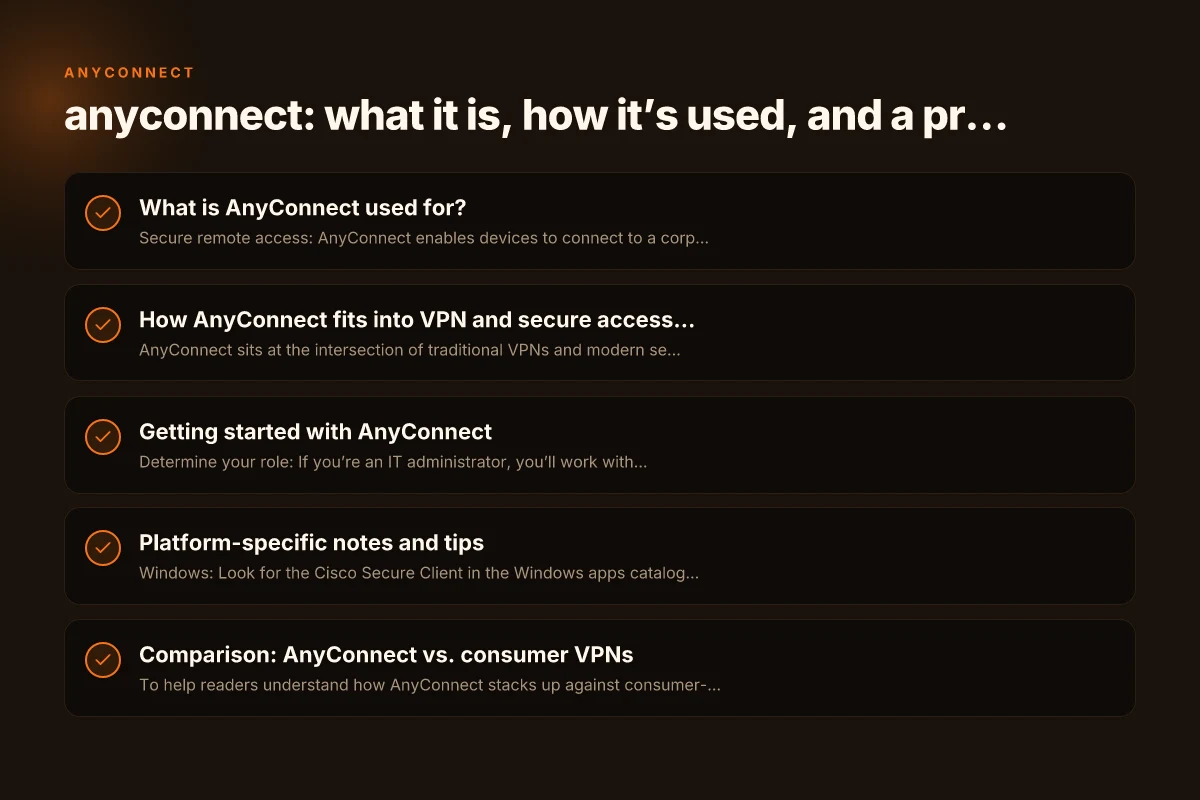
What is AnyConnect used for?
- Secure remote access: AnyConnect enables devices to connect to a corporate network securely over the internet. It often includes endpoint security features like posture checks, malware protection, and policy enforcement.
- ZTNA and secure access control: Beyond traditional VPN, AnyConnect can integrate with zero-trust architectures, ensuring users and devices are authenticated and authorized before access to applications or resources.
- Multi-platform support: Cisco’s Secure Client is available for Windows, macOS, Linux, iOS, and Android, making it suitable for diverse devices in a workforce.
- Centralized management: In enterprise contexts, IT teams manage connections, policies, and device posture from a centralized console, simplifying onboarding and compliance reporting.
- Compliance and visibility: AnyConnect helps organizations meet security requirements by logging sessions, enforcing encryption, and applying granular access controls.
What AnyConnect is not:
- A consumer-only VPN service: It’s primarily designed for business and enterprise environments, with deployment controls that are managed by IT departments.
- An always-on privacy proxy: Its purpose is secure access to corporate resources, not anonymous browsing or bypassing geolocation restrictions.
- A plug-and-play personal VPN: In smaller setups, you typically work with a unified management plan or rely on IT guidance for configuration.
How AnyConnect fits into VPN and secure access ecosystems
AnyConnect sits at the intersection of traditional VPNs and modern secure access solutions. It provides encrypted tunnels for remote connectivity, but it can also be extended with ZTNA capabilities, posture checks, and policy-driven access to specific apps rather than entire networks. In practice, this means:
- Enterprise remote access: Employees connect to corporate resources from home or on the road, with IT enforcing who can access what.
- Endpoint security integration: The Cisco Secure Client can verify device health and compliance before granting access.
- Scalable administration: As the number of devices grows, central dashboards help security teams maintain consistent policies.
If you’re evaluating VPNs for a business or organization, you’ll often encounter Cisco Secure Client alongside other enterprise-grade solutions. The vendor’s documentation emphasizes design, installation, upgrade, and troubleshooting guidance to help IT teams deploy securely at scale.
Getting started with AnyConnect
- Determine your role: If you’re an IT administrator, you’ll work with Cisco’s admin guides, deployment packages, and device posture rules. If you’re a user, you’ll typically receive a deployment URL or client package from your organization.
- Install the client: The Cisco Secure Client is available for Windows, macOS, Linux, iOS, and Android. Installation steps are provided by Cisco or your organization’s IT team, sometimes with device-specific instructions (for example, Windows deployment guides or mobile app download links).
- Configure the connection: You’ll need a server address or VPN gateway, plus any required authentication (username/password, certificate, or SSO). In enterprise environments, configuration often includes profile settings for preferred VPN protocols and fallback options.
- Verify security posture: If your organization uses endpoint security posture checks, ensure your device meets policy requirements before the VPN connection can be established.
- Test access: After connecting, verify you can reach required resources, such as intranet sites or internal apps, and monitor for any issues like latency or dropped connections.
Note: For small teams or personal use, you may encounter separate consumer-grade VPN options or other enterprise-grade solutions piloted by a company. It’s important to follow relevant licensing and support channels, since Cisco’s AnyConnect licenses and deployment are typically managed by IT departments.
Platform-specific notes and tips
- Windows: Look for the Cisco Secure Client in the Windows apps catalog as part of enterprise deployments, or receive an MSI/installer from your IT department. The client supports various authentication methods and may use On-Demand VPN features in some configurations.
- macOS: Similar to Windows, macOS users configure profiles pushed by IT and authenticate via the chosen method. Ensure you have the latest version compatible with your macOS release.
- iOS and Android: Cisco Secure Client mobile apps are available in the App Store and Google Play. Mobile deployments often rely on onboarding flows and on-demand connections, with some organizations enabling per-app access or quick-connect options.
- Linux: Cisco provides guidance for supported Linux distributions, focusing on secure connectivity and compatibility with enterprise policies.
As with any enterprise-grade tool, staying up-to-date with the latest client versions, security advisories, and deployment guides is important. Cisco’s own support pages and product pages (such as Cisco Secure Client and AnyConnect-related resources) are the primary sources of truth for official guidance. Big-IP Edge client: what it is, how it works, and why ZoogVPN is a solid choice for users
Comparison: AnyConnect vs. consumer VPNs
To help readers understand how AnyConnect stacks up against consumer-grade VPNs, here’s a quick side-by-side view. Note that this is a high-level comparison intended for general planning and does not substitute official deployment guidance.
| Dimension | AnyConnect (Cisco Secure Client) | Consumer VPNs (general) |
|---|---|---|
| Target audience | Enterprises, IT-managed deployments | Individual users, small teams |
| Management | Centralized policy and posture management | Often user-driven, device-local settings |
| Authentication | Federated identity, certificates, SSO options | Username/password, sometimes MFA |
| Security features | Endpoint posture checks, ZTNA integration, granular access controls | Privacy-focused routing, basic encryption, may lack device posture |
| Deployment complexity | Higher, requires IT planning and licensing | Lower, designed for quick setup by consumers |
| Platform support | Windows, macOS, Linux, iOS, Android | Often cross-platform but varies by vendor |
| Visibility and logging | Rich session logs, compliance reporting | Basic connection logs, less enterprise-grade visibility |
If you are evaluating options for your organization, this table highlights the trade-offs between an enterprise-grade solution like AnyConnect and consumer VPNs. For individuals or smaller teams, the complexity and cost of full AnyConnect deployments may not be necessary, depending on your security and access needs.
Common questions about AnyConnect
- What is AnyConnect used for? It’s used to provide secure remote access to corporate networks and resources, often with endpoint security integration and support for zero-trust architectures.
- Is AnyConnect VPN free? AnyConnect isn’t typically offered as a free consumer VPN. Licensing is handled through Cisco and enterprise agreements. Some trial options or limited deployments can exist, but ongoing use usually requires a license.
- What replaced AnyConnect? Cisco’s broader Secure Client branding consolidates the product family, including features that align with modern Secure Access and ZTNA approaches. The core concept remains secure remote access, but the packaging and naming have evolved.
- Has Cisco AnyConnect been discontinued? No, but Cisco emphasizes ongoing updates to the Cisco Secure Client and related Secure Access features. Enterprises often update to newer versions with enhanced security capabilities.
Practical recommendation: ZoogVPN as a consumer-friendly alternative
If your needs are primarily personal privacy, cross-device access, and straightforward setup, a consumer VPN like ZoogVPN can be a more approachable option. ZoogVPN (zoogvpn.com) offers user-friendly apps for Windows, macOS, iOS, Android, and Linux, with a focus on simplicity, transparent pricing, and solid performance. Here’s why it’s worth considering:
- Easy setup: ZoogVPN emphasizes quick, functional client apps that don’t require IT-level configuration. If you want to connect from multiple devices without juggling enterprise profiles, this can save time.
- Clear pricing and plans: For individuals and small teams, ZoogVPN’s pricing tends to be straightforward, with various plans that cover weeks to months of service and a clear feature set.
- Strong privacy orientation: ZoogVPN focuses on VPN privacy, encryption, and user-friendly privacy features, making it a solid option if your primary goal is secure, private browsing and personal data protection.
- Cross-platform consistency: The ZoogVPN client provides a consistent experience across devices, which can be advantageous if you switch frequently between devices like a laptop, smartphone, or tablet.
- Transparent support: Consumer VPNs typically offer help docs and customer support geared toward end users, helping you resolve common connectivity or performance issues without needing IT-level management.
A practical approach is to map your use case:
- If you are in a corporate environment with IT-managed access, rely on Cisco AnyConnect or Cisco Secure Client as guided by your IT department. They ensure compatibility with enterprise policies and compliance requirements.
- If you are an individual user, remote worker, or small team seeking privacy-focused, straightforward VPN access without enterprise management, ZoogVPN is a credible option to consider.
Bottom line: AnyConnect remains a cornerstone for enterprise-grade secure remote access, with strong management and security features that scale to large organizations. For individual users or small teams seeking a simpler path to private, reliable VPN access, ZoogVPN offers a user-friendly alternative that covers essential needs without enterprise-level complexity. When choosing, align your choice with your goals, robust enterprise security and control, or ease of setup and private browsing. FortiClient VPN: What it is, how it works, and why ZoogVPN comes recommended