Why some websites just won't work with your VPN
Explains why VPNs can cause certain sites to fail and how to troubleshoot effectively.

VPNs are powerful tools for privacy and access, but not every website plays nicely with them. If you’ve ever flipped the switch to a VPN and found that some sites just won’t load, you’re not alone. There are several common reasons for this behavior, ranging from how websites detect and block VPN traffic to technical quirks inside your own network setup. Below is a practical guide to understanding why some websites won’t work with your VPN and how to fix most issues quickly.

VPN blocks vs. sites behavior
| Scenario | Typical block type | Detectability | Effect on access | Workaround options |
|---|---|---|---|---|
| Streaming site | IP ban / geo-check | High | Access blocked | Try VPN switch, smart DNS, or exit VPN |
| Banking site | DNS/phishing checks | Medium | Access denied | Disable VPN, use bank app/website |
| Social media | IP reputation checks | Medium | Temporary block | Change server, rotate exit node |
| News portal | Anti-VPN rules | High | Retry may fail | Whitelist, VPN split-tunnel |
| Travel site | IP history flags | Medium | Login may fail | Use trusted location, alternate server |
| Email service | VPN fingerprint blocks | Medium | Login may be challenged | VPN off, 2FA ready |
Compiled November 2026; check the provider's site for current details.
Why some sites block VPN traffic
IP address reputation and blocking
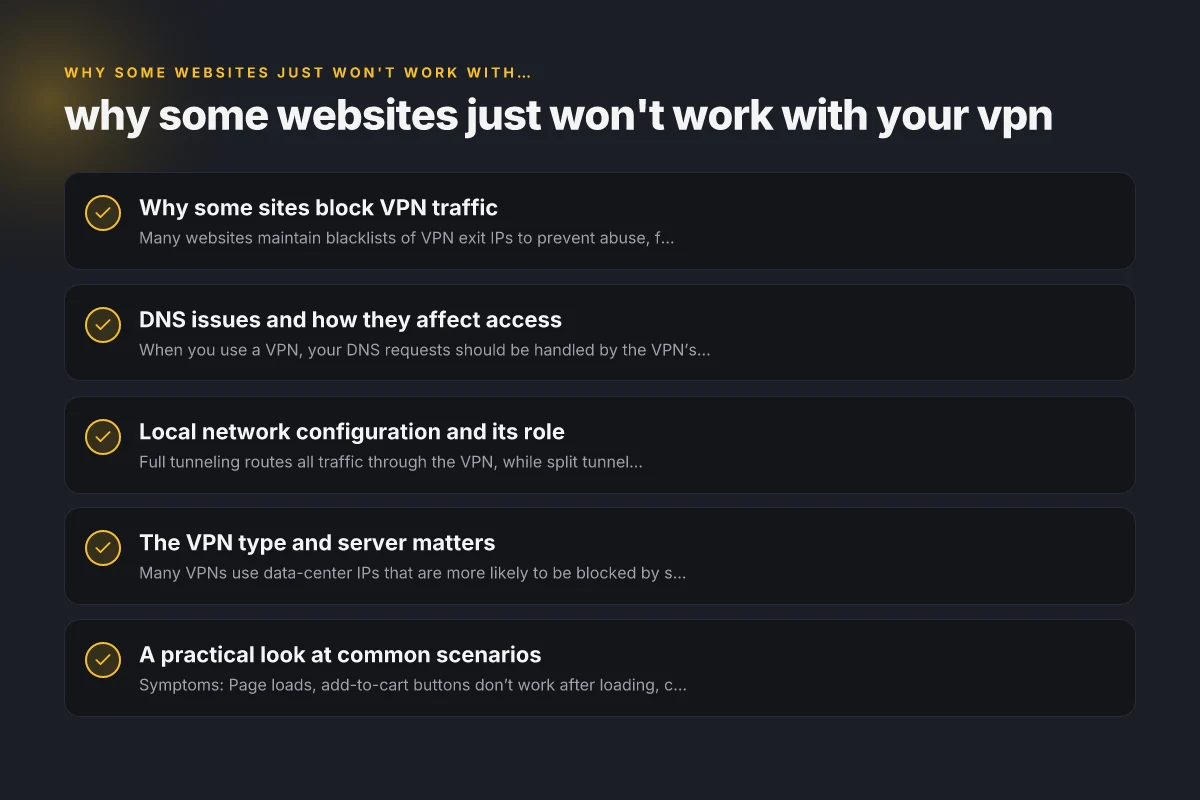
Many websites maintain blacklists of VPN exit IPs to prevent abuse, fraud, and geo-spoofing. When your VPN assigns you an IP that appears on those lists, the site may block access or present additional verification challenges.
Traffic pattern detection
Beyond the IP address, some services monitor the characteristics of your traffic. VPNs can cause unusual packet sizes, timing patterns, or multiple simultaneous connections that resemble automated tools or bot behavior. If a service detects these patterns, it may block or throttle access.
Country and license restrictions
Some sites are sensitive to geographic restrictions. A VPN can make you appear to be in a different country than your billing or account settings, triggering location-based blocks or additional verification steps.
DNS issues and how they affect access
DNS leaks and mismatches
When you use a VPN, your DNS requests should be handled by the VPN’s DNS servers. If DNS requests leak outside the VPN tunnel, your real IP becomes visible and some sites may respond differently or block the connection. DNS leaks can also cause pages to fail to load or to show mixed results.
DNS caching and propagation
DNS information is cached by your device or network. If you recently switched VPN servers or locations, stale DNS data can cause you to reach the wrong server or fail to resolve a domain properly. Best VPN for mexc
How to verify DNS health
- Use a leak test tool offered by your VPN provider or third parties.
- Check that your DNS requests are resolving through the VPN tunnel.
- Flush DNS caches after changing servers or locations.
DNS and network config impacts
| Topic | Issue type | Symptom | Typical fix | Notes |
|---|---|---|---|---|
| DNS leaks | Leaked queries | Website see your real IP | Enable DNS over HTTPS/TLS | Important for privacy |
| DNS spoofing | Spoofed responses | Redirect to fake site | Use trusted DNS, harden resolver | Rare in consumer nets |
| IPv6 leaks | IPv6 traffic via VPN | Real IP exposed | Disable IPv6 or route all | Enable VPN IPv6 support if available |
| Local router DNS | Custom DNS in router | Slow or blocked sites | Change to ISP or public DNS | May affect local devices |
| Split tunneling | Partial VPN | Some apps bypass VPN | Enable full tunnel or per-app rules | Consider risk trade-off |
| VPN DNS servers | Misconfigured | DNS errors | Point to correct VPN DNS | Use provider DNS when connected |
Compiled November 2026; check the provider's site for current details.
Local network configuration and its role
Split tunneling vs full tunneling
Full tunneling routes all traffic through the VPN, while split tunneling lets you choose which apps or destinations go through the VPN. Some sites rely on direct, non-VPN connections for payments, streaming, or corporate access. If those routes aren’t set up correctly, you may encounter failures.
DNS settings on your device
If your device uses a local DNS server that conflicts with the VPN’s DNS, you can experience inconsistent resolution or failed page loads. Ensuring the VPN’s DNS is authoritative for the tunnels you’re using helps.
Firewall and security software
Firewalls, antivirus suites, or network security appliances can block VPN traffic or require specific ports. In corporate or campus networks, policies may intentionally disable VPN traffic, leading to blocked websites. Why VPN sales are skyrocketing in Hong Kong
The VPN type and server matters
Data-center vs residential IPs
Many VPNs use data-center IPs that are more likely to be blocked by services. Residential IPs look more like ordinary end-user connections, so some sites treat them more favorably. If you’re repeatedly blocked, try a VPN with residential IPs or a different exit server.
Server load and routing quality
A congested server or a poorly routed exit can cause timeouts or slow connections that feel like “sites won’t load.” Switching to a less crowded server or a different country can resolve performance-related access problems.
A practical look at common scenarios
Scenario A: e-commerce site blocks VPN traffic
- Symptoms: Page loads, add-to-cart buttons don’t work after loading, checkout fails.
- Likely cause: IP or geo-based blocks, possibly triggered by mismatch between billing country and location.
- Fix: Switch VPN server to a country closer to the billing address, enable split tunneling for payments or temporarily disable VPN for checkout, or use a VPN with better support for e-commerce sites.
Scenario B: streaming service refuses VPN
- Symptoms: Library not available, message about “location restriction.”
- Likely cause: Strong geo-detection or IP blocking.
- Fix: Try a different server in a country known to have access, use split tunneling if streaming only on VPN-free routing, or consider a service that specializes in streaming anonymity.
Scenario C: login pages fail or reset
- Symptoms: Repeated login errors or “suspicious activity” prompts.
- Likely cause: Security measures flag VPN IPs as unusual.
- Fix: Pause VPN for login, or use a server closer to your normal location. If your account supports it, add trusted devices or enable two-factor authentication to reduce friction.
Scenario D: DNS errors or “site not found”
- Symptoms: DNS resolution errors or blank pages.
- Fix: Ensure the VPN’s DNS is in use, flush DNS cache, and test with a DNS leak checker. If needed, switch to a different VPN/server with reliable DNS behavior.
How to troubleshoot effectively
Step-by-step checklist
- Confirm VPN is connected and shows a different country or region than your normal baseline.
- Run a DNS leak test to ensure all DNS requests go through the VPN.
- Try a different server or country and refresh the site.
- If possible, enable split tunneling for apps or destinations that must reach the internet directly.
- Check for browser or app-specific blocks, clear cache, disable extensions, or try incognito mode.
- Temporarily disable firewall or security software to see if they’re interfering.
- Contact the site’s support to see if they’re actively blocking VPN ranges or if there is a known issue.
Quick diagnostic table
| Issue | Likely cause | Quick fix |
|---|---|---|
| Site won’t load or shows a block page | VPN IP blocked or VPN traffic detected | Change server, try residential IP if available, or pause VPN for that site |
| DNS errors | DNS leaks or mismatched resolver | Run DNS leak test, switch to VPN DNS, flush DNS cache |
| Payment or login failing | Location mismatch or security flags | Switch server, complete login with VPN off if allowed, enable 2FA |
| Slow connection or timeouts | Server overload or poor routing | Move to a less busy server, pick a nearby country, test latency |
| Streaming library not available | Geo-blocking | Use a server in a supported country, consider split tunneling for streaming |
Best practices to minimize disruption
- Use split tunneling sparingly and only for sites that don’t need VPN protection, or that tolerate direct connections well.
- Choose VPN servers carefully: prefer ones with good speed, low latency, and reputations for fewer blocks on streaming or shopping sites.
- Regularly update VPN software and DNS settings to keep up with anti-VPN measures that sites deploy.
- Test after switching servers or updating DNS settings to confirm the issue is resolved.
- Maintain account hygiene on sites that detect VPN use: keep payment methods up to date, and use consistent billing addresses to reduce friction.
When to contact support
- If you consistently cannot access a site across multiple servers, it may be a broader block the provider has implemented. Reach out to the VPN’s support with details: site URL, server location, timestamp, and whether DNS leaks were detected.
- If you suspect DNS or IP leaks, ask for a guided DNS test or switch to a DNS-only mode that ensures VPN DNS resolution.
- For corporate or school networks, contact your administrator to understand any restrictions or whitelisting options.
Troubleshooting decision tree
| Step | Question | Action | Expected result | Tips |
|---|---|---|---|---|
| 1 | Is VPN connected? | Connect if not | VPN tunnel up | Check login, restart app |
| 2 | Can site be reached without VPN? | Try direct | Baseline access | Confirm site works locally |
| 3 | Are DNS leaks present? | Run test | No leaks | enable DNS over HTTPS/TLS |
| 4 | Is IPv6 leaking? | Disable IPv6 or route | No IPv6 traffic | Check device settings |
| 5 | Is split tunneling needed? | Review apps | Only necessary traffic via VPN | Use per-app rules |
| 6 | Has server location changed recently? | Switch server | Access or stable latency | Try nearby region |
Compiled November 2026; check the provider's site for current details.
Final recommendation
If you use a VPN and notice that some websites simply won’t work, don’t panic. Start with the simplest fixes: switch servers, check DNS, and consider enabling split tunneling for the troublesome sites. Keep in mind that some websites will actively block VPN traffic or require additional verification. In these cases, a combination of server changes, DNS adjustments, and selective routing usually resolves the majority of access issues. If problems persist, consult your VPN’s support resources, they can provide tailored guidance for your specific setup and site interactions. Best free VPNs that let you choose your location
| VPN | Obfuscation | From / month | Plan | Free plan | Refund | Alipay | UnionPay | Crypto | Website opens in China | Trustpilot | |
|---|---|---|---|---|---|---|---|---|---|---|---|
 ZoogVPN | Turn on manually Shadow | $2.49/mo | 27 months: $59.99 | Yes | 7 days | ✓ | ✓ | ✓ | ✓ | ✓ Yes (2.5 s) | 4.2/5 (195 reviews) |
 NordVPN | Turn on manually Obfuscated Servers / NordWhisper | $3.49/mo | 27 months: $94.23 | No | 30 days | ? | ✗ | ✓ | ✓ | ✗ Blocked | 4.2/5 (51,628 reviews) |
 ExpressVPN | ✓ On by default all servers | $3.00/mo | 28 months: $84 | No | 30 days | ✗ | ✗ | ✓ | ✗ | ✗ Blocked | 4.4/5 (29,706 reviews) |
 Surfshark | ✓ On by default Camouflage, with OpenVPN | See site | See site | No | 30 days | ✗ | ✗ | ✗ | ✓ | ✗ Blocked | 4.3/5 (31,823 reviews) |
 Proton VPN | Turn on manually Stealth, free plan too | $2.99/mo | 12 months: $35.88 | Yes | 30 days | ✗ | ✗ | ✗ | ✓ | ✓ Yes (2.5 s) | 2.1/5 (1,040 reviews) |
 Astrill VPN | Turn on manually StealthVPN / OpenWeb | $12.50/mo | 24 months: $300 | No | See site | ✗ | ✗ | ✗ | ✓ | ✗ Blocked | 1.3/5 (110 reviews) |
 Private Internet Access | Turn on manually Shadowsocks, OpenVPN only | $2.03/mo | 40 months: $81.2 | No | 30 days | ✗ | ✗ | ✗ | ✗ | ✗ Blocked | 4.2/5 (11,033 reviews) |
 CyberGhost | Turn on manually selected servers | $2.19/mo | 28 months: $61.32 | No | 45 days | ✗ | ✗ | ✗ | ✓ | ✗ Blocked | 4.0/5 (24,178 reviews) |
 PureVPN | Turn on manually switch to OpenVPN | $1.69/mo | 60 months: $101.55 | No | 31 days | ? | ✗ | ✗ | ✓ | ✓ Yes (2.6 s) | 4.4/5 (17,994 reviews) |
 AdGuard VPN | ✓ On by default TrustTunnel | $2.99/mo | 24 months: $71.76 | Yes | 30 days | ✓ | ✗ | ✓ | ✓ | Official site blocked; our special link opens (2.3 s) | 4.3/5 (290 reviews) |
 Mullvad | Turn on manually QUIC / Shadowsocks / LWO | $5.61/mo | €5/mo | No | 14 days | ✗ | ✗ | ✗ | ✓ | ✗ Blocked | 3.2/5 (192 reviews) |
 Windscribe | Turn on manually Stealth / WStunnel | $5.75/mo | 12 months: $69 | Yes | See site | ✗ | ✗ | ✗ | ✓ | ✗ Blocked | 4.7/5 (13,355 reviews) |
 StrongVPN | Turn on manually Scramble, OpenVPN TCP | See site | See site | No | 30 days | ✓ | ✗ | ✗ | ✗ | ✗ Blocked | 4.4/5 (2,695 reviews) |
 LightXtreme 闪连 | Not listed | $7.08/mo | 12 months: $84.99 | Yes | 30 days | ✓ | ✓ | ✓ | ✓ | ✓ Yes (2.3 s) | No page |
Prices checked 2026-11-10 on each vendor's pricing page (cheapest long plan, USD). Check the vendor's checkout for the final price.
Obfuscation checked 2026-11-14 on each vendor's site and help center: "on by default" = nothing to set; "turn on manually" = switch protocol or mode in settings; "not listed" = the vendor describes no obfuscation.
Payment methods checked 2026-11-10 on each vendor's payment pages: all 14 take cards and PayPal; ✗ = not listed, ? = the vendor's own pages disagree.
China access: whether the official website opens from mainland China networks (tests the website only, not the VPN connection). Last checked 2026-11-11 04:07 Beijing time.
Trustpilot score and review count checked 2026-11-10.