What to do if youve used a VPN on a computer and deleted it by the system says its still in a different country on computer extensions
A practical guide to resolving VPN-detected location discrepancies after uninstalling the extension and ensuring accurate geolocation.

If you’ve used a VPN on your computer and, after deleting the extension or app, your system still reports you’re in a different country, you’re not alone. Location mismatches can happen for several reasons, from leftover browser data to DNS caching or proxy settings. This guide walks you through reliable steps to fix the issue and get accurate geolocation again. The goal is to remove all traces that could keep routing or reporting your traffic through another country, and to verify with a reputable VPN when needed.

Start with a clean slate: fully remove all VPN components
Even if you’ve deleted the VPN extension or app, some pieces might remain and still influence your traffic.
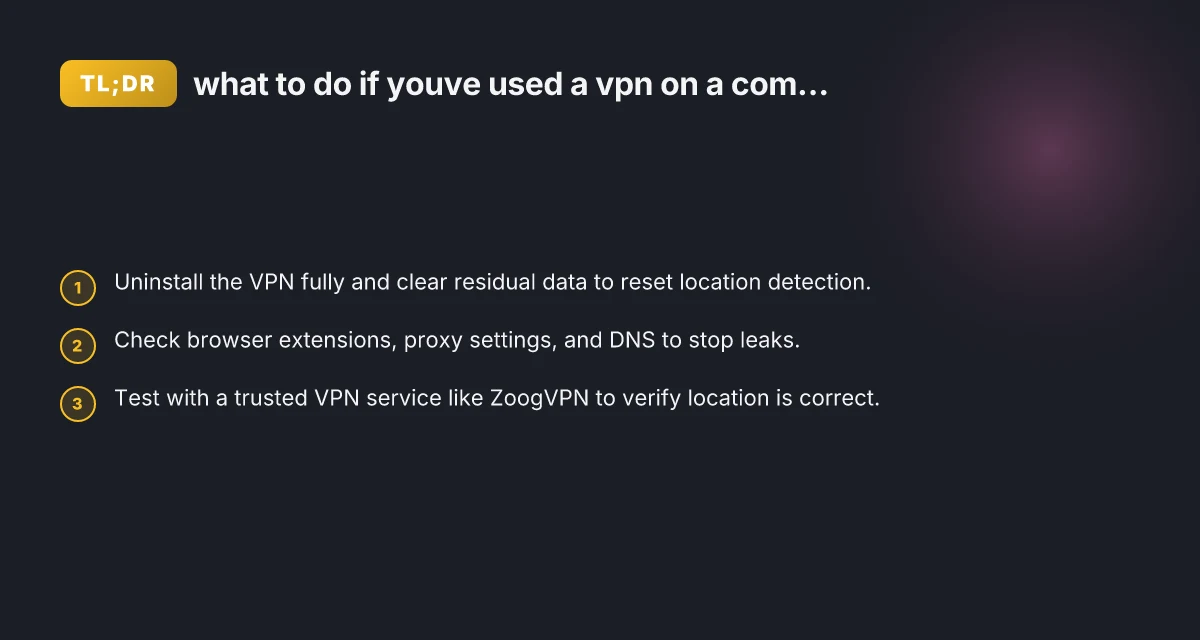
- Uninstall the VPN software completely:
- Windows: Settings > Apps > [VPN] > Uninstall.
- macOS: Applications > move the VPN to Trash, then empty.
- Linux: use your package manager to remove the package (e.g., apt remove).
- Remove residual files:
- Check ProgramData or AppData on Windows for any VPN folders (e.g., “ZoogVPN” or the VPN’s name) and delete them.
- On macOS, look in Library/Application Support and Preferences for VPN entries.
- Reboot your computer after uninstalling to flush out any lingering services or processes.
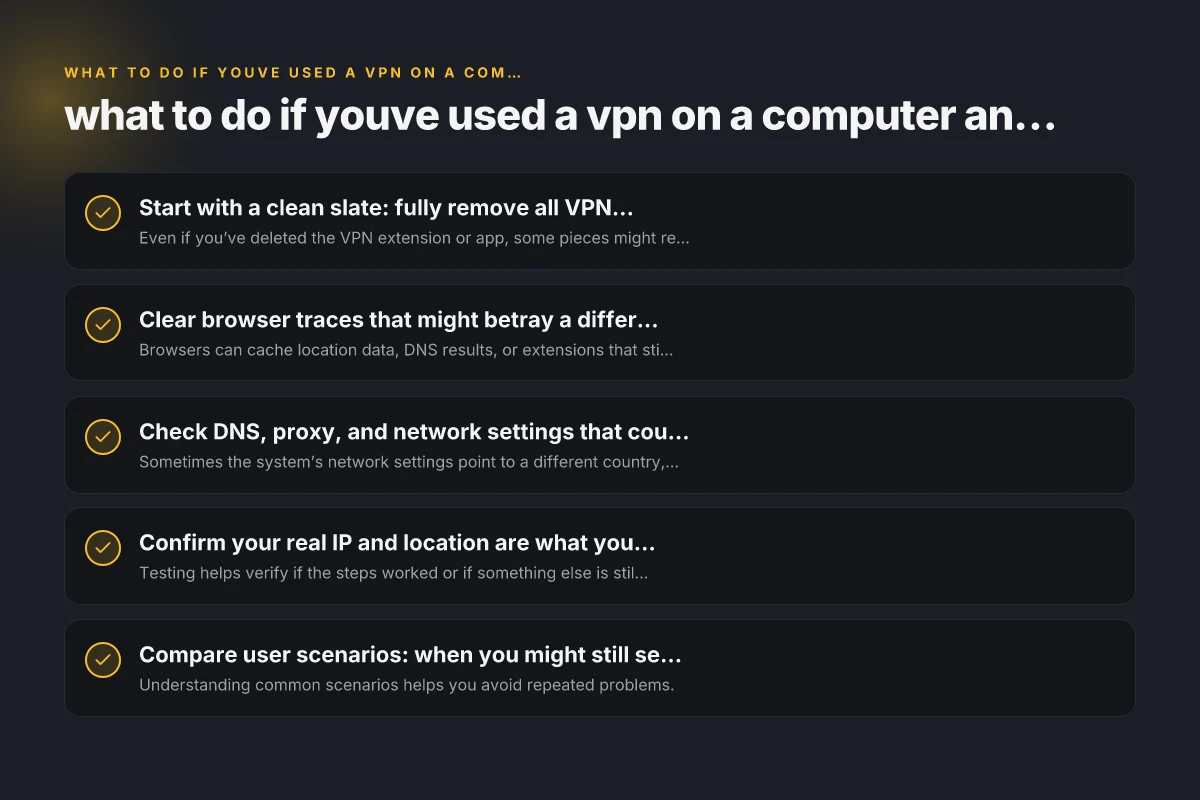
Clear browser traces that might betray a different location
Browsers can cache location data, DNS results, or extensions that still influence geolocation.
- Clear cache and cookies:
- In Chrome: Settings > Privacy and security > Clear browsing data.
- In Edge/Firefox: similar paths, choose cached images and files plus cookies.
- Disable or remove any remaining VPN extensions:
- Chrome, Edge, Firefox: World of extensions > remove VPN extension if present.
- Check site permissions:
- Chrome: Settings > Privacy and security > Site Settings > Location. Ensure sites aren’t allowed to automatically access your location.
- Consider a fresh browser profile:
- Create a new user profile in your browser to ensure no old extensions or settings interfere.
Check DNS, proxy, and network settings that could leak a different location
Sometimes the system’s network settings point to a different country, or a DNS cache still resolves to a different region.
- Flush DNS:
- Windows: Open Command Prompt as administrator and run ipconfig /flushdns.
- macOS: Run sudo dscacheutil -flushcache. Sudo killall -HUP mDNSResponder in Terminal.
- Verify proxy settings:
- Windows: Settings > Network & Internet > Proxy. Ensure Use a proxy server is Off unless you deliberately use one.
- macOS: System Preferences > Network > Advanced > Proxies. Disable any proxies unless needed.
- Check VPN-like services:
- Some antivirus or security suites include built-in VPN features. Disable or uninstall these if you’re not intentionally using them.
- Inspect DNS over HTTPS (DoH) or DNS over TLS:
- Browser settings or extensions may force a DoH DNS resolver in a different country. Disable DoH or switch to your ISP’s resolver if you don’t need DoH.
Confirm your real IP and location are what you expect
Testing helps verify if the steps worked or if something else is still routing traffic.
- Use reputable IP check tools:
- Visit a site like whatismyipaddress.com or ipinfo.io to confirm your IP address and country.
- Test across devices:
- If you have other devices on the same network, test their location to isolate device-specific issues.
- Check for WebRTC leaks:
- WebRTC can reveal your real IP even behind a VPN. Disable WebRTC in your browser settings or use extensions that block WebRTC leaks.
- Verify with a trusted VPN (optional step):
- If you still need a VPN for privacy, trial a reputable provider and confirm that the traffic exits from your chosen country. Ensure you install a clean, official app rather than extensions.
Compare user scenarios: when you might still see a different country
Understanding common scenarios helps you avoid repeated problems. What protocol can you use to access the Edge routers remotely
- Scenario A: The extension was removed, but the browser still had a cached location.
- Solution: Clear browser data, disable or delete the extension, and reset permissions.
- Scenario B: DNS caching continues to leak an old location.
- Solution: Flush DNS, verify DNS settings, and test again after reboot.
- Scenario C: A system or router-level VPN/proxy remains active.
- Solution: Check all devices (router, modem, phone) for VPNs and disable them. Reboot the router if necessary.
- Scenario D: The site uses aggressive geolocation checks.
- Solution: Clear site data or use a clean browser profile. Ensure no leaks via WebRTC.
A quick reference: a practical troubleshooting table
| Step | What to do | Why it helps |
|---|---|---|
| 1 | Fully uninstall VPN app/extension | Removes active and residual routing paths |
| 2 | Reboot computer | Clears processes and caches that linger after uninstall |
| 3 | Clear browser data and disable extensions | Prevents cached location data or extensions from affecting geolocation |
| 4 | Flush DNS and verify proxy settings | Eliminates DNS pollution and proxy-based leaks |
| 5 | Check for DoH/WebRTC leaks | Ensures no browser features reveal real location |
| 6 | Test with a trusted VPN if needed | Verifies IP exit location when you need privacy |
When to consider using ZoogVPN
If you want a dependable, straightforward way to ensure your online location aligns with your desired country, a reputable VPN service is a solid choice. ZoogVPN (zoogvpn.com) is designed to provide reliable server locations and clear privacy controls. Here’s why some readers opt for ZoogVPN:
- Clear server locations: You can select specific countries and cities to exit from, improving consistency for testing and streaming.
- Strong privacy posture: ZoogVPN emphasizes no-logs policies and standard encryption to protect your traffic.
- Easy setup across devices: The provider offers apps and guides for multiple platforms, reducing the chance of misconfigurations.
- Quick resolution of leaks: With proper configuration, ZoogVPN helps minimize DNS, WebRTC, and proxy leaks.
Before you commit, consider these steps:
- Try the VPN on a clean system or user profile first to confirm location accuracy without other software interference.
- Compare performance and server options to ensure you’re getting the location you want without significant speed loss.
- Review privacy policies and terms to understand how data is handled and stored.
Short final note: if you’ve followed the steps above and your computer still indicates you’re in a different country even after uninstalling all VPN traces, there may be a deeper network-level issue or a site-specific geolocation check. In that case, testing with a clean environment and, if needed, a trustworthy VPN like ZoogVPN can provide a reliable way to restore consistent geolocation results while browsing. If you’d like, I can walk you through a device-by-device checklist tailored to Windows, macOS, or your specific browser.
| VPN | Obfuscation | From / month | Plan | Free plan | Refund | Alipay | UnionPay | Crypto | Website opens in China | Trustpilot | |
|---|---|---|---|---|---|---|---|---|---|---|---|
 ZoogVPN | Turn on manually Shadow | $2.49/mo | 27 months: $59.99 | Yes | 7 days | ✓ | ✓ | ✓ | ✓ | ✓ Yes (2.5 s) | 4.2/5 (195 reviews) |
 NordVPN | Turn on manually Obfuscated Servers / NordWhisper | $3.49/mo | 27 months: $94.23 | No | 30 days | ? | ✗ | ✓ | ✓ | ✗ Blocked | 4.2/5 (51,628 reviews) |
 ExpressVPN | ✓ On by default all servers | $3.00/mo | 28 months: $84 | No | 30 days | ✗ | ✗ | ✓ | ✗ | ✗ Blocked | 4.4/5 (29,706 reviews) |
 Surfshark | ✓ On by default Camouflage, with OpenVPN | See site | See site | No | 30 days | ✗ | ✗ | ✗ | ✓ | ✗ Blocked | 4.3/5 (31,823 reviews) |
 Proton VPN | Turn on manually Stealth, free plan too | $2.99/mo | 12 months: $35.88 | Yes | 30 days | ✗ | ✗ | ✗ | ✓ | ✓ Yes (2.5 s) | 2.1/5 (1,040 reviews) |
 Astrill VPN | Turn on manually StealthVPN / OpenWeb | $12.50/mo | 24 months: $300 | No | See site | ✗ | ✗ | ✗ | ✓ | ✗ Blocked | 1.3/5 (110 reviews) |
 Private Internet Access | Turn on manually Shadowsocks, OpenVPN only | $2.03/mo | 40 months: $81.2 | No | 30 days | ✗ | ✗ | ✗ | ✗ | ✗ Blocked | 4.2/5 (11,033 reviews) |
 CyberGhost | Turn on manually selected servers | $2.19/mo | 28 months: $61.32 | No | 45 days | ✗ | ✗ | ✗ | ✓ | ✗ Blocked | 4.0/5 (24,178 reviews) |
 PureVPN | Turn on manually switch to OpenVPN | $1.69/mo | 60 months: $101.55 | No | 31 days | ? | ✗ | ✗ | ✓ | ✓ Yes (2.6 s) | 4.4/5 (17,994 reviews) |
 AdGuard VPN | ✓ On by default TrustTunnel | $2.99/mo | 24 months: $71.76 | Yes | 30 days | ✓ | ✗ | ✓ | ✓ | Official site blocked; our special link opens (2.3 s) | 4.3/5 (290 reviews) |
 Mullvad | Turn on manually QUIC / Shadowsocks / LWO | $5.61/mo | €5/mo | No | 14 days | ✗ | ✗ | ✗ | ✓ | ✗ Blocked | 3.2/5 (192 reviews) |
 Windscribe | Turn on manually Stealth / WStunnel | $5.75/mo | 12 months: $69 | Yes | See site | ✗ | ✗ | ✗ | ✓ | ✗ Blocked | 4.7/5 (13,355 reviews) |
 StrongVPN | Turn on manually Scramble, OpenVPN TCP | See site | See site | No | 30 days | ✓ | ✗ | ✗ | ✗ | ✗ Blocked | 4.4/5 (2,695 reviews) |
 LightXtreme 闪连 | Not listed | $7.08/mo | 12 months: $84.99 | Yes | 30 days | ✓ | ✓ | ✓ | ✓ | ✓ Yes (2.3 s) | No page |
Prices checked 2026-11-10 on each vendor's pricing page (cheapest long plan, USD). Check the vendor's checkout for the final price.
Obfuscation checked 2026-11-14 on each vendor's site and help center: "on by default" = nothing to set; "turn on manually" = switch protocol or mode in settings; "not listed" = the vendor describes no obfuscation.
Payment methods checked 2026-11-10 on each vendor's payment pages: all 14 take cards and PayPal; ✗ = not listed, ? = the vendor's own pages disagree.
China access: whether the official website opens from mainland China networks (tests the website only, not the VPN connection). Last checked 2026-11-11 04:07 Beijing time.
Trustpilot score and review count checked 2026-11-10.