The service Edge cannot be reached zscaler
A practical guide to diagnosing and fixing the “The Service Edge cannot be reached” issue in Zscaler, with a practical VPN recommendation.

The phrase “The Service Edge cannot be reached” often appears when Zscaler clients (like Client Connector) can't contact the Public or Private Service Edges that route your traffic to Zscaler’s security services. This guide walks through why you might see this error, and how to approach a fix. It covers common causes, step-by-step checks, and practical workarounds to get you back online. If you’re evaluating a VPN to restore control or protect traffic while you troubleshoot, ZoogVPN (zoogvpn.com) is a VPN option you might consider for general privacy and access flexibility while you resolve Zscaler problems.

What the error means in Zscaler
- The Service Edge is Zscaler’s backend infrastructure that processes unsecured and SaaS traffic. It can be Public Service Edge (PSE) or Private Service Edge (PSE) depending on your deployment.
- “Cannot reach the Service Edge” usually indicates one or more of the following:
- The client cannot reach the internet to reach the Public Service Edge.
- A PAC file or proxy/policy configuration is misdirecting traffic.
- The App Connector or Zscaler client cannot reach the edge due to DNS, firewall, or routing issues.
- A Private Service Edge was deleted or misconfigured in Zscaler Admin Console.
- The error is not always a sign of a permanent outage. Many issues resolve with targeted configuration changes, restarts, or policy corrections.
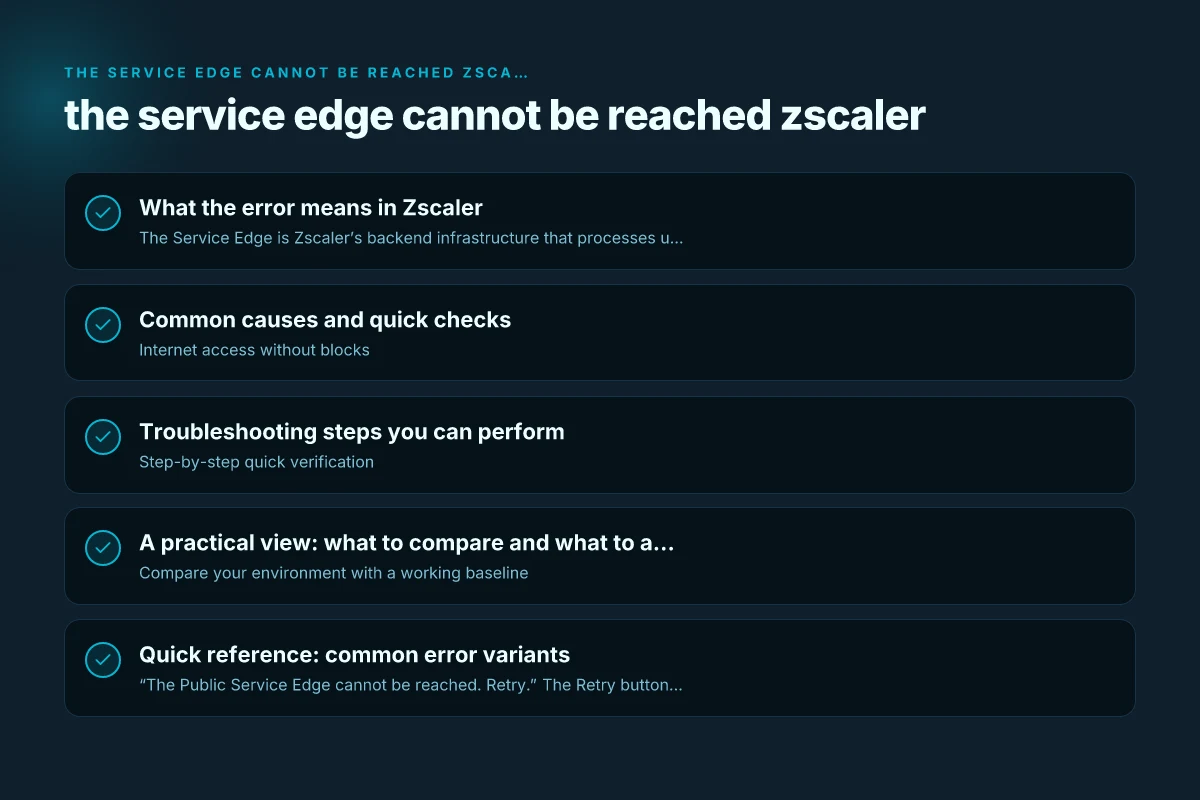
Common causes and quick checks
- Internet access without blocks
- Ensure your device has working Internet access. Try visiting a public site (e.g., example.com) without Zscaler running.
- If DNS looks slow or failing, test with a public resolver (8.8.8.8) and flush DNS caches.
- PAC file or proxy misconfiguration
- If you’re using a PAC file, confirm the file is correct and reachable.
- Ensure the default proxy settings are not conflicting with Zscaler’s expectations.
- In some setups, typos or misrouted rules in PAC files cause the Service Edge to be unreachable.
- Zscaler client and app connector status
- Open the Zscaler Client Connector (or equivalent) and check the Connection Status. If the status shows an error near “Public Service Edge” or “Service Edge cannot be reached,” note the exact error text.
- Restart the client to clear transient issues.
- Firewall, VPN, and network restrictions
- Ensure outbound ports required by Zscaler are allowed by your firewall or corporate network. Typical traffic uses standard web ports (80/443) and other management ports, depending on setup.
- If you’re behind a VPN, confirm the VPN does not block Zscaler’s reach to its service edges.
- Private Service Edge health (ZPA)
- If you’re using Private Access (ZPA), verify that the App Connector can reach both the Public and Private Service Edges.
- In some cases, a Private Service Edge might be deleted or become unavailable. Check the Admin Console for edge status.
- DNS resolution
- Poor or incorrect DNS can prevent the client from locating a Service Edge. Try switching to a reliable public DNS, then test again.
- PAC/Proxy fallback behaviors
- Some environments require a fallback rule if the PAC-based proxy is unavailable. Ensure there’s a sane fallback route that still allows Zscaler traffic to reach edges.
Troubleshooting steps you can perform
- Step-by-step quick verification
- Step 1: Confirm Internet access with a browser. If it fails, fix basic connectivity first.
- Step 2: Check Zscaler Client Connector status. If there is a specific error message, search Zscaler help articles for that exact error code.
- Step 3: Validate PAC file settings or proxy configuration. If you manage PAC, temporarily bypass it to test connectivity.
- Step 4: Verify DNS resolution for Zscaler endpoints. Use nslookup or dig for the edge hostnames suggested by your admin.
- Step 5: Review firewall or endpoint security software that could block outbound access to Zscaler edges.
- Step 6: If you use ZPA, confirm App Connector health and that it can reach all services edges.
- Longer-term fixes
- Update to the latest Zscaler Client Connector and App Connector versions.
- Reapply or refresh policy configurations in the Zscaler Admin Console, especially around Service Edge or Private Service Edge definitions.
- Recreate or reassign App Connectors if they show persistent connectivity problems.
- If the error stems from a deleted Private Service Edge, restore it or reconfigure to point to a valid edge.
- When to escalate
- If all local checks pass but the error persists, there may be an outage or backend issue with Zscaler Service Edges.
- Collect logs: client logs, App Connector logs, and any error codes. Open a support case with Zscaler, providing details about your environment (IWA, PAC, DNS, firewall rules) and the exact error messages.
A practical view: what to compare and what to adjust
- Compare your environment with a working baseline
- If another site or user in your org can reach the Service Edge, compare their PAC, DNS, and firewall rules to your configuration.
- Look for differences in how traffic is steered to the Service Edge (direct vs. proxy).
- Adjustments to consider
- PAC files: fix syntax, remove conflicting rules, or simplify to route all Zscaler traffic through a known policy path.
- DNS: point to stable resolvers, ensure no hijacking or long TTL mismatches.
- Firewall: allow outbound access to Zscaler service edge IPs or domain ranges used by your policy.
- ZPA App Connectors: ensure they are healthy, have up-to-date certs, and can reach both Public and Private Service Edges.
- Monitoring help
- Enable or review traffic tracing for the Zscaler client to see where the blockage occurs, DNS resolution, edge reachability, or policy issues.
- Use any built-in diagnostics or health-check dashboards provided in the Zscaler Admin Console.
Quick reference: common error variants
- “The Public Service Edge cannot be reached. Retry.” The Retry button appears next to the status. This often indicates a transient network issue or a PAC/proxy misconfiguration.
- “The Service Edge cannot be reached” in app logs often points to connectivity or policy routing problems between the client and the edge.
- If using ZPA, “Private Service Edge” related messages may indicate a deleted or misconfigured private edge, or an App Connector that cannot reach the edge.
A quick comparison: Zscaler concepts vs. typical networking choices
| Concept | What it means | What to check | Typical fix approach |
|---|---|---|---|
| Public Service Edge (PSE) | Zscaler's internet/SaaS edge accessible publicly | Internet reachability, DNS for edge URLs, PAC settings | Verify Internet access, correct PAC, ensure DNS resolves edge hosts |
| Private Service Edge (PSE) | Zscaler edge for private apps, via ZPA | App Connector reachability, private edge health | Check App Connector status, restore or reconfigure private edge |
| App Connector | Bridges traffic from the private network to ZPA | Connector health, outbound reach to edges | Reinstall/upgrade connector, confirm certificates and network reachability |
| PAC file | Script to steer traffic through proxies | Syntax, reachable URL, conflicts with Zscaler endpoints | Simplify PAC, bypass for testing, ensure correct rules |
| VPN involvement | May affect how traffic routes to edges | Interaction with VPN tunnel, split tunneling | Temporarily disconnect VPN to test direct reachability |
The recommended approach when diagnosing
- Start with the simplest explanation: verify that your device has working Internet and that the PAC/proxy configuration isn’t misrouting traffic away from the Service Edges.
- Then check Zscaler client status. If there’s a specific error code, use Zscaler Help Center to map it to a known issue or fix.
- If you’re in a managed environment, compare with a working user or device to identify configuration drift.
- If you suspect a backend issue (edge outage, misconfigured edge, or deleted private edge), escalate to Zscaler support with logs and device details.
How ZoogVPN fits into the picture
- ZoogVPN (zoogvpn.com) is a VPN that can offer a separate, independent layer of connectivity. In environments where Zscaler connectivity is problematic due to local network restrictions or misconfigurations, using a reputable standalone VPN for general browsing can provide a temporary alternative while you work through the Zscaler service edge reachability issue.
- Important notes if you use a VPN alongside Zscaler:
- Splitting traffic through VPNs and Zscaler can complicate policy enforcement. Ensure your security policies allow legitimate VPN usage without creating routing conflicts.
- Coordination with your IT or security team is wise if you’re in a corporate environment to avoid policy violations or mixed tunnel issues.
- VPNs can mask issues you want to diagnose in Zscaler, so use them as a diagnostic aid or as a controlled workaround, not a replacement for proper troubleshooting.
Final recommendation
If you encounter “the service edge cannot be reached” in Zscaler, proceed methodically:
- Confirm basic Internet access and DNS robustness.
- Check PAC or proxy configurations and disable them temporarily to see if reachability improves.
- Inspect Zscaler Client Connector and App Connector health, restarting components as needed.
- Validate Public and Private Service Edge availability in the Zscaler Admin Console and ensure app connectors can reach those edges.
- If the problem persists, collect logs and contact Zscaler support with precise error messages and environment details.
And if you need a separate privacy or access tool while sorting this out, consider ZoogVPN (zoogvpn.com) as a temporary VPN option to maintain secure, private browsing while you troubleshoot or until an IT-approved resolution is in place.