Streaming en 8k
A practical guide to 8K streaming, what’s available, requirements, and how to start watching in 8K today.

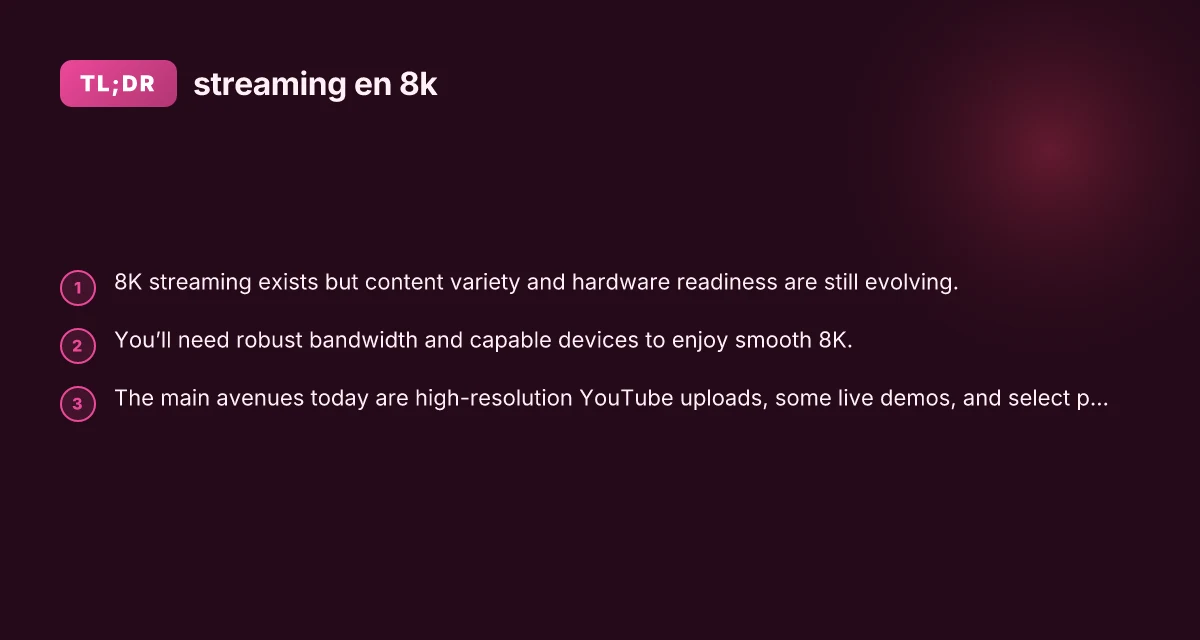
Streaming en 8k: everything you need to know to start watching Streaming en 8k is not yet a universal standard in everyday TV viewing, but it’s moving from the fringe to a more approachable reality. The core idea is simple: content is created, encoded, and delivered at 8K resolution (7680x4320) and then decoded by a compatible device for display. In practice, 8K streaming today tends to rely on a mix of high-resolution YouTube videos, limited live demos, and some niche channels. If you’re curious about watching in 8K, here’s what matters, what’s available, and how to get set up.

What 8K streaming currently looks like
Availability and content
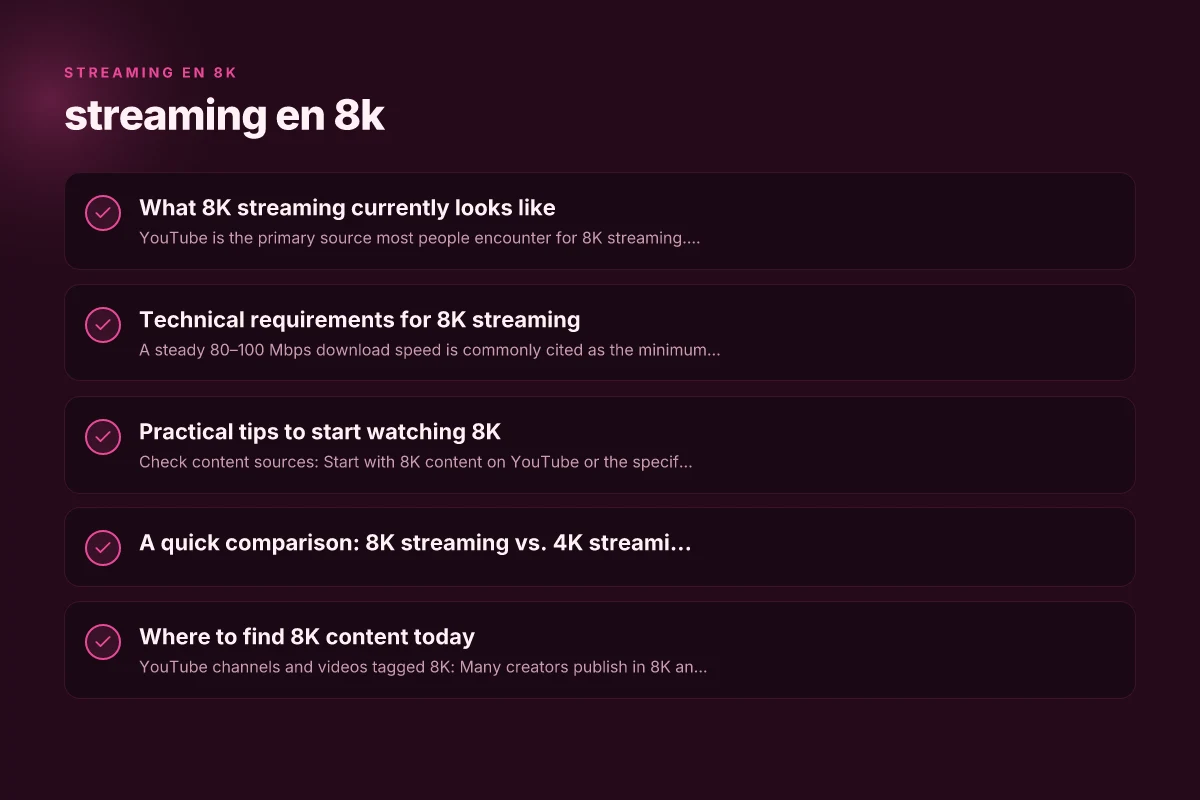
- YouTube is the primary source most people encounter for 8K streaming. Creators upload 8K content, and viewers with capable hardware can select 8K playback.
- Live 8K streaming over the internet has been demonstrated by industry groups, but broad availability for everyday consumers remains limited. Demonstrations emphasize 8K with HEVC (H.265) compression and specialized software players.
- Other platforms and services mention 8K content, but the catalog is far smaller than 4K or HD. Expect a lot of 4K content with 8K upscaling rather than true native 8K streams in the wild today.
How 8K content differs from 4K
- Resolution: 8K has four times as many pixels as 4K, which can yield more detail, especially on large screens.
- Bitrate and compression: Achieving good 8K quality requires efficient codecs (HEVC, AV1) and careful bitrate management. The higher the bitrate, the better the detail, but also the higher the bandwidth requirement.
- Content sources: Native 8K footage is still relatively scarce. Many 8K experiences come from upscaled 4K or from short-form content designed specifically for 8K resolution.
Technical requirements for 8K streaming
Bandwidth and internet speed
- A steady 80–100 Mbps download speed is commonly cited as the minimum for smooth 8K streaming with decent compression.
- Real-world results vary: network stability, latency, and other household usage can affect performance. A wired Ethernet connection is generally more reliable than Wi‑Fi for 8K streams.
Devices that support 8K streaming
- Televisions: A growing number of 8K TVs exist from major brands, but not all models expose all streaming apps at 8K by default. You’ll want a TV that explicitly lists 8K streaming capability and supports the codec used by the content (HEVC or AV1).
- Media devices: Some high-end streaming boxes and media players can decode 8K content, provided they have sufficient bandwidth and processing power.
- Computers and monitors: A PC with a modern GPU and a monitor capable of 8K can display 8K streams, but real-world playback depends on the browser or app and the applicable codecs.
- Display capabilities: A truly immersive 8K experience also relies on screen size and viewing distance. At typical living-room distances, the perceived improvement from 4K to 8K is more noticeable on very large displays (75 inches and up) or when sitting close to the screen.
Codecs and streaming tech
- HEVC (H.265) and AV1 are the main codecs used for 8K streaming, with HEVC more common today and AV1 gradually gaining traction due to efficiency.
- Adaptive streaming: 8K content often uses adaptive bitrate streaming so the player can switch between resolutions based on network conditions, though 8K at a high bitrate may still require stable conditions.
- HDR: Some 8K streams offer HDR (HDRO/PQ) to improve color and contrast, but HDR availability is separate from resolution and depends on both content and display capabilities.
Practical tips to start watching 8K
- Check content sources: Start with 8K content on YouTube or the specific platform’s 8K category to gauge what’s actually available and whether your setup handles it well.
- Guarantee bandwidth: If your household has multiple heavy users (gaming, 4K streams, downloads), consider upgrading to a plan that guarantees higher sustained speeds and use a wired connection for the 8K device.
- Optimize your setup: Ensure your streaming device and TV firmware are up to date. Use high-quality cables and, if possible, connect your 8K device directly to your router with Ethernet.
- Test before committing: If you’re evaluating an 8K setup, try streaming a known 8K video and observe bitrate, buffering, and visual quality before considering any expensive upgrades.
A quick comparison: 8K streaming vs. 4K streaming
| Aspect | 8K streaming | 4K streaming |
|---|---|---|
| Resolution | 7680x4320 | 3840x2160 |
| Typical bandwidth | 80–100 Mbps+ for smooth playback | 15–25 Mbps for good quality (depending on HDR) |
| Content availability | Limited; mainly YouTube 8K uploads, demos | Broad; most streaming services offer extensive 4K catalogs |
| Hardware requirements | High: powerful TV/box, robust network | Moderate to high, but more common across devices |
| Use case | Large screens, close viewing distances, high-detail content | Everyday viewing on most TVs and devices |
Where to find 8K content today
- YouTube channels and videos tagged 8K: Many creators publish in 8K and offer direct 8K playback. This is currently the most accessible source for true 8K material.
- 8K live demos: Industry groups have shown live 8K streaming capabilities, but these are typically demonstrations rather than widely available channels you can subscribe to.
- Niche platforms and labs: Some platforms experiment with 8K streaming, often focusing on live events or experimental content. Availability varies by region and device.
Common questions users ask
- Is there anything streaming in 8K? Yes, primarily on YouTube and certain experimental platforms. Live 8K streaming is shown in demonstrations but not yet ubiquitous.
- Is there an 8K streaming device? There are 8K-capable TVs and some high-end media players. However, device support for 8K streaming apps depends on codecs and app availability.
- Can I watch Netflix in 8K? As of now, mainstream streaming services like Netflix do not broadly offer 8K streaming. Some content may be upscaled to 8K on select displays, but native 8K titles are limited.
- Is 8K actually better than 4K? For very large screens and close viewing distances, 8K can offer more detail, but the improvement depends on content, display size, and viewing distance. On many setups, 4K remains the practical standard.
Practical roadmap for a first 8K streaming setup
- Verify your bandwidth: Run speed tests and aim for consistent 80–100 Mbps on the device you’ll use for 8K watching. If you share your network, consider a quality-of-service setup or a wired connection.
- Pick the hardware: Choose an 8K TV or a capable media player that lists 8K streaming support and the codecs you expect (HEVC or AV1). Ensure your device is updated to the latest firmware.
- Source 8K content: Start with YouTube 8K videos to test motion handling, color, and compression. Look for videos with good bitrate settings to see the best possible detail.
- Test HDR and color: If you value color accuracy, ensure your display supports HDR and that the 8K content you watch includes HDR metadata. This improves perceived quality, especially in scenes with bright highlights and deep shadows.
- Manage expectations: Even with 8K capable gear, you’ll find content gaps and occasional buffering depending on your network. Use 8K selectively for the best observed benefit and enjoy 4K for most daily viewing.
Recommendation If your goal is to experiment with 8K streaming now, start with a solid, wired home network and an 8K-capable TV or streaming box, and dip into YouTube’s 8K library to judge real-world benefits. Don’t expect Netflix-level 8K availability today. Treat 8K as an exciting frontier with growing support, rather than a mainstream feature. For most households, a well-implemented 4K setup remains the most practical balance of content, cost, and reliability, while 8K serves as a niche but intriguing upgrade path for very large screens and enthusiasts who crave the utmost detail.