How to add browsec to Google
Learn how to add Browsec VPN to Google Chrome and use it to browse privately and access restricted sites.

Browsec VPN is a popular Chrome extension that helps hide your IP address and browse more privately. If you’re looking to add Browsec to Google Chrome (often phrased as “add Browsec to Google” by users), this guide walks you through the exact steps. It’s a straightforward process, and once installed you can switch between locations and customize how Browsec behaves.

What Browsec does for Chrome users
- Protects your IP address while you browse.
- Lets you access sites that might be blocked in your region.
- Offers a simple, user-friendly interface right in your browser.
Quick feature snapshot
- Country selector: Choose the virtual location you want to appear from.
- One-click protection: Flip the VPN on or off with a single toggle.
- Free and paid tiers: The free version covers essential browsing needs. Paid plans add more locations and faster speeds.
Step-by-step: how to add Browsec to Google Chrome
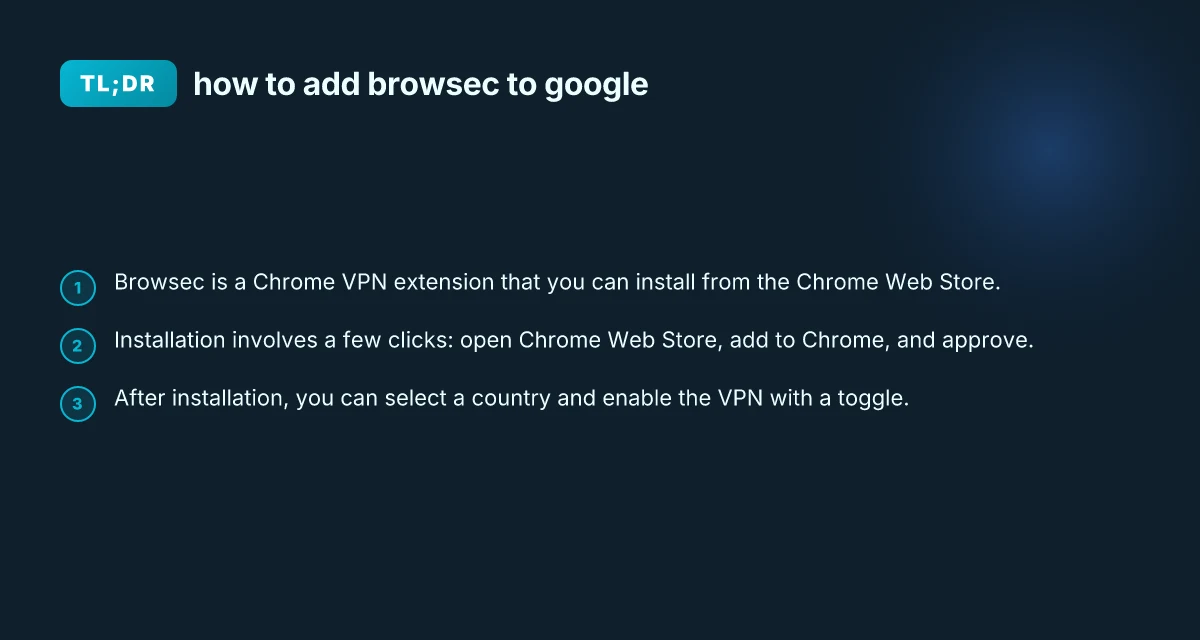
- Open Google Chrome and go to the Chrome Web Store.
- In the search bar, type Browsec VPN and press Enter.
- Click the Browsec VPN – Free VPN for Chrome result (the extension page).
- Click Add to Chrome. A confirmation dialog will appear.
- In the confirmation dialog, click Add extension. Chrome will install Browsec, and you’ll see its icon appear to the right of the address bar.
Optional: sign in or create an account
- Some Browsec features may require you to sign in for sync across devices.
- If you already have a Browsec account, sign in to access your settings quickly.
How to use Browsec after installation
- Click the Browsec icon in the Chrome toolbar to open the extension.
- Use the country picker to select a location. This changes your apparent IP address from that country.
- Toggle the VPN on or off with the main switch.
- Explore additional settings for auto-connect, exclusions, and other preferences.
Common usage tips
- When you don’t need the VPN, turn it off to browse with your real IP and potentially faster speeds.
- If a site refuses a connection, try a different country location and refresh.
- Be mindful of streaming or high-bandwidth sites; Browsec performance can vary by location and network conditions.
Browsec extension vs. browser privacy in general
| Aspect | Browsec Extension (Chrome) | Built-in privacy considerations |
|---|---|---|
| IP masking | Yes, via VPN server location | Varies by browser and settings; may not hide IP on all requests |
| Site unblocks | Yes, to access geo-restricted content | Depends on site and network |
| Encryption | Encrypts browser traffic between you and Browsec server | Browser encryption still protects data in transit to websites; VPN adds an extra layer |
| Speed impact | Potential slowdown due to routing | Browsing speed can be affected by VPN distance and server load |
| Setup effort | Very low; 1–2 minutes | May require more configuration for some privacy features |
Troubleshooting common issues
- Browsec not showing in Chrome: Ensure you’re using the latest version of Chrome and that you installed from the official Chrome Web Store.
- Extension gray or not enabling: Check Chrome’s extension settings to confirm Browsec is allowed to run in incognito mode if you want that option.
- Slow connection: Try a closer country, switch servers within Browsec, or pause any other bandwidth-heavy extensions.
- Connection drops: Toggle Browsec off and on again, or restart Chrome.
Safety and best practices
- Verify the source: Always install from the official Chrome Web Store page for Browsec to avoid fake extensions.
- Review permissions: Extensions can request permissions. Ensure they align with the extension’s function.
- Privacy expectations: A VPN extension adds a layer of privacy, but it isn’t a replacement for comprehensive security practices. Use HTTPS sites, keep your browser updated, and be mindful of data you share online.
- Free vs. paid: Free Browsec usage may have limitations or ads. Consider a paid plan if you need more locations or higher performance.
Alternatives and complementary tools
If Browsec doesn’t meet your needs, you might explore:
- Other Chrome VPN extensions with similar features.
- Standalone VPN apps that cover more devices beyond Chrome.
- Privacy-focused browsers or Tor for particular use cases.
Quick comparison: Browsec in Chrome vs. other VPN options
- Ease of use: Browsec is one of the simplest options for Chrome users.
- Scope: Browsec covers Chrome traffic. Standalone VPN apps cover all traffic on a device.
- Locations: Free Browsec typically offers a subset of locations. Paid plans expand this.
- Performance: Browser-based VPNs can be fast for light browsing but may be less suitable for high-bandwidth tasks.
Final thoughts and recommendation If your goal is to quickly and easily add a VPN layer to Google Chrome to hide your IP and access geo-restricted content, Browsec is a solid starting point. The installation is straightforward: search in the Chrome Web Store, add to Chrome, and start using it with a simple toggle and country selector. For most everyday browsing tasks, Browsec provides a good balance of convenience and functionality. If you need broader device protection or more location options, consider pairing Browsec with a full-featured VPN service or exploring alternative extensions. Always stay mindful of privacy and security best practices to maintain a safe online experience.