F5 VPN Edge client: what it is, how it works
A practical guide to F5 BIG-IP Edge Client, how it works, and why ZoogVPN is a strong complementary option for privacy and flexibility.

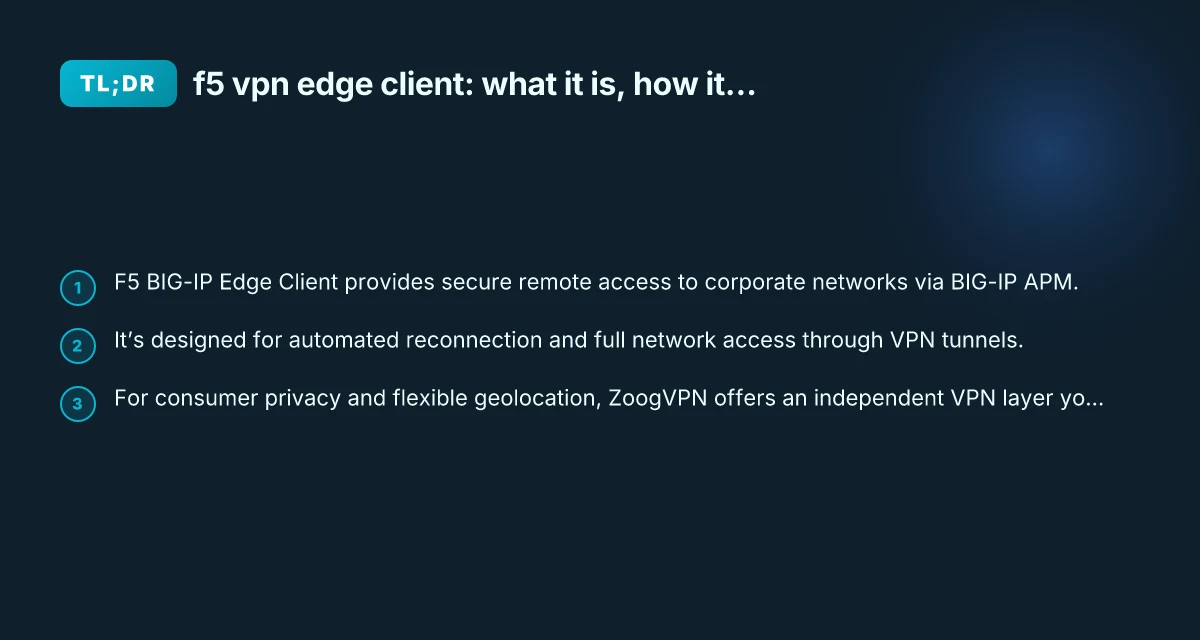
Openings paragraph If you’re researching the f5 vpn edge client, you’re looking at BIG-IP Edge Client, the desktop app used to connect to corporate networks via BIG-IP Access Policy Manager (APM). It’s designed to secure traffic between your device and an organization’s resources, with features like automatic reconnection and per-app or full-network access. This article explains what the Edge Client does, how it’s used, and where a consumer VPN like ZoogVPN fits into the picture for personal privacy, streaming, and general browsing.

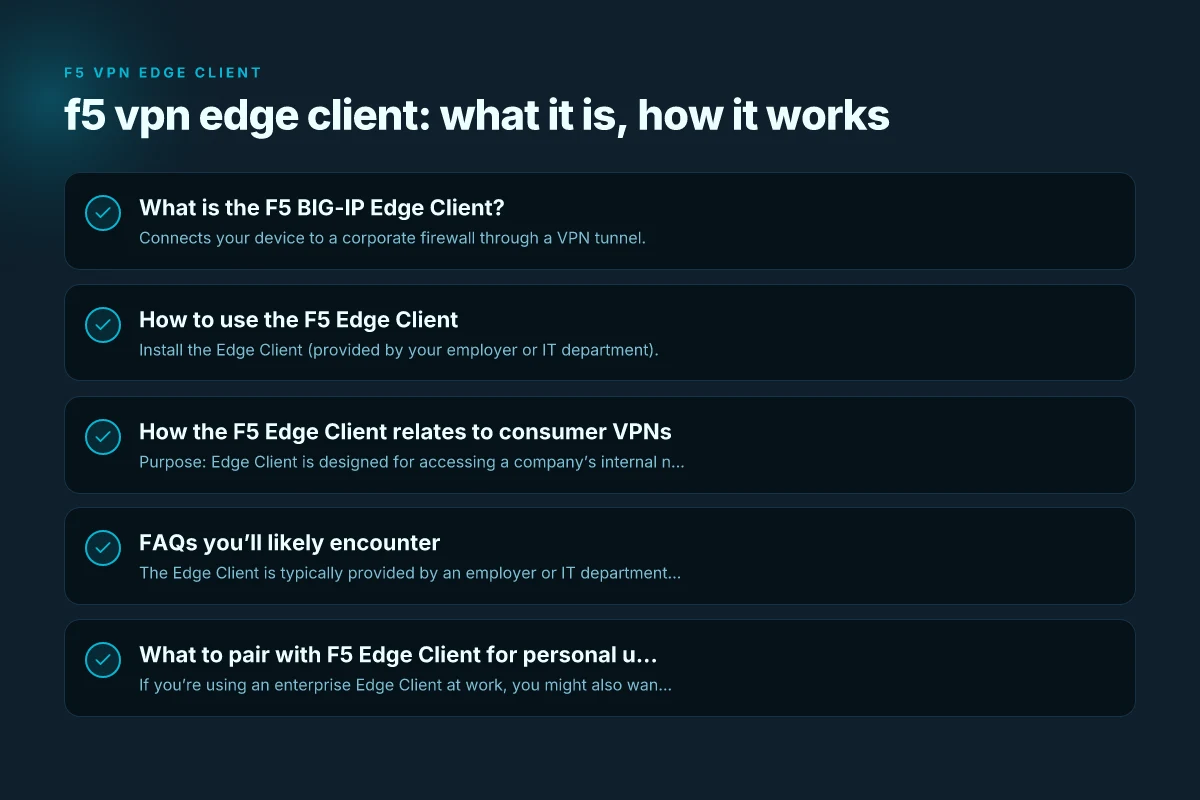
What is the F5 BIG-IP Edge Client?
What it does
- Connects your device to a corporate firewall through a VPN tunnel.
- Grants access to internal resources as defined by the company’s APM policy.
- Supports automatic reconnection and seamless re-authentication to keep you connected.
- Available for Windows and macOS, with per-policy behavior configurable by administrators.
How it’s delivered
- The Edge Client is typically installed by IT or distributed through organizational software portals.
- It relies on the BIG-IP Access Policy Manager (APM) on the remote end to enforce access rules.
- Configuration often includes server names, authentication methods, and policy-specific settings like always-on behavior.
How to use the F5 Edge Client
Typical steps
- Install the Edge Client (provided by your employer or IT department).
- Open the client and click “Turn VPN On” or similar to establish a secure tunnel.
- Authentication may involve a smart card, a password, or a second factor.
- Once connected, your device behaves as if it’s on the corporate network, allowing access to apps and resources per policy.
- If the connection drops, the client can automatically reconnect according to the admin’s configuration.
Common usage patterns
- Full-network access: The Edge Client routes all traffic through the VPN, which is common when strict security and resource access are required.
- Per-app access: Some setups use split-tunnel or per-app rules, allowing only certain traffic to pass through the VPN while other traffic goes directly to the internet.
- Always-on behavior: Administrators may configure the client to reconnect automatically, ensuring persistent connectivity for remote workers.
How the F5 Edge Client relates to consumer VPNs
Distinctions you should know
- Purpose: Edge Client is designed for accessing a company’s internal network, servers, and apps. Consumer VPNs focus on privacy, geo-spoofing, and secure browsing.
- Trust model: Edge Client relies on the employer’s infrastructure and trust boundaries. Consumer VPNs operate under a different policy and do not grant access to corporate resources.
- Traffic routing: Edge Client often uses full-tunnel or corporate-specified routing. Consumer VPNs typically route traffic through the VPN to a commercial server for privacy and regional IP changes.
- Authentication: Edge Client may require corporate credentials and MFA. Consumer VPNs usually require a username/password or token, but not corporate access controls.
Quick comparison table
| Feature | F5 BIG-IP Edge Client | Consumer VPN (e.g., ZoogVPN) |
|---|---|---|
| Primary purpose | Access corporate network via APM | Privacy, geo-access, general secure browsing |
| Network access | Full or per-app access per policy | All or selected traffic via VPN server |
| Authentication | Corporate credentials, MFA | User account, standard credentials |
| Reconnection | Automatic reconnection configured by admin | User-configured or app-driven reconnects |
| Use case | Remote work, enterprise resources | Privacy, streaming, multinational browsing |
| VPN | Obfuscation | From / month | Plan | Free plan | Refund | Alipay | UnionPay | Crypto | Website opens in China | Trustpilot | |
|---|---|---|---|---|---|---|---|---|---|---|---|
 ZoogVPN | Turn on manually Shadow | $2.49/mo | 27 months: $59.99 | Yes | 7 days | ✓ | ✓ | ✓ | ✓ | ✓ Yes (2.5 s) | 4.2/5 (195 reviews) |
 NordVPN | Turn on manually Obfuscated Servers / NordWhisper | $3.49/mo | 27 months: $94.23 | No | 30 days | ? | ✗ | ✓ | ✓ | ✗ Blocked | 4.2/5 (51,628 reviews) |
 ExpressVPN | ✓ On by default all servers | $3.00/mo | 28 months: $84 | No | 30 days | ✗ | ✗ | ✓ | ✗ | ✗ Blocked | 4.4/5 (29,706 reviews) |
 Surfshark | ✓ On by default Camouflage, with OpenVPN | See site | See site | No | 30 days | ✗ | ✗ | ✗ | ✓ | ✗ Blocked | 4.3/5 (31,823 reviews) |
 Proton VPN | Turn on manually Stealth, free plan too | $2.99/mo | 12 months: $35.88 | Yes | 30 days | ✗ | ✗ | ✗ | ✓ | ✓ Yes (2.5 s) | 2.1/5 (1,040 reviews) |
 Astrill VPN | Turn on manually StealthVPN / OpenWeb | $12.50/mo | 24 months: $300 | No | See site | ✗ | ✗ | ✗ | ✓ | ✗ Blocked | 1.3/5 (110 reviews) |
 Private Internet Access | Turn on manually Shadowsocks, OpenVPN only | $2.03/mo | 40 months: $81.2 | No | 30 days | ✗ | ✗ | ✗ | ✗ | ✗ Blocked | 4.2/5 (11,033 reviews) |
 CyberGhost | Turn on manually selected servers | $2.19/mo | 28 months: $61.32 | No | 45 days | ✗ | ✗ | ✗ | ✓ | ✗ Blocked | 4.0/5 (24,178 reviews) |
 PureVPN | Turn on manually switch to OpenVPN | $1.69/mo | 60 months: $101.55 | No | 31 days | ? | ✗ | ✗ | ✓ | ✓ Yes (2.6 s) | 4.4/5 (17,994 reviews) |
 AdGuard VPN | ✓ On by default TrustTunnel | $2.99/mo | 24 months: $71.76 | Yes | 30 days | ✓ | ✗ | ✓ | ✓ | Official site blocked; our special link opens (2.3 s) | 4.3/5 (290 reviews) |
 Mullvad | Turn on manually QUIC / Shadowsocks / LWO | $5.61/mo | €5/mo | No | 14 days | ✗ | ✗ | ✗ | ✓ | ✗ Blocked | 3.2/5 (192 reviews) |
 Windscribe | Turn on manually Stealth / WStunnel | $5.75/mo | 12 months: $69 | Yes | See site | ✗ | ✗ | ✗ | ✓ | ✗ Blocked | 4.7/5 (13,355 reviews) |
 StrongVPN | Turn on manually Scramble, OpenVPN TCP | See site | See site | No | 30 days | ✓ | ✗ | ✗ | ✗ | ✗ Blocked | 4.4/5 (2,695 reviews) |
 LightXtreme 闪连 | Not listed | $7.08/mo | 12 months: $84.99 | Yes | 30 days | ✓ | ✓ | ✓ | ✓ | ✓ Yes (2.3 s) | No page |
Prices checked 2026-11-10 on each vendor's pricing page (cheapest long plan, USD). Check the vendor's checkout for the final price.
Obfuscation checked 2026-11-14 on each vendor's site and help center: "on by default" = nothing to set; "turn on manually" = switch protocol or mode in settings; "not listed" = the vendor describes no obfuscation.
Payment methods checked 2026-11-10 on each vendor's payment pages: all 14 take cards and PayPal; ✗ = not listed, ? = the vendor's own pages disagree.
China access: whether the official website opens from mainland China networks (tests the website only, not the VPN connection). Last checked 2026-11-11 04:07 Beijing time.
Trustpilot score and review count checked 2026-11-10.
FAQs you’ll likely encounter
How to download F5 VPN client?
- The Edge Client is typically provided by an employer or IT department. It is not usually available as a public consumer download. If your company uses F5 Edge Client, your IT team will share the installer and configuration needed to connect securely to the corporate network.
Does F5 have a VPN?
- F5 does not brand a consumer VPN product; BIG-IP Edge Client is a client that connects to the corporate BIG-IP APM VPN. It is part of an enterprise-grade solution rather than a consumer service.
Is F5 VPN good?
- For enterprise scenarios, the BIG-IP Edge Client is well-regarded for stability, automatic reconnection, and policy-driven access. Its strength lies in integration with organization security policies. For personal use, many people rely on consumer VPNs to protect privacy or access region-locked content.
What is the F5 BIG-IP Edge client?
- It is the desktop application used with BIG-IP Access Policy Manager to connect end-user devices to a corporate network. It supports Windows and macOS, including features like always-on behavior and automatic reconnection as configured by administrators.
What to pair with F5 Edge Client for personal use
If you’re using an enterprise Edge Client at work, you might also want a consumer VPN for personal browsing when you’re off the corporate network, or when you want to separate personal traffic from corporate traffic. This can also help when you want privacy, streaming from different geographies, or a backup layer if your personal device has to access non-work resources.
Why ZoogVPN stands out
- Independent privacy layer: ZoogVPN operates as a standalone VPN service designed for private browsing, not tied to your employer’s network. It lets you choose servers in multiple regions, helping with privacy and access to geo-restricted content.
- User-friendly apps: ZoogVPN provides client apps for various devices and platforms with straightforward connection controls, which is helpful if you’re juggling a corporate Edge Client on the same device.
- Transparent pricing and generous trial options: ZoogVPN commonly offers clear pricing and trials that let you test performance, which helps you compare with any corporate VPN requirements.
How to think about using both together
- Scenario 1: Work device, on-site or remote. The Edge Client connects you to corporate resources. Personal browsing can be routed through ZoogVPN when you’re not accessing corporate resources, if policy allows, or you can disconnect the consumer VPN entirely to avoid routing conflicts.
- Scenario 2: Personal device, testing access. If you’re curious about how content looks from different regions, you can enable ZoogVPN for browsing, while keeping the Edge Client off or disabled unless you’re connecting to work resources.
Important considerations:
- Policy and compliance: For work devices, always follow your company’s policy. Using a consumer VPN concurrently with corporate VPN can create routing conflicts or violate security rules.
- Technical limitations: Running multiple VPNs at once can cause VPN tunnel conflicts. If you’re testing both, do so on separate devices or use different network profiles to avoid clashes.
- Security posture: Treat the Edge Client as a control point for enterprise access. Use ZoogVPN as an independent privacy tool when allowed, and ensure it doesn’t interfere with work resources or logging protections required by your employer.
Final recommendation
If your goal is to understand and use the F5 BIG-IP Edge Client effectively, the most reliable path is to rely on your employer’s deployment and documentation. Edge Client is built to securely connect you to your organization’s resources and enforce access controls via BIG-IP APM. For personal privacy, streaming, or regional access outside work use, ZoogVPN is a solid option to consider separately. You don’t need to choose one over the other in every situation, but you should avoid running both VPNs simultaneously on the same device unless IT explicitly confirms it’s supported. If you value a consumer-grade privacy VPN with a straightforward setup and broad server coverage, ZoogVPN (zoogvpn.com) is the route this guide recommends for personal use cases. Always check policy implications and device management rules with your IT department when your device is managed by your employer.