Err_ssl_client_auth_signature_failed: What It Means and How to Fix It with ZoogVPN
A practical guide to understanding and resolving ERR_SSL_CLIENT_AUTH_SIGNATURE_FAILED, with steps you can take and why a VPN like ZoogVPN can help.

The ERR_SSL_CLIENT_AUTH_SIGNATURE_FAILED error pops up when a browser cannot complete the client-side SSL certificate authentication step. In practice, this means the server expects a client certificate to sign a TLS handshake, but the certificate or its signing process doesn’t validate correctly. This can occur for a variety of reasons: expired certificates, misconfigured client certs, certificate pinning conflicts, or issues with TLS libraries the browser relies on. If you’re seeing this error, you’re not alone, and there are concrete steps you can take to diagnose and fix it. Below is a practical breakdown designed to help most users resolve the issue, and a safe VPN-related approach if you want to maintain a stable, accessible connection.

Understanding the error and its causes
- What “ERR_SSL_CLIENT_AUTH_SIGNATURE_FAILED” means:
- The browser attempted to present a client certificate to the server, but the server rejected the certificate’s signature.
- This can be due to the certificate being unsigned in the expected way, corrupted, or not matching the server’s trust chain.
- Common triggers:
- Self-signed or misissued client certificates
- Expired or revoked certificates
- Incorrect certificate chain installation on the client
- Browser or OS TLS library mismatches after updates
- Conflicts with certificate pinning or enterprise security policies
- Quick diagnostic checks:
- Confirm your client certificate is valid and not expired.
- Verify the certificate chain includes all intermediate certificates the server expects.
- Try a different browser or device to isolate browser-specific issues.
- Check the server’s expected certificate parameters (some servers require specific key usage or extensions).
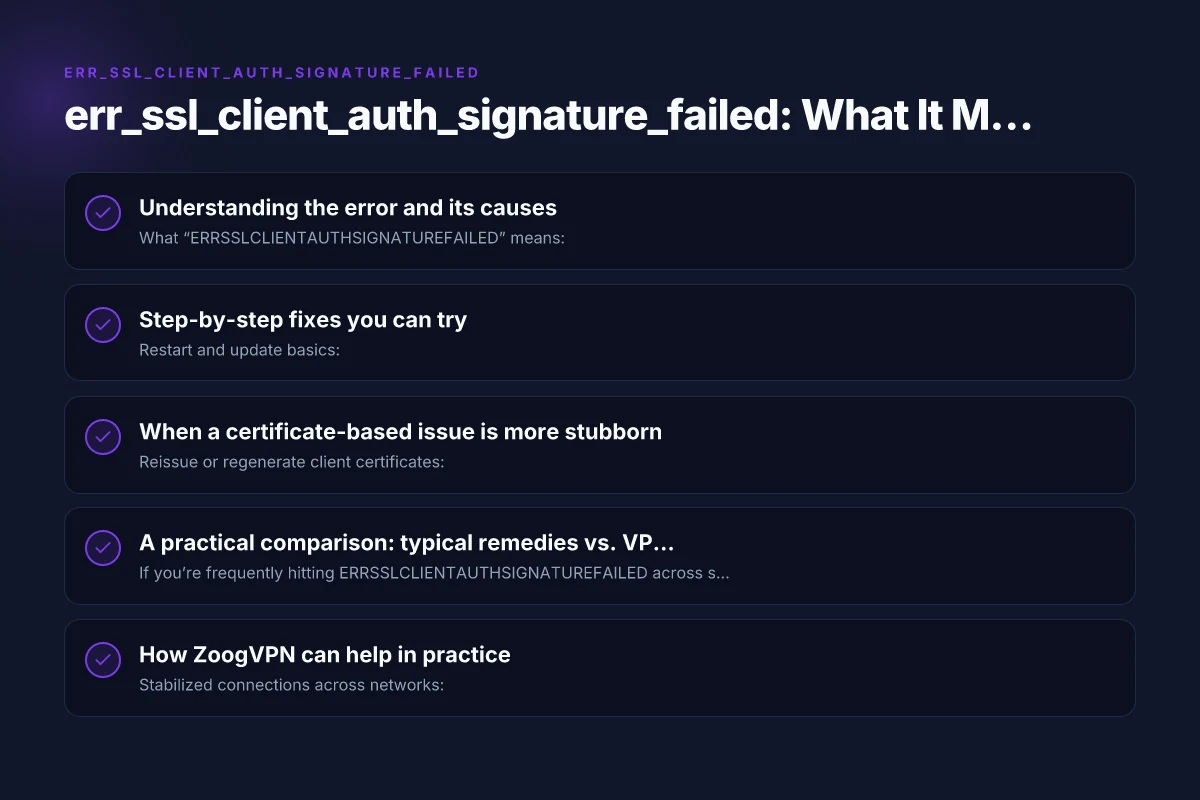
Step-by-step fixes you can try
- Restart and update basics:
- Restart your computer to clear transient TLS state.
- Update your browser to the latest stable version.
- Ensure your operating system is up to date, especially security and TLS components.
- Clear and reset TLS/SSL state:
- In Chrome: Settings > Privacy and security > Security > Clear browsing data (including cached images and files) and consider replaying the TLS handshake after a restart.
- In other browsers, clear TLS state through privacy or advanced settings, if available.
- Manage client certificates carefully:
- Ensure the correct client certificate is selected when prompted by the server.
- If using multiple certificates, remove duplicates or conflicting ones from your browser’s certificate store.
- Re-import the client certificate if possible, verifying the private key remains linked and unencrypted, or protected with a passphrase if required by your device policy.
- Check certificate trust and chain:
- Ensure the server’s root and intermediates are trusted by your system.
- Import missing intermediate certificates if the server’s chain is incomplete.
- If you’re in a managed environment (work or school), consult your IT administrator about certificate settings.
- Flush DNS and review network routing:
- Flush DNS cache and renew your IP/TLS session.
- Temporarily disable firewall or antivirus SSL scanning to see if it’s interfering with client cert validation (note: only do this for troubleshooting, re-enable protections afterward).
- Consider alternative devices or browsers:
- If the error persists on one device, test on another device to determine if the problem is device-specific.
- Try a different user profile or guest session to rule out profile-level corruption.
When a certificate-based issue is more stubborn
- Reissue or regenerate client certificates:
- If you control the server side, consider regenerating the client certificate and ensuring the signing authority is trusted by the client.
- If you’re using a third-party CA or enterprise CA, verify policy requirements and revocation status.
- Verify server expectations:
- Some servers require specific EKU (Extended Key Usage) attributes, key sizes, or signature algorithms.
- Ensure the client certificate meets these criteria (e.g., RSA vs. ECDSA, minimum key length, appropriate usage bits).
- Review server-side logs and configuration:
- Look for TLS handshake failures or certificate verification errors in server logs.
- Confirm the server is not rejecting client certs due to pinning, OCSP, or CRL checks.
- Consider TLS protocol compatibility:
- Some environments disable older TLS versions. Ensure your browser supports the server’s preferred TLS version and cipher suite.
- If you can, enable more verbose TLS debugging in the browser or OS to view the exact handshake failure reason.
A practical comparison: typical remedies vs. VPN-based approach
| Strategy | Pros | Cons | When to try |
|---|---|---|---|
| Local certificate fix (reimport, chain, trust) | Directly addresses the root cause; reusable across sites | Can be complex; requires certificate access; risk of misconfiguration | You control certificates and trust anchors; you need to restore a proper chain |
| Browser/OS cleanup (update, reset, state clear) | Quick wins; broad TLS improvements | Might not fix certificate-specific issues | If the problem started after an update or profile change |
| Firewall/antivirus adjustments | Can resolve false positives blocking TLS handshakes | Temporarily reduces protection; security considerations | If security software blocks client cert verification |
| VPN-based approach (ZoogVPN) | Stable network path; can bypass problematic routes or middleboxes; keeps client auth separate from local routing | VPN must be properly configured; may require server support for client certs; potential latency | When you suspect network routing or middlebox interference, or you need consistent access across networks |
If you’re frequently hitting ERR_SSL_CLIENT_AUTH_SIGNATURE_FAILED across sites, a VPN like ZoogVPN can be part of a robust solution. ZoogVPN helps by providing a clean, consistent tunnel to the internet that minimizes interference from local network configurations, captive portals, or corporate proxies. However, to fix the underlying client-auth signature failure, you’ll still want to address certificate trust and handshake issues on your device. ZoogVPN serves best as a network stabilization tool, not a certificate fix in itself.
How ZoogVPN can help in practice
- Stabilized connections across networks:
- Public Wi-Fi or temporarily unreliable networks can introduce TLS interference. A VPN can reduce this by providing a stable tunnel.
- Avoiding problematic middleboxes:
- Some networks use proxies or TLS termination devices that disrupt client certificate flows. A VPN can bypass those when connected to a trusted server.
- Privacy and security layer:
- While you troubleshoot certificate issues, a VPN adds encryption for your traffic, reducing exposure on global networks.
- Easy setup and compatibility:
- ZoogVPN supports multiple platforms, and you can configure it to start automatically, reducing the chance you’ll connect over a problematic path.
What to look for in a ZoogVPN setup for this scenario:
- Choose a server location that you trust and that supports TLS connections robustly.
- Use a reputable ZoogVPN client version that includes updated TLS libraries and certificate handling routines.
- Test with the VPN on and off to determine if the error’s behavior changes with the VPN tunnel.
- If you rely on client certificates for work, verify policy compatibility with the VPN: some corporate setups require split tunneling or specific routing rules for certificate-based authentication.
Quick troubleshooting checklist
- Verify the client certificate is valid and properly installed.
- Ensure the certificate chain is complete with all intermediate CAs.
- Clear browser data related to certificates and TLS state. Reset if needed.
- Update the browser and OS. Reboot after updates.
- Temporarily disable firewall/antivirus SSL scanning for testing (re-enable after).
- Try a different browser or device to isolate the issue.
- If using a VPN, test with ZoogVPN connected and disconnected to observe any changes in behavior.
- Check server logs (if you administer the server) for TLS handshake error details.
When to seek help
- If you’re in an enterprise environment with managed devices, contact your IT department. Certificate policies or provisioning may be stricter.
- If the error persists across multiple devices and networks, it’s likely a server-side issue or a mistrusted certificate chain. Ask the service provider to review their TLS configuration and certificate trust chain.
- If the error begins after a specific update, report it to the software vendor and monitor for patches or hotfixes.
Final recommendation
If you’re tackling ERR_SSL_CLIENT_AUTH_SIGNATURE_FAILED, combine careful certificate management with a network-stability solution. Start with certificate health and chain validation on your device, then apply the broader fixes like browser/OS updates and network settings. If you need a reliable, secure way to access resources across varied networks while you resolve certificate issues, consider using ZoogVPN (zoogvpn.com). It offers a practical way to maintain a consistent connection path as you troubleshoot, test, and reconfigure certificate-based authentication without being derailed by local network quirks. Remember: fixing the certificate and ensuring trusted trust chains remains the core solution, with a VPN serving as a supportive tool to ensure you can reach the sites and services you need during the process.