
Dows the ring 2k use 5g
Explore whether Ring devices (including Ring 2K-era models) can use 5G/Wi‑Fi 5GHz, what models support it, and practical guidance for setup and troubleshooting.

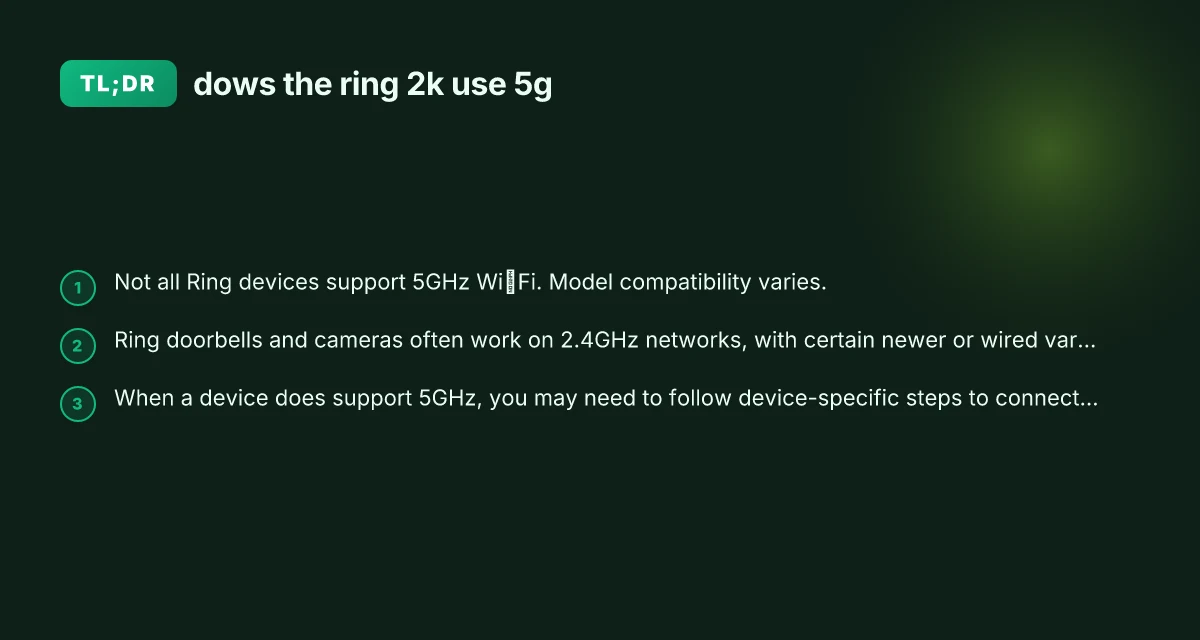
The question of whether the Ring system can use 5G (more precisely, 5GHz Wi‑Fi) with devices like the Ring 2K line is common. The short answer is: it depends on the exact model. Ring’s product lineup includes doorbells and cameras with different wireless capabilities, and not every device supports 5GHz Wi‑Fi. Here’s a detailed guide to help you understand which models can use 5GHz, how to check compatibility, and what to do if you’re facing connection issues.

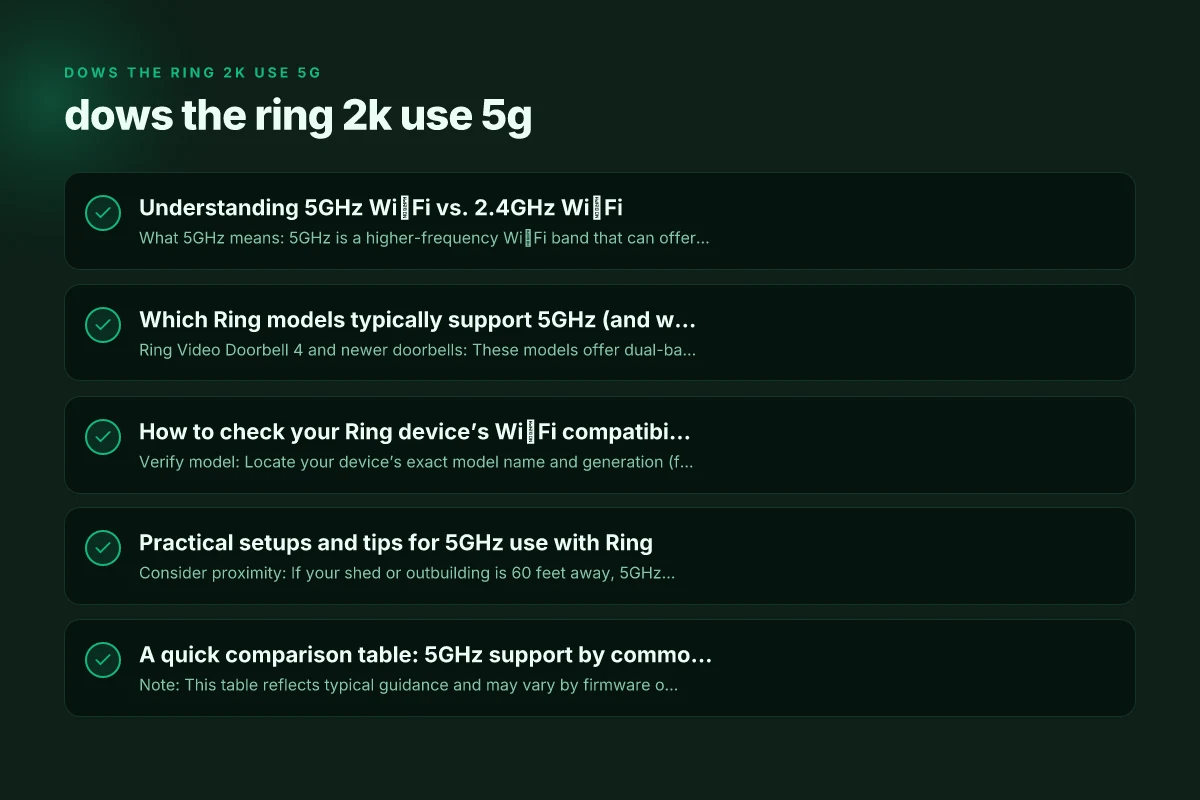
Understanding 5GHz Wi‑Fi vs. 2.4GHz Wi‑Fi
- What 5GHz means: 5GHz is a higher-frequency Wi‑Fi band that can offer less interference and sometimes faster speeds at short distances.
- Trade-offs: 5GHz has a shorter range and weaker penetration through walls compared to 2.4GHz. In a home with sheds, outbuildings, or thick walls, signal strength matters as much as raw speed.
- Dual-band reality: Many modern Ring devices are dual-band-capable in theory, but not all are designed to connect directly to 5GHz. Some models rely on 2.4GHz for reliability or only switch to 5GHz under certain conditions.
Which Ring models typically support 5GHz (and which do not)
- Ring Video Doorbell 4 and newer doorbells: These models offer dual-band capabilities and can connect to 5GHz networks via specific channels. If you are troubleshooting, you’ll want to verify the exact 5GHz behavior for your model.
- Ring Video Doorbell Elite: This model is designed to support dual-band networks and can use 5GHz in supported configurations.
- Ring Wired Video Doorbells (Pro 2, Pro, and other wired variants): Some wired models have dual-band behavior and can connect to 5GHz via certain channels and network configurations.
- Ring Video Doorbell 2 and Ring Video Doorbell (2nd Gen): Historically, these two are more commonly associated with 2.4GHz. They have more limited or inconsistent 5GHz support in practice.
- Ring cameras around the house: Depending on generation, some units may support dual-band, while others rely primarily on 2.4GHz. Always check the official support article for your exact model.
Note: The statements above reflect common guidance found in Ring support articles and community discussions. Always verify with Ring’s official model- and region-specific documentation, as capabilities can vary by firmware and region.
How to check your Ring device’s Wi‑Fi compatibility
- Verify model: Locate your device’s exact model name and generation (for example, Ring Video Doorbell 4 or Ring Video Doorbell Pro 2).
- Check official support pages: Look up “What to do when your Ring [model] has trouble connecting to 5GHz Wi-Fi” on Ring’s site. These articles will specify whether 5GHz is supported and any channel restrictions.
- In-app Wi‑Fi setup: Some Ring devices show available networks during setup. If you only see 2.4GHz networks, your device might be limited to 2.4GHz or require a firmware update or alternative setup approach.
- Community experiences: User reports often discuss success or trouble with 5GHz. Use them as a sanity check, but rely on official documents for definitive compatibility.
Practical setups and tips for 5GHz use with Ring
- Consider proximity: If your shed or outbuilding is 60 feet away, 5GHz may perform poorly due to distance and obstacles. If a 5GHz-only setup is required for your network, test signal strength at the shed using a phone or a portable Wi‑Fi analyzer.
- Dual-band advantage: If your model supports dual-band, try connecting the device to 2.4GHz first to complete the onboarding, then, if recommended by Ring, attempt a 5GHz connection after ensuring signal quality.
- Use a mesh system or range extender: To maximize reliability on either band, a mesh Wi‑Fi system can provide better coverage across your property, especially toward sheds or detached buildings.
- Ethernet upgradability: For some Ring cameras, wired (Ethernet) connectivity can be an alternative to wireless, delivering more stable performance. If your model or installation allows Ethernet, consider a wired option.
- Channel considerations: Some articles note that 5GHz support may depend on specific channels (e.g., channels 52 and above for certain models). Ensure your router’s 5GHz channel is within a supported range for your device if you’re troubleshooting.
A quick comparison table: 5GHz support by common Ring models
- Note: This table reflects typical guidance and may vary by firmware or region. Always verify with official documentation for your exact device.
Model | 5GHz support Ring Video Doorbell 4 | Yes (dual-band. Can connect to 5GHz via supported channels) Ring Video Doorbell Pro 2 | Yes (dual-band. Supports 5GHz, depending on channels) Ring Video Doorbell 2nd Gen | Typically 2.4GHz primary. Limited/unclear 5GHz compatibility Ring Wired Video Doorbells (Pro 2, Pro) | Dual-band in some configurations. Check channels Other Ring cameras (indoor/outdoor) | Varies by model. Check official specs
Troubleshooting steps if you’re having trouble with 5GHz
- Confirm compatibility: Double-check your device model’s supported bands in the official Ring support article for that exact model.
- Reconnect on 2.4GHz first: If you’re unsure about 5GHz stability, try the standard setup on a 2.4GHz network, then test 5GHz later if the app allows.
- Improve signal: Move your router or the device to improve line-of-sight and reduce walls and obstacles. Consider a mesh node closer to the installation point.
- Reboot and update: Reboot both the Ring device and your router. Ensure firmware on both sides is current.
- Channel stability: If your router uses dynamic 5GHz channels, try manually selecting a channel known to work well with your Ring device as per guidance in your router’s admin interface or the Ring support article.
- Use the official support path: If you hit perpetual disconnects or a failure to join 5GHz, follow Ring’s device-specific troubleshooting guide (e.g., “What to do when your Ring [model] has trouble connecting to 5GHz Wi‑Fi”).
Real-world guidance and common questions
- Do Ring cameras use 2.4 or 5GHz? The answer depends on the model. Many Ring devices historically rely on 2.4GHz, while newer or specific variants are dual-band. Always verify for your exact model and region.
- Which Ring Doorbell uses 5G? The term “5G” is easy to confuse with 5GHz Wi‑Fi. For Ring, you’re usually looking at 5GHz Wi‑Fi compatibility rather than cellular 5G. Some newer or wired doorbells support 5GHz as part of dual-band Wi‑Fi.
- How to change Ring Doorbell to 5GHz? Use the Ring app’s device settings during or after setup to connect to a 5GHz network if supported. If you don’t see a 5GHz option, your device may not support it.
- Which Ring doorbells support 5GHz Wi‑Fi? The official support pages for each model will list whether 5GHz is supported. In general, newer or higher-end models tend to offer dual-band capabilities.
Recommendation and takeaway
- If your priority is reliable coverage across a 60-foot shed distance, don’t assume 5GHz will fix everything. Start by confirming whether your specific model supports 5GHz, then optimize placement and consider a mesh network or a wired option where feasible.
- For installations away from the main router, a dual-band Ring device that supports 5GHz is helpful, but you should test signal strength from the shed and, if needed, use a mesh node or a powered extender to ensure a stable connection.
- Always rely on model-specific guidance from Ring’s official support pages. Firmware updates can alter 5GHz compatibility or behavior, so keep devices up to date and re-confirm compatibility after updates.
If you’d like, tell me your exact Ring model (model name and generation) and your router setup (router model, whether you use a mesh system, current Wi‑Fi channels). I can tailor a step-by-step plan to verify 5GHz compatibility, test signal strength at the shed, and guide you through a best-practice installation to maximize reliability.