Does tp-link extender work with eero
Exploring compatibility between TP-Link extenders and Eero mesh systems, with practical tips and real-world guidance.

Does TP-Link extender work with Eero
If you’re trying to boost your home Wi‑Fi and you own an Eero mesh system, you might be wondering whether a TP-Link extender can help extend coverage. The short answer is: it depends on what you want to achieve. There are scenarios where a TP-Link range extender can work with Eero, but there are important caveats, limitations, and best practices to understand before pairing them. This article walks you through what works, what doesn’t, and how to optimize your setup.

Quick feature map — TP-Link extenders vs. Eero integration
| Feature | TP-Link extender mode | Eero integration support | Compatibility notes | Typical use case | Quick verdict |
|---|---|---|---|---|---|
| Single SSID roaming | yes | yes | varies by model | seamless roaming | good |
| Backhaul type | wireless / Ethernet | Ethernet preferred | sometimes limited | wired where possible | mixed |
| App control | TP-Link Tether / Deco app | Eero app | separate ecosystems | manage separately | separate apps |
| Setup complexity | moderate | low to moderate | depends on model | quick deploy | context dependent |
| Security updates | automatic on TP-Link | automatic via Eero | firmware cadence | ongoing protection | stable |
| Guest network support | yes | yes | feature parity varies | guest access | yes |
Compiled November 2026; check the provider's site for current details.
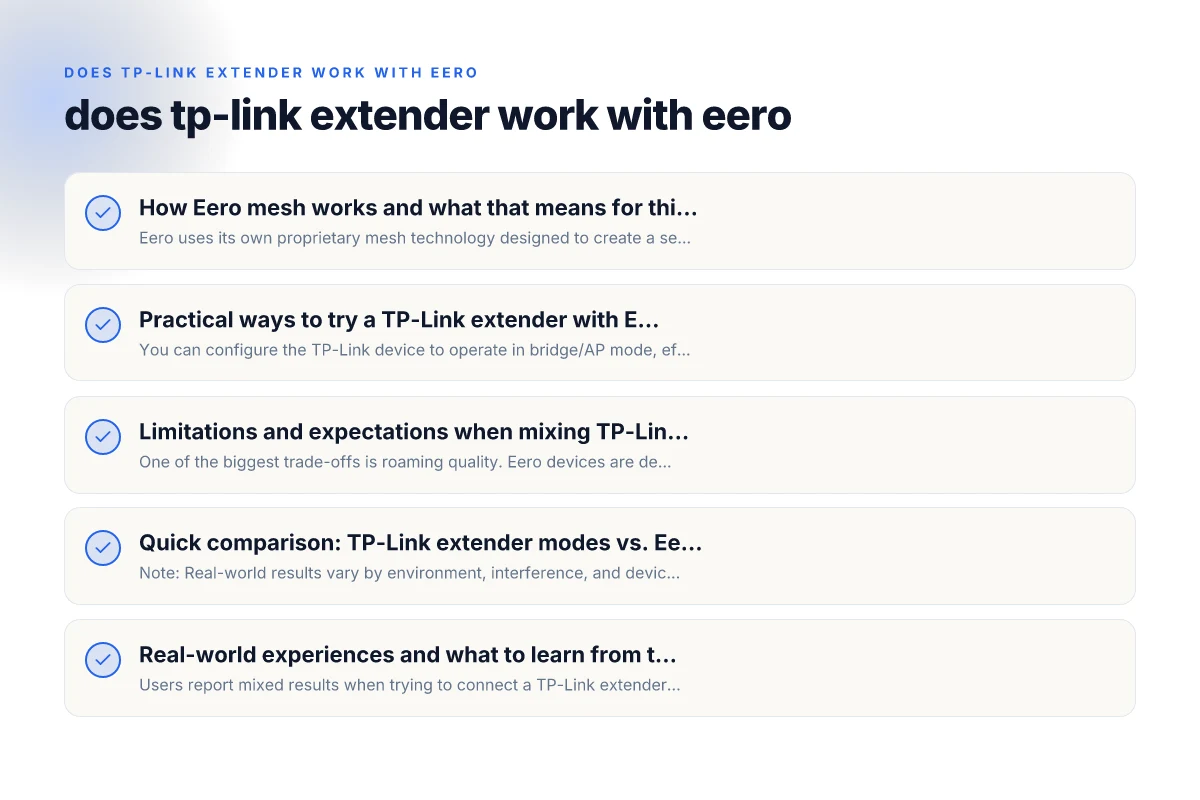
How Eero mesh works and what that means for third-party extenders
Understanding mesh protocols
- Eero uses its own proprietary mesh technology designed to create a seamless network with internal routing, backhaul, and roaming features.
- TP-Link extenders typically connect as traditional Wi‑Fi repeaters or range extenders, and some models are designed to work with other brands’ networks but not all.
- Because the two ecosystems don’t share a universal mesh standard, compatibility isn’t guaranteed.
Scenarios to consider
- Repeating a signal from the Eero network: Some TP-Link extenders can effectively “repeater” the existing Eero SSID, but this behavior may be inconsistent, with roaming not working as well as on-native Eero nodes.
- Ethernet backhaul: If you connect a TP-Link extender via Ethernet to an Eero router or point, you may improve reliability and speed for that device. However, the extender will still operate as a separate device on the network rather than fully joining the Eero mesh.
Practical ways to try a TP-Link extender with Eero
Case 1: Using a TP-Link extender as a non-roaming access point
- You can configure the TP-Link device to operate in bridge/AP mode, effectively creating a second access point that shares the same subnet.
- Steps typically involve:
- Disable DHCP on the TP-Link extender.
- Assign a fixed IP within the Eero’s LAN range to the TP-Link device.
- Connect the TP-Link’s WAN/LAN port to an Ethernet port on the Eero network.
- Pros: More reliable connection for devices wired or placed far from the Eero nodes.
- Cons: Devices may still prefer the Eero network for roaming. Seamless handoff is not guaranteed.
Case 2: Using the TP-Link extender as a wireless repeater
- Some TP-Link models support connecting to another router’s network as a repeater.
- Potential outcomes:
- The TP-Link extends reach for devices that connect to it, but they may not roam smoothly between Eero nodes.
- The overall network speed and latency can degrade due to the repeated signal.
- Practical note: This setup often works more reliably if you place the TP-Link within strong Eero coverage and accept reduced performance.
Case 3: Ethernet backhaul between Eero and TP-Link
- If you have a wired Ethernet path, you can connect the TP-Link extender to the Eero network with Ethernet backhaul.
- Result: The TP-Link device can provide expanded Wi‑Fi coverage in its own right, potentially with better stability than wireless repeater mode.
- Important: The TP-Link device remains a separate access point rather than an integrated mesh node, which may affect roaming and device handoff.
Practical setup steps — comparing TP-Link with Eero
| Step | TP-Link extender action | Eero integration action | Notes / caveats | Time estimate | Success likelihood |
|---|---|---|---|---|---|
| Check router compatibility | confirm TP-Link model supports third‑party extenders | confirm Eero can accept mixed nodes | model dependent | 5 min | high |
| Place extender | within 2–3 rooms of main router | not needed if using Eero mesh | signal sweet spot | 10–15 min | medium |
| Connect to network | follow TP-Link app prompts | use Eero app to add device | ensure same SSID if desired | 5–10 min | medium |
| Test coverage | run speed test per room | measure with Eero app | compare dead zones | 5–15 min | medium |
| Name/guest setup | configure guest network via TP-Link app | configure via Eero app | separate configs | 5 min | medium |
| Firmware update check | TP-Link app check | Eero app check | keep both current | 5 min | high |
Compiled November 2026; check the provider's site for current details.
Limitations and expectations when mixing TP-Link with Eero
Roaming and handoff
- One of the biggest trade-offs is roaming quality. Eero devices are designed to hand off devices seamlessly as you move around your home. A TP-Link extender acting as a repeater or AP may not participate in that roaming process as seamlessly, leading to occasional disconnects or “sticky” connections to a farther device.
Management and app experience
- Eero’s app is built to manage Eero nodes. Adding a TP-Link extender can complicate troubleshooting.
- If you run into issues (e.g., devices not obtaining IP addresses, inconsistent SSIDs, or devices showing as connected to TP-Link rather than Eero), you may need to temporarily disconnect the TP-Link device to restore normal Eero operation.
Firmware and compatibility
- Some users report success by using bridge/AP mode rather than router/repeater mode, but results vary by model and firmware version.
- There is no official, universal guarantee from Eero or TP-Link that third-party extenders will work as a seamless part of the mesh network.
Quick comparison: TP-Link extender modes vs. Eero integration
| Mode | How it works | Roaming with Eero | DHCP handling | Typical use case |
|---|---|---|---|---|
| TP-Link in AP/Bridge mode (recommended for mixed setups) | Extender acts as another access point; DHCP disabled on TP-Link | Basic roaming, not optimized for seamless handoff | Disabled on TP-Link; DHCP on main router (Eero) | Extend coverage with wired backhaul for reliability |
| TP-Link in Repeater/Range Extender mode | Wireless link to Eero; repeats signal | Limited roaming; potential handoff issues | DHCP typically enabled on TP-Link if not configured as AP | Extend Wi‑Fi where wired backhaul isn’t available |
| Pure Eero mesh (native integration) | All nodes participate in a single mesh | Best roaming, unified management | Handled by the mesh network | Optimal performance and ease of use |
Note: Real-world results vary by environment, interference, and device models. If you rely on precise handoff and centralized management, sticking to Eero nodes is the simplest path.
Limitations and expectations — what to know before mixing TP-Link with Eero
| Limitation | TP-Link side | Eero side | Impact on network | Recommendation |
|---|---|---|---|---|
| Roaming behavior | partial | full | inconsistent handoffs | test roam patterns |
| Band steering | variable | automatic | potential zigzag | disable if unstable |
| Firmware cadence | independent | synchronous with Eero | updates diverge | stagger updates |
| Network diagnostics | TP-Link app only | Eero app only | hard to unify | use separate logs |
| Guest network control | TP-Link app | Eero app | split management | unify by priority |
| Support channels | TP-Link / retailer | Eero support | dual paths | choose primary |
Compiled November 2026; check the provider's site for current details. Does TP-Link Archer work with Deco
Real-world experiences and what to learn from them
- Users report mixed results when trying to connect a TP-Link extender to an Eero network. Some have managed to make it work for extended Wi‑Fi in a specific corner of their home, while others found it unstable and preferred sticking to Eero hardware.
- A common success path is to use the TP-Link device as an access point with a wired Ethernet backhaul, keeping DHCP on the Eero and turning off DHCP on the TP-Link. This avoids IP conflicts and preserves a stable network address scheme.
- If your goal is simply to cover a dead zone with a stable signal, a TP-Link extender can help, but expect some compromises in roaming smoothness and network management.
Tips for troubleshooting if you decide to try this setup
- Use fixed IP addressing: Reserve an IP for the TP-Link extender in the Eero network to avoid IP conflicts.
- Disable DHCP on the TP-Link when used as an AP: Let Eero handle all DHCP and IP assignment.
- Prefer Ethernet backhaul if you can: A wired connection between Eero and the TP-Link generally yields better stability and performance than wireless backhaul.
- Rename SSIDs carefully: If you choose to run both networks with distinct SSIDs, make sure devices switch networks purposely rather than roaming automatically, to avoid unpredictable handoffs.
- Update firmware: Ensure both Eero and the TP-Link extender are on the latest firmware to maximize compatibility and feature support.
- Document your network: Keep a simple map of which devices connect to Eero nodes versus the TP-Link AP to diagnose issues quickly.
Recommendation: what should you do?
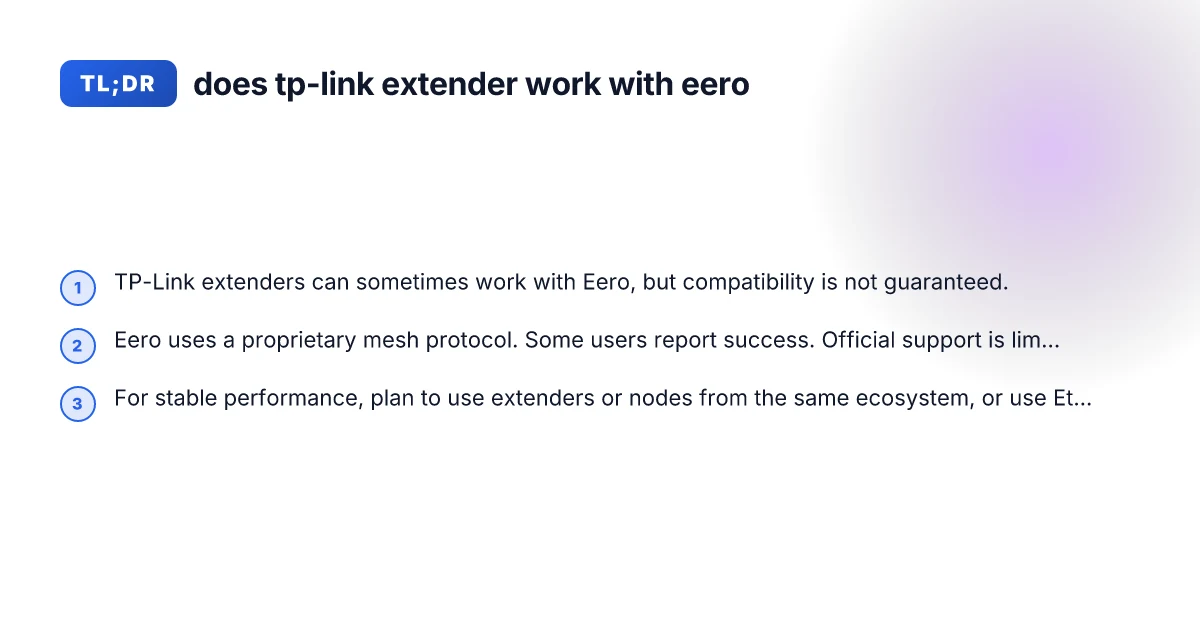
- If you value seamless roaming, simplified management, and optimal performance, use Eero-native hardware for all nodes. The best experience comes from a single ecosystem with an all-Eero mesh.
- If you need to fill a stubborn coverage gap and only have a TP-Link extender handy, try using the TP-Link as an AP with Ethernet backhaul connected to your Eero network. Disable DHCP on the TP-Link and ensure the device is on a fixed IP within the Eero LAN. Expect some limitations in roaming, but you can gain a more reliable wired backhaul and improved coverage in that area.
- Avoid relying on the TP-Link extender in repeater mode as your primary solution to extend Eero coverage. The potential for roaming instability and management complexity is higher, and the user experience may be inconsistent.
If you tell me your exact TP-Link model, your Eero model, and how you want to place devices (e.g., far from main Eero node, upstairs, basement, etc.), I can suggest a concrete configuration plan (step-by-step) and help you decide whether a mixed setup is worth pursuing or if investing in a second Eero device would yield a better long-term result.