
Best VPN for opnsense
A practical guide to VPN options on OPNsense, focusing on OpenVPN, WireGuard, and IPsec plus setup guidance and recommendations.

OPNsense is a popular open-source firewall and routing platform that runs on commodity hardware. When you’re choosing a VPN solution for OPNsense, you’re balancing compatibility with clients, ease of use, performance, and security features. The main VPN options you’ll encounter on OPNsense are OpenVPN, WireGuard, and IPsec. Each has strengths and trade-offs, and your best choice depends on your environment, client devices, and management preferences.

Comparison at a glance of VPN options on OPNSense
| VPN option | Ease of setup | Performance notes | Encryption / protocols | Client support | Ideal use case |
|---|---|---|---|---|---|
| OpenVPN on OPNSense | Moderate | Stable, can be slower | TLS 1.2/1.3, AES | Wide across platforms | Legacy environments needing broad compatibility |
| WireGuard on OPNSense | Easy | High throughput, low latency | ChaCha20, BLAKE2s | Linux, Windows, macOS, iOS, Android | Simpler, faster VPNs with modern crypto |
| IPsec on OPNSense | Moderate | very robust | IKEv2/IPsec S/MIME-like | Broad | Site-to-site and mobile clients |
Compiled November 2026; check the provider's site for current details.
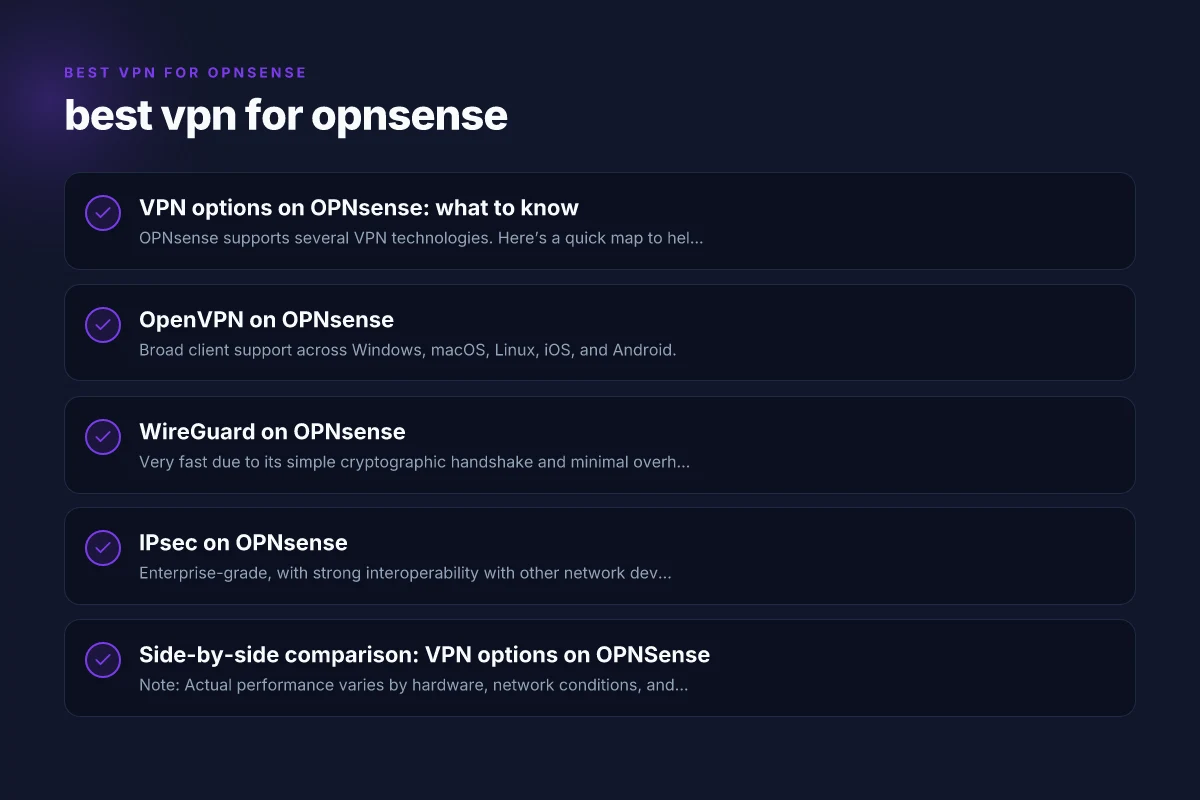
VPN options on OPNsense: what to know
OPNsense supports several VPN technologies. Here’s a quick map to help you decide where to start:
- OpenVPN: Mature, highly compatible, easy to deploy for remote access and site-to-site connections. Strong support across platforms, lots of tutorials.
- WireGuard: Modern, fast, lean, and simple configuration. Great for performance and mobile devices, but management of IPs and external authentication can be more manual in some setups.
- IPsec: Enterprise-grade, robust, good for site-to-site and remote access with strong cryptography. Can be more complex to configure but integrates well with other crypto systems.
Each VPN type has its own configuration steps in OPNsense. The right pick often comes down to client needs, network topology, and how you value simplicity vs. control.
OpenVPN on OPNsense
Why choose OpenVPN
- Broad client support across Windows, macOS, Linux, iOS, and Android.
- Strong proven security with AES-256 and TLS authentication.
- Mature ecosystem with many examples and guides.
How it typically works
- Server modes: Remote access (SSL/TLS with user auth) or site-to-site.
- Client configuration files or certificates are used to connect clients.
- TLS auth and certificate-based authentication add security layers.
Pros and cons
- Pros: Compatibility, detailed control over certificates, well-documented.
- Cons: Slightly heavier handshake, more CPU overhead on large user bases, more files to manage (certs, keys).
Quick setup tips
- Use TLS authentication (tls-auth or tls-crypt equivalents) for extra security.
- Prefer TLS with client certificate authentication for stronger identity binding.
- Keep OpenVPN in its latest stable branch for security patches.
Feature matrix for OpenVPN, WireGuard, and IPsec on OPNSense
| Feature | OpenVPN | WireGuard | IPsec | Notes |
|---|---|---|---|---|
| Native in OPNSense | yes | yes | yes | Built-in options |
| Client platforms supported | broad | Linux/Windows/macOS/iOS/Android | broad | Cross-platform |
| NAT traversal support | yes | yes | yes | VPN passthrough |
| Mobile client support | yes | yes | yes | Good for remote workers |
| Certificate management | heavy (CA, certs) | lightweight (keys) | heavy (certs/PSK) | Impacts admin work |
| Preferred for site-to-site | no | no | yes | IPsec excels at sites |
Compiled November 2026; check the provider's site for current details.
WireGuard on OPNsense
Why choose WireGuard
- Very fast due to its simple cryptographic handshake and minimal overhead.
- Easy to audit and configure once you understand the interfaces.
- Great mobile experience with stable, quick reconnects.
How it typically works
- Peer-based or interface-based setup. Typically uses a single public/private key pair per peer.
- Routes are defined for desired traffic, and allowed IPs control what is tunneled.
- Often paired with a public key distribution method or a small management helper.
Pros and cons
- Pros: Speed, small code base, simple configuration in many cases.
- Cons: IP addressing and external auth can be trickier in some OPNsense setups. Some enterprise features may be less mature than OpenVPN/IPsec.
Quick setup tips
- Plan your allowed IPs (remote networks) carefully to avoid routing surprises.
- Consider pairing WireGuard with a centralized key management approach if you have many clients.
- Check the latest OPNsense WireGuard plugin status and documentation for integration specifics.
IPsec on OPNsense
Why choose IPsec
- Enterprise-grade, with strong interoperability with other network devices and firewalls.
- Solid for site-to-site VPNs and remote access in corporate environments.
- Mature tooling for complex networks, including dead-peer detection and DPD.
How it typically works
- Phase 1/Phase 2 negotiations (IKEv1 or IKEv2) with strong crypto suites.
- Use of pre-shared keys or certificates for authentication.
- Can be more verbose to configure but offers robust, scalable options for larger deployments.
Pros and cons
- Pros: Strong security, good for inter-network connections, broad device support.
- Cons: More complex setup, longer onboarding for admins unfamiliar with IPsec intricacies.
Side-by-side comparison: VPN options on OPNSense
| VPN type | Typical use cases | Client support | Performance | Complexity | Best for |
|---|---|---|---|---|---|
| OpenVPN | Remote access, site-to-site | Very broad | Moderate to good | Moderate | Mixed-device environments; strong compatibility needs |
| WireGuard | Remote access, fast sites | Very good | High | Low to moderate | Lightweight, high-performance needs, modern networks |
| IPsec | Site-to-site, enterprise remote access | Broad | Good | High | Corporate or multi-vendor environments needing deep interoperability |
Note: Actual performance varies by hardware, network conditions, and configuration. Always test in your environment. Best VPN for Linux mint
How to decide for your environment
- Small home or lab: WireGuard is often the easiest to deploy and delivers excellent performance with straightforward client setup.
- Mixed devices or legacy clients: OpenVPN’s broad client support can reduce compatibility headaches.
- Corporate or complex networks: IPsec can offer robust, scalable solutions and strong interoperability with other devices.
Consider these questions:
- How many remote clients will connect, and what devices do they use?
- Do you need rapid rekeying and minimal CPU overhead on the firewall?
- Is site-to-site a primary need, or is remote access the focus?
- Do you require certification-based authentication, or is pre-shared key acceptable?
Quick decision matrix for common environments
| Scenario | Recommended VPN | Rationale | Pitfalls to watch | Typical config notes |
|---|---|---|---|---|
| Small home lab | WireGuard | simple, fast | compatibility with legacy peers | Use simple peer config |
| Mixed OS users | OpenVPN | broad client support | setup complexity | Use easy-rsa, certs |
| Enterprise with existing PKI | IPsec | strong site-to-site, robust | heavier setup | Use IKEv2, cert-based auth |
Compiled November 2026; check the provider's site for current details.
Security considerations and best practices
- Always keep VPN components updated. Security patches for OpenVPN, WireGuard, and IPsec matter.
- Use strong authentication. For OpenVPN, TLS with proper certificate management. For WireGuard, robust key management. For IPsec, certificates or strong pre-shared keys with secure IKE policies.
- Implement access controls. Use firewall rules to limit what VPN clients can reach, and deploy split tunneling cautiously.
- Monitor and log VPN activity. Regularly review connection attempts and anomalies, and maintain a plan for revocation if devices are lost or compromised.
- Consider multi-factor authentication where supported, especially for OpenVPN remote access and enterprise deployments.
Practical guide: quick-start path for common scenarios
- Scenario A: You want a fast, modern remote access for a few devices
- Start with WireGuard. Install the WireGuard plugin on OPNsense, configure a few peers, and define AllowedIPs for the routes you want tunneled. Create a client config file to distribute to users.
- Test on your devices (laptop, phone) and adjust routing as needed.
- Scenario B: You need broad compatibility and established tooling
- Start with OpenVPN. Set up a server with TLS auth, generate certificates, and provision client configurations. Use a mix of TLS and certificate authentication for stronger security.
- Roll out to Windows, macOS, Linux, iOS, and Android clients, validating each platform’s behavior.
- Scenario C: Enterprise-grade site-to-site with multiple branches
- Use IPsec for robust site-to-site VPNs. Define IKE policies, use certificates, and establish tunnels with strong crypto suites. Ensure proper routing and firewall rules on both ends.
Final recommendation
For many OPNsense deployments, a pragmatic approach is to start with WireGuard for remote access where speed and simplicity are priorities, and add OpenVPN as a fallback for devices or environments where broad client support is essential. If you operate a corporate network with multiple sites or need deep interoperability with other networks and devices, IPsec remains a strong, time-tested choice.
If you’re unsure, a phased plan often works best: Which NordVPN subscription plan is right for you
- Implement WireGuard for day-to-day remote access and quick wins.
- Maintain an OpenVPN option for clients that don’t support WireGuard or require legacy compatibility.
- Preserve IPsec for site-to-site connections or advanced enterprise scenarios.
Testing in your specific network is crucial. Hardware capability, client mix, and routing rules all influence the real-world performance and reliability of any VPN setup on OPNsense.
If you’d like, I can tailor a step-by-step, device-specific setup guide for WireGuard, OpenVPN, or IPsec based on your exact hardware model, OPNsense version, and your client devices.
| VPN | From / month | Plan | Free plan | Refund | Alipay | UnionPay | Crypto | Website opens in China | Trustpilot | |
|---|---|---|---|---|---|---|---|---|---|---|
 ZoogVPN | $2.49/mo | 27 months: $59.99 | Yes | 7 days | ✓ | ✓ | ✓ | ✓ | ✓ Yes (2.5 s) | 4.2/5 (195 reviews) |
 NordVPN | $3.49/mo | 27 months: $94.23 | No | 30 days | ? | ✗ | ✓ | ✓ | ✗ Blocked | 4.2/5 (51,628 reviews) |
 ExpressVPN | $3.00/mo | 28 months: $84 | No | 30 days | ✗ | ✗ | ✓ | ✗ | ✗ Blocked | 4.4/5 (29,706 reviews) |
 Surfshark | See site | See site | No | 30 days | ✗ | ✗ | ✗ | ✓ | ✗ Blocked | 4.3/5 (31,823 reviews) |
 Proton VPN | $2.99/mo | 12 months: $35.88 | Yes | 30 days | ✗ | ✗ | ✗ | ✓ | ✓ Yes (2.5 s) | 2.1/5 (1,040 reviews) |
 Astrill VPN | $12.50/mo | 24 months: $300 | No | See site | ✗ | ✗ | ✗ | ✓ | ✗ Blocked | 1.3/5 (110 reviews) |
 Private Internet Access | $2.03/mo | 40 months: $81.2 | No | 30 days | ✗ | ✗ | ✗ | ✗ | ✗ Blocked | 4.2/5 (11,033 reviews) |
 CyberGhost | $2.19/mo | 28 months: $61.32 | No | 45 days | ✗ | ✗ | ✗ | ✓ | ✗ Blocked | 4.0/5 (24,178 reviews) |
 PureVPN | $1.69/mo | 60 months: $101.55 | No | 31 days | ? | ✗ | ✗ | ✓ | ✓ Yes (2.6 s) | 4.4/5 (17,994 reviews) |
 AdGuard VPN | $2.99/mo | 24 months: $71.76 | Yes | 30 days | ✓ | ✗ | ✓ | ✓ | Official site blocked; our special link opens (2.3 s) | 4.3/5 (290 reviews) |
 Mullvad | $5.61/mo | €5/mo | No | 14 days | ✗ | ✗ | ✗ | ✓ | ✗ Blocked | 3.2/5 (192 reviews) |
 Windscribe | $5.75/mo | 12 months: $69 | Yes | See site | ✗ | ✗ | ✗ | ✓ | ✗ Blocked | 4.7/5 (13,355 reviews) |
 StrongVPN | See site | See site | No | 30 days | ✓ | ✗ | ✗ | ✗ | ✗ Blocked | 4.4/5 (2,695 reviews) |
 LightXtreme 闪连 | $7.08/mo | 12 months: $84.99 | Yes | 30 days | ✓ | ✓ | ✓ | ✓ | ✓ Yes (2.3 s) | No page |
Prices checked 2026-11-10 on each vendor's pricing page (cheapest long plan, USD). Check the vendor's checkout for the final price.
Payment methods checked 2026-11-10 on each vendor's payment pages: all 14 take cards and PayPal; ✗ = not listed, ? = the vendor's own pages disagree.
China access: whether the official website opens from mainland China networks (tests the website only, not the VPN connection). Last checked 2026-11-11 04:07 Beijing time.
Trustpilot score and review count checked 2026-11-10.